Coin Community Family of Web Sites Join Thousands of Coin, Bullion, & Money Collectors
300,000 items to help build your collection! Vancouvers #1 Coin and Paper Money Dealer Royal Canadian Mint products, Canadian, Polish, American, and world coins and banknotes. Specializing in Modern Numismatics Royal Estate Auctions - $1 Coin AuctionsCoin, Banknote and Medal Collectors's Online Mall Join Thousands of Coin, Bullion, & Money Collectors


Username:
Password:
Save Password
Forgot your Password?


This page may contain links that result in small commissions to keep this free site up and running.

Welcome Guest! Registering and/or logging in will remove the anchor (bottom) ads. It's Free!

Ended 2009 D And 2010 P Jefferson Nickel Contest

To participate in the forum you must log in or register.
Author Previous TopicReplies: 55 / Views: 3,715Next Topic
Page: of 4
Pillar of the Community
arthrene's Avatar
United States
1713 Posts
 Posted 07/09/2010  5:16 pm  Show Profile   Bookmark this reply Add arthrene to your friends list Get a Link to this Reply
Morgan dollars VAM - I just learned this recently so I thought I'd share it (as I understand it).

Coins are minted by using dies. Each each die is slightly different (due to die wear, maintenance and striking differences).

The term VAM is an acronym for "Van Allen - Mallis." Van Allen and Mallis are men who researched and identified the differences in the dies used to mint Morgan and Peace silver dollars.

The VAM system works to archive all known die varieties according to date and mintmarks.
Valued Member
AndrewC's Avatar
United States
335 Posts
 Posted 07/09/2010  5:38 pm  Show Profile   Bookmark this reply Add AndrewC to your friends list Get a Link to this Reply
PORTRAITS ON CANADIAN COINS

Canada has been issuing its own coins since the middle of the 19th century, but it wasn't until 1990 that the portrait of the queen (or king, at times in the past) was made by a Canadian artist. Dora dePedery-Hunt made the portrait with the crown that was on their coins beginning in 1990; Susanna Blunt designed the one we see today, which was introduced in 2003. The portraits before that came from the British Royal Mint and were used in other countries as well. These last two portraits have only been used on Canadian coins.

Bedrock of the Community
United States
10284 Posts
 Posted 07/09/2010  7:07 pm  Show Profile   Bookmark this reply Add TNG to your friends list Get a Link to this Reply
Good stuff, hope everyone is enjoying the informative posts.

Winners so far
( I'll get your addresses via PM when the contest is over, please wait til then. )

1. mad258
2. COINAHOLIC
3. Scooby Due
4. SHAFTA9a
5. The_Duke
6. dustin43160
7. wolf-n-wa
8. AndrewC
9. arthrene
10.Moe145
11.Agosos (wrote to me for an OkeeDoke)
12.Adam_E
13.wheatguy
14.paul


There are ONLY 6 sets to go before this ends TONIGHT.
Edited by TNG
07/12/2010 9:06 pm
Pillar of the Community
Moe145's Avatar
United States
8904 Posts
 Posted 07/09/2010  7:14 pm  Show Profile   Bookmark this reply Add Moe145 to your friends list Get a Link to this Reply
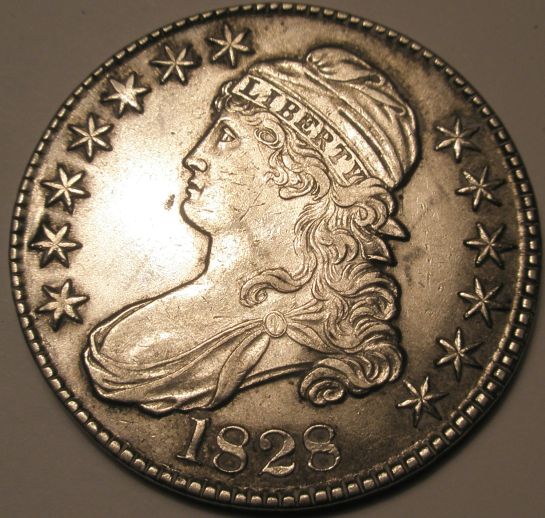
Capped Bust Half Dollar Lettered Edge (1807-1836)


Ended--2009-D-And-2010-P-Jefferson-Nickel-Contest


Description & History


Bust Half Dollar (Lettered Edge) (1807-1836)

Some coins are admired by collectors. Many are coveted. Only a precious few are truly beloved. Early United States coppers (large cents and Half Cents) fall into this special category, and so do Capped Bust/lettered edge half dollars or, as they're widely known with warm affection, "Bust halves."

Bust half dollars with lettered edges have undeniable charm, much like the copper coinage of early America. They were struck with screw presses, and each working die was prepared individually, the date, stars and lettering being punched in by hand. These elements resulted in a myriad of varieties. They've also enabled specialists to pinpoint just which die struck any given coin. And this marvelous diversity is the yeast that keeps interest rising in these coins.

The term "Bust halves" actually applies to both Capped Bust half dollars and the Draped Bust coins that preceded them. Draped Bust halves, in turn, come in two types: one with a small eagle on the reverse, the other with a larger, heraldic eagle. For a short time at the end of the Capped Bust coinage in the late 1830s, half dollars of that design were made with reeded edges, after the introduction of steam power at the U.S. Mint made that technology possible. The Bust halves most collectors view with the warmest affection, though, are the Capped Bust/lettered edge pieces issued by the Mint from 1807 to 1836. These are the real heart of this fondly remembered era in U.S. silver coinage.

Design changes occurred with great frequency during the early years of United States coinage, and often they were triggered by a change in leadership at the Mint. So it was that Robert Patterson's arrival as the Mint's fourth director in 1806 set the stage for a shake-up in designs across the board.

Patterson not only saw the need for new designs but also had a man in mind to create them. His handpicked choice was a talented, young, German-born engraver named John Reich. The mint director appealed for authorization to hire Reich as a staff engraver, maintaining that "the beauty of our coins would be greatly improved by his masterly hand." His argument carried the day and, in 1807, Reich was hired for the less-than-princely salary of $600 per year, not much more than common laborers made at that time. Then again, Reich had little leverage: he had come to the United States as an indentured servant in order to escape the Napoleonic Wars.

Reich's redesign was truly comprehensive, encompassing every coin from the Half Cent through the half eagle, the lowest and highest denominations then being produced. His basic obverse design was a left-facing portrait of Liberty with curly hair tucked into a mobcap, a bit of fashion featuring a high, puffy crown. As a consequence, this likeness is often referred to as the "Turban Head" portrait. Liberty wears a headband inscribed with her name, and she is surrounded by a circle of thirteen stars, with the date below. The reverse shows a naturalistic eagle with a shield superimposed upon its breast. The eagle clutches an olive branch, as well as a bundle of three arrows. Above the bird is a banner inscribed with the Latin motto E PLURIBUS UNUM. The legend UNITED STATES OF AMERICA appears in an arc around the periphery. On the Capped Bust/lettered edge half dollar, the edge bears the statement of value: FIFTY CENTS OR HALF A DOLLAR. For good measure, the inscription 50 C. also appears below the eagle.

Reich was widely accused of basing the buxom Liberty on his "fat mistress," though no confirmation of any specific model has ever been found. Whoever she may have been (if indeed there was such a model), the Capped Bust coinage was clearly an improvement over the Draped Bust style.

During the 30-year lifespan of the series, Capped Bust/ lettered edge halves were issued every year with the single exception of 1816, when a major fire destroyed the Mint's rolling mills and forced it to suspend all silver coinage. Mintages routinely exceeded one million pieces a year, reaching a peak of more than 6.5 million in 1836, the final year. The low point occurred in 1815, when just 47,150 examples were struck. Proofs of this type are known, but they are extremely rare.

For almost every date, though, the total mintage is broken down into multiple major varieties, and these are what give the series its rich flavor and broad appeal. Overdates, deviations in the size of numbers and letters, shifts in the style of numbers-these and other varieties have captivated and challenged collectors for generations.

The rarest of these varieties is the 1817-over-14. Only about a half dozen examples are known. Its rarity is underscored by the fact that the late Al C. Overton chose it as the cover coin for his popular book Early Half Dollar Die Varieties 1794-1836, which serves as the standard reference work on the series. Overton's book, which identifies and codifies the many die varieties, greatly spurred interest in Bust halves. Collectors have paid homage to the author, in turn, by using "Overton numbers" as shorthand for the coins.

In the first edition of his book, published in 1967, Overton put into words the affection he felt for his favorite coinage series. In the process, he summed up the reasons so many other hobbyists also find them so appealing: "The collection and study of our first series of United States half dollars ... has intrigued me almost since I began collecting in the late nineteen twenties. These early U.S. silver coins are not only beautiful and fascinating, but due to the large numbers made and minting methods of the earlier years, there exists a myriad of die varieties and sub varieties, that seem to be unequaled by any other U.S. series, not even the large cents. This offers an almost unlimited challenge to the collector who wishes to become a numismatic student of the early half dollars [and] at the same time, most are within reach of the average collector."

Capped Bust/lettered edge half dollars are plentiful in high circulated grades. They're also readily available in mint state grades up to MS-64. Above that level, however, their numbers drop sharply. The overwhelming majority saw use in daily commerce, though their high face value (nearly half a day's pay for many workers) limited that use drastically. Points to check for wear include the drapery at the front of the bust and the edges of the eagle's wings.

Specifications


Diameter: approximately 32.5 millimeters
Weight: 13.48 grams
Composition: .8924 silver, .1076 copper
Edge: Lettered
Net Weight: .38672 ounce pure silver
If you own one: Priceless

Valued Member
Agosos's Avatar
Australia
155 Posts
 Posted 07/10/2010  08:26 am  Show Profile   Bookmark this reply Add Agosos to your friends list Get a Link to this Reply
WHAT!!Aussies aren't good enuff?


Pillar of the Community
Adam_E's Avatar
United States
4846 Posts
 Posted 07/10/2010  09:31 am  Show Profile   Bookmark this reply Add Adam_E to your friends list Get a Link to this Reply
umm....how about NEVER CLEAN A COIN!

cleaning coins unprofessionally can create hairlines and other degrading marks that drastically change the value of the coin.

although you may take a coin to a professional coin cleaner, most people would not advise it.

that's all I got. sorry I'm really not good at writing passages.
Bedrock of the Community
United States
10284 Posts
 Posted 07/10/2010  11:13 am  Show Profile   Bookmark this reply Add TNG to your friends list Get a Link to this Reply
Aussies are great people, I got your PM and we did deal before. In my original post I wrote something about how I can't keep track of all the nice people who have sent me coins or who I did the same for. It is good for people outside the US to write me though. There are some places I have not traded with and won't due to miscommunication, postage, tariffs, paperwork, taxes, and customs etc.

THERE ARE 8 SETS LEFT!
Valued Member
Agosos's Avatar
Australia
155 Posts
 Posted 07/10/2010  12:09 pm  Show Profile   Bookmark this reply Add Agosos to your friends list Get a Link to this Reply
hehe in my excitement,I missed the bit about U.S residents etc,my bad!
Pillar of the Community
wheatguy's Avatar
United States
1534 Posts
 Posted 07/11/2010  12:02 am  Show Profile   Bookmark this reply Add wheatguy to your friends list Get a Link to this Reply
I think I'll give it a try- thanks for the informative contest!

The 1917 Standing Liberty quarter

Many members most likely know this information due to the recent influx of SLQ posts, but:

The Standing Liberty quarter (often abbreviated as the acronym SLQ) is a coin designed by Hermon Atkins MacNeil. It is considered by many to be the most beautiful design produced by the US Mint. There are many interesting individual issues, but to many, the 1917 Type 1 stands out. It is often a coin necessary for a type set or Dansco 7070, therefore it is popular amongst a wide variety of collectors, which include those who enjoy type sets and collectors that specialize only in SLQ's. This specific type is often very well struck, and it is more common to find a well struck 1917 than to find one that is weakly struck. The date is often very worn and many dateless coins are available, although there is basically no premium over melt. All in all, it is a great type coin that features one of the nicest designs produced by the United States Mint.

Thanks again for the contest!
Bedrock of the Community
United States
10284 Posts
 Posted 07/11/2010  12:46 am  Show Profile   Bookmark this reply Add TNG to your friends list Get a Link to this Reply
Gotcha wheatguy and funny thing, I have this 1917 SLQ keeps floating around in my brain lately.
Pillar of the Community
Scooby Due's Avatar
United States
4000 Posts
 Posted 07/11/2010  6:26 pm  Show Profile   Bookmark this reply Add Scooby Due to your friends list Get a Link to this Reply
I know I've already posted, but this is a great thread you started wheezy and I wanted to hopefully enlighten and educate a few more people. After all, we love hearing and reading about coins - no?

Ahem! (clearing throat)

Susan B. Anthony Dollars

I think the story of Susan Brownell Anthony (February 15, 1820 - March 13, 1906) is interesting, also.

She was born in West Grove, near Adams, Massachusetts. We all know her as an American civil rights leader who played a pivotal role in the 19th century women's rights movement.

But, did you know that she learned to read and write at age of three?

In 1826, when she was six years old, her family moved from Massachusetts to New York. Susan was sent to attend a local district school, where a teacher refused to teach her long division because of her gender.

In 1837, she was sent to Deborah Moulson's Female Seminary, a Quaker boarding school in Philadelphia, but was forced to end her formal studies because her family was financially ruined during the Panic of 1837. Their losses were so great that they attempted to sell everything in an auction, even their most personal belongings, which were saved at the last minute when Susan's uncle, Joshua Read, stepped up and bid for them in order to restore them to the family.

In 1839, she left home to teach and to help pay off her father's debts. She taught first at Eunice Kenyon's Friends' Seminary, and then at the Canajoharie Academy in 1846, when she was promoted to headmistress of the Female Department. Anthony's first occupation inspired her to fight for wages equivalent to those of male teachers, since men earned roughly four times more than women for the same duties.

On November 18, 1872, Anthony was arrested by a U.S. Deputy Marshal for voting illegally in the 1872 Presidential Election two weeks earlier!

Anthony neither married nor had children, but had seen some success in fighting for the right of a widowed mother to keep any child she birthed after the death of her husband. Previously, the child was considered part of the dead father's estate, and could be taken away from the mother if so stated in his will!

Susan B. Anthony died 14 years before passage of the 19th Amendment giving women the right to vote and never seen her dream come to fruition.

She was honored as the first real (non-allegorical) American woman on circulating U.S. coinage with her appearance on the Susan B. Anthony dollar. It is the shortest dollar series since 1795, being struck from 1979-1981, and then again briefly in 1999, the longest lapse in minting for any U.S. coinage.

To Susan B. Anthony -

Bedrock of the Community
United States
10284 Posts
 Posted 07/12/2010  12:31 pm  Show Profile   Bookmark this reply Add TNG to your friends list Get a Link to this Reply
I'm giving this a shameless bump. Soon I will have to close the contest even if they are not all taken.
Looks like I am going to be giving some more away at the local coin club meeting than I thought?
I would have rather seen more go this route. There are 7 sets left.
I am ending this tonight so I can start getting email with addresses to mail them off.
I'll let you guys know when I want that after this ends.
Bedrock of the Community
SHAFTA9a's Avatar
Canada
10743 Posts
 Posted 07/12/2010  6:33 pm  Show Profile   Bookmark this reply Add SHAFTA9a to your friends list Get a Link to this Reply
Gee... I would have thought that a lot more members would have participated in this.
Valued Member
paul's Avatar
United States
213 Posts
 Posted 07/12/2010  8:03 pm  Show Profile   Bookmark this reply Add paul to your friends list Get a Link to this Reply
The Shield nickel

-It is not spelled "Sheild" nor "nickle"
-Not "Teh" for that matter, either.

Anyway, The Shield nickel was introduced in 1866. The reason that Nickel was chosen as the metal for this coin was purely political. The Nickel miners wanted a larger and government backed market for nickel. The easiest way to do this was to have a coin produced that was made of nickel. The final composition was 75% copper and 25% nickel, due to the extreme hardness of nickel.

Nickel was so hard, in fact, that the mint had trouble minting coins of this metal. Dies would break after around 10,000 coins. The mint was used to minting silver. Since silver is softer, the mint could produced hundreds of thousands of silver coins before dies broke. To make the dies last longer, the mint increased striking pressure of the dies as the dies aged. This had created some interesting varieties, but that is a different story.

Now factoids-
-The composition of the nickel has never changed.

-Before the nickel, the US had a " Half Dime" and "5 C.", made of silver. (and 1/2 the size of the dime) Which is why the nickel is larger than a dime.

-The Shield nickel was considered horribly ugly when it was introduced.

-The guy that designed the Shield nickel looked quite strange.
Bedrock of the Community
United States
10284 Posts
 Posted 07/12/2010  9:04 pm  Show Profile   Bookmark this reply Add TNG to your friends list Get a Link to this Reply
I like that humor Paul and that is an interesting factoid post.
I misspell anything with I and e together. I wish to add something to your sentence ... but won't.
The composition of the nickel has never changed.
I will leave you think about that.

Here's one of those spelling rules I memorized in grade school by writing 100 times as an extra assignment...
i before e except after c
There are exceptions.
Edited by TNG
07/12/2010 9:20 pm
  Previous TopicReplies: 55 / Views: 3,715Next Topic
Page: of 4

To participate in the forum you must log in or register.


Disclaimer: While a tremendous amount of effort goes into ensuring the accuracy of the information contained in this site, Coin Community assumes no liability for errors. Copyright 2005 - 2026 Coin Community Family- all rights reserved worldwide. Use of any images or content on this website without prior written permission of Coin Community or the original lender is strictly prohibited.
Contact Us  |  Advertise Here  |  Privacy Policy / Terms of Use

Coin Community Forum © 2005 - 2026 Coin Community Forums
It took 0.49 seconds to rattle this change. Forums


