| Author |
 Replies: 76 / Views: 11,993 Replies: 76 / Views: 11,993 |
|
|
|
Valued Member
Canada
200 Posts |
Before I asked for a close-up of the beads, I did look at the ebay item you posted. American coins are a complete unknown to me, but I've never seen a "indent by clad error" on a Canadian coin. No offense was intended by me (and I don't think anyone else) I'd love to see a better pic. |
|
Valued Member
United States
499 Posts |
Something that hasn't been taken into consideration is that not all washers are made of metal. It could be plastic, rubber, nylon, felt, etc. Any of which would allow the image to show through with the same effect.
Richard
|
|
Pillar of the Community
Canada
693 Posts |
|
|
Valued Member
United States
499 Posts |
The only way that an impression that big on the reverse would NOT leave a bulge on the obverse is if the coin was still in the die at the time of the making of the impression. This coin is genuine
Richard
|
|
Pillar of the Community
Canada
693 Posts |
There is a lot of nievity(sp?) when it comes to error fabrication. A member of this site has hit the nail on the head so to speak, then was challenged by another to do it and post pics of said. To the people who believe that a coin "strike can show thru" either a fibre washer, a copper washer, etc.....please look at a struck thru(grease) coin. Then look at a struck thru wire coin.....or any actual struck thru coin like a cap...........learn errors, then buy errors. I own a bunch.....and I like errors, I do not like home made errors, and I make them as educational tools. Have a nice day.
|
|
Bedrock of the Community
United States
10045 Posts |
coinsrfun, I'm honestly trying to figure out this process, and gave my best shot at what happened. In respect to the OP's coin, do you think it's possible to create that circular dimension with a vise, while not bending the coin, or affecting obverse detail or overall dimensions? If I learn something from this, then all the better.  |
|
Pillar of the Community
Canada
693 Posts |
There are numerous ways to apply something to one side while not affecting/effecting the other. A rigid resin mold (about 5 minutes work)......a piece of hardwood as in so called vice soft jaws etc. Please when looking at an error....remember that a strike thru error MUST affect/effect what ever should/must be below it..........generally that means distortion or lack of detail......IMO only and by the way....the theory of transfer image......is just that.....because a pressure applied works at all angles....and at right angles to them......hence..everywhere.......and the missing/weakly struck loon would be the last thing struck....but the fields would eat the pressure as applied...........the bird was there before the round thingy hit it.......IMO
|
|
Valued Member
 United States
462 Posts |
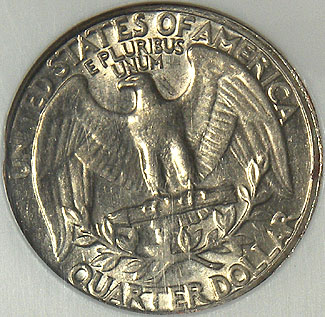
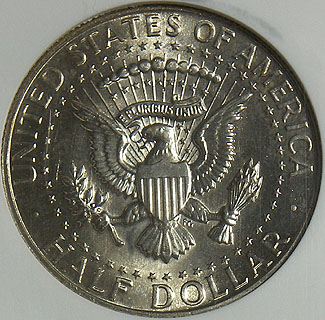
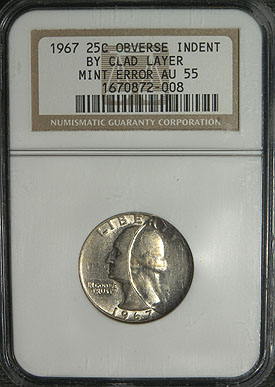
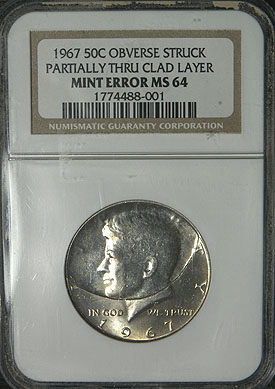
OK Here are examples of coins struck thru clad layers that have been certified by NGC and Anacs, respectively. Those that think the loon struck thru is manmade, explain why these coins are genuine mint erros, and the loon error is not.   |
|
Valued Member
United States
462 Posts |
|
|
Valued Member
Canada
250 Posts |
I don't know what a "clad" is. Is it anything like a metal washer?
$0.02 Worth
|
|
Valued Member
United States
462 Posts |
Many US coin planchets have clad layers on the obverse and reverse of a planchet that also contains a copper core...sort of like a sandwich. A clad layer can sometimes split away from the planchet and end up between a normal planchet and the die during the striking process. The clad layer is thin and made of metal. As you can see from the pictures, the die is able to strike through this clad layer that is resting on a normal planchet and still strike up the die's image underneath this metal layer. The reverse and diameter of the coin is normal. Based on this evidence, which is the closest example I can find of a metal object duplicating my washer strike, I am confident of my findings. Thanks,
|
|
Pillar of the Community
Canada
693 Posts |
Totally different scenario. Apples oranges....oh ya 'merican vs canuck as well. Use your wisdom of the striking process and explain how the design of the loon (the deepest part of the design)is there, but the circle is just that...still a circle....it would have to distort dramatically and it has NOT.....also note the scratches at 10 and 11 oclock on the rev stop at the edge of said circle...and are not evident inside the circle......and oh ya, 'merican grading companies certified a Canadian 1 cent error with 2 reverses. By Canadian minting procedures this MUST BE MADE INTENTIONALLY not an error, also the 1976 10 dollar silver with 4 other denominations struck onit....yup, they called it an error as well.....yup ...it ain,t either........please do not compare apples and oranges.
|
|
Pillar of the Community
United States
2752 Posts |
It's an authentic struck-through error. I would think a washer would be the most likely candidate for the foreign object. Authenticity is indicated by the ghost image of the reverse design in the floor of the depression and the lack of any damage to the obverse face.
Error coin writer and researcher.
|
|
Bedrock of the Community
United States
12437 Posts |
Post-mint, you cannot displace metal on one side of the coin without also displacing it on the other side. If someone created this error, the obverse would not be in perfect as-struck condition, there would be evidence of tampering. Quote:
explain how the design of the loon (the deepest part of the design)is there, but the circle is just that...still a circle A metal washer would more than likely be made of hardened steel which would be much harder than an annealed nickel bronze planchet. The planchet would fill the recesses of the die(including the uncovered loon head) via plastic expansion while the washer would not be able to properly fill the die, thus only allowing a very weak transfer of design. |
|
Pillar of the Community
United States
2600 Posts |
While in the AF, we did bore sighting on B-52s to align the radar with the bomb and nav computers. We mounted a devise to the aircraft that allowed us the align the true center line of the AC with that of the radars. We had very thin metal shims of varying thicknesses that allowed us to help zero the devise. If they use anything along those line in aligning the press and dies, one of these would have easily done what we see here. Thin enough to have image transfer.
Kurt, can you find a way to determine the thickness of the impression?
Ji,
|
| |
Replies: 76 / Views: 11,993 |








 First Page


 Posted 09/28/2010 06:27 am