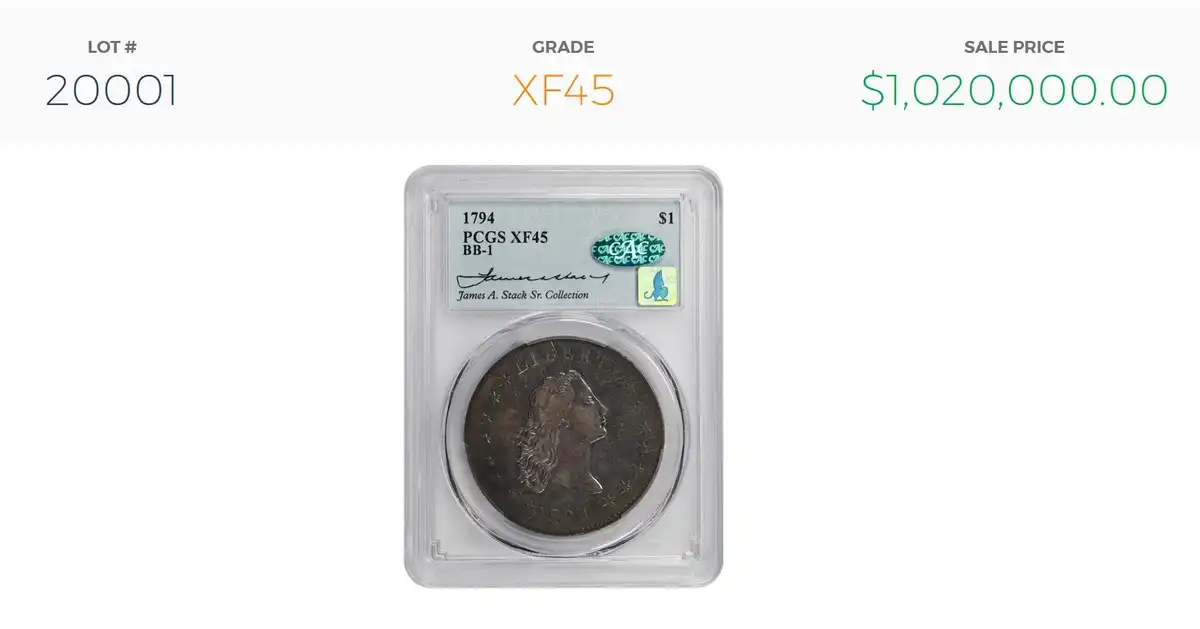
I wonder if the altered surfaces designation by PCGS was in regards to the adjustment marks or if they saw something else they didn't like? It would be nice if they gave a little more explanation as to their decisions, especially when it comes to a high value coins like this one. Regardless, still an amazing coin
This was the Heritage assessment of the coin when it was in the PCGS details holder. Not too bad I think.
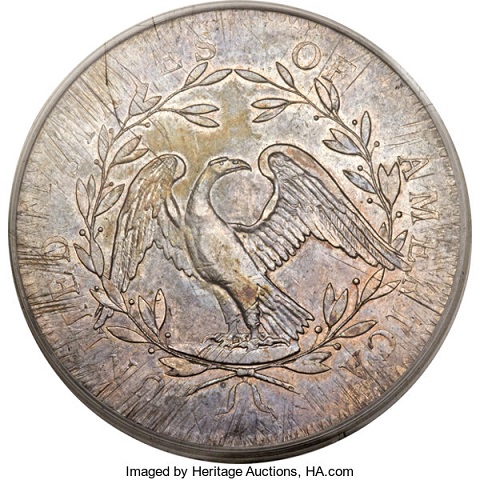
"The coin is currently encased in a PCGS Genuine holder with XF Details, with "Altered Surfaces" the reason (or one of the reasons) it did not receive a numeric grade. There are no overt signs of surface alteration other than a silver-gray patina that is perhaps overly light for a 1794 dollar. Some faint hairlines indicate an old cleaning, but they are barely visible on the coin. Several Mint-related adjustment marks appear at the obverse margins, with strike weakness along the left border and incompleteness at STATES on the reverse. A moderate rim bump at 4 o'clock on the reverse is noted, as are three linear planchet streaks in the right obverse field from star 12 to the neck. Two or three small planchet flaws exist, not unexpected for this early dollar.
The hair definition is strong and Liberty's cheek full and rounded. Likewise, the eagle's wing feathers and tailfeathers are individually sharp, and the eagle's head is well-formed. Now slate-gray in color with some deep-gray accents, the surfaces retain considerable appeal. The few collectors fortunate enough to seek a 1794 dollar will find this a suitable representative of the classic American issue, our nation's first silver dollar coinage."
The coin more than holds it's own in the NGC XF45 holder when compared to other examples at the same grade. From looking at the photos from the 80's it appears that the coin may have been conserved and PCGS did not like it, thus, the Heritage comments about the light patina.
Quote: It might be interesting to research the people who made the early adjustments.
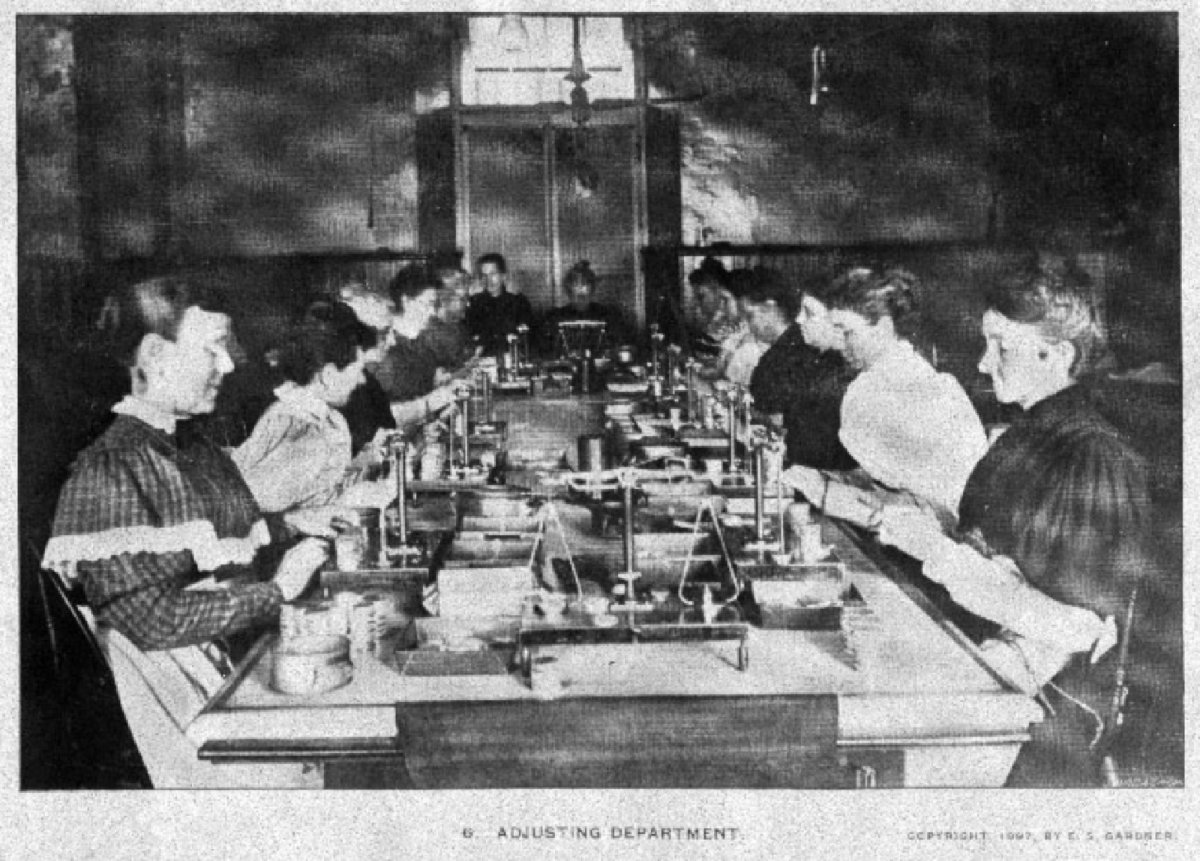
I don't know about that era but my impression from mint records in the late 1800s is that many (most?) adjusting room employees were women. In New Orleans in April 1900 they averaged 352 planchets per hour, each! https://archive.org/details/rg104en...109/mode/2up
The previous "details" grade seems pretty picky to me. I see the same "halo" below the chin and neck in the 1987 auction pic.
This is a picture of women working in the the weight adjustment department in the NOLA Mint. Women began working at Treasury in large numbers during the Civil War when all the men were away fighting the War. Happened again in WWI and WWII.
Another interesting fact was that in the early days, overweight planchets were filed to get then down to the correct weight, but underweight planchets, which were later just melted with the scrap, back in the 18th century, Mint workers would drill a hole in the center and place an overweight silver plug in order to increase the weight of the planchet. This would be more work than it was worth and when steam metal rollers were introduced, underweight planchets were thrown in the melt scrapheap. That's why early Mint plugged coins are rare and prized today.
Can you imagine working all day in a building without air conditioning in New Orleans dressed the way these women were? The room had to be closed and secure because the gold and silver shavings were so valuable. I bet there was zero air circulation in that room.
Quite the history behind this piece, a few adjustment marks just add to it, not being distracting on your example IMO. I 100% agree with Slider, it holds its own and then some in comparison.
Here is a $1 1794 reverse that PCGS graded XF40 in a OGH holder. The ladies were busy on this coin. There are so many adjustment marks that it almost looks like part of the design.
Just updating this thread to mark that a comp realized a sale above $1 million in December 2025 for posterity. Discussion of how this coin compares to the million $+ coin here: https://goccf.com/t/482894
IN NECESSARIIS UNITAS - IN DUBIIS LIBERTAS - IN OMNIBUS CARITAS THE MAN IN THE ARENA, Theodore Roosevelt at the Sorbonne Paris on April 23, 1910: "It is not the critic who counts; not the man who points out how the strong man stumbles or where the doer of deeds could have done better. The credit belongs to the man who is actually in the arena, whose face is marred by dust and sweat and blood, who strives valiantly, who errs and comes up short again and again, because there is no effort without error or shortcoming, but who knows the great enthusiasms, the great devotions, who spends himself in a worthy cause; who, at the best, knows, in the end, the triumph of high achievement, and who, at the worst, if he fails, at least he fails while daring greatly, so that his place shall never be with those cold and timid souls who knew neither victory nor defeat." My coin website:https://fairfaxcoins.com
Disclaimer: While a tremendous amount of effort goes into ensuring the accuracy of the information contained in this site, Coin Community assumes no liability for errors. Copyright 2005 - 2026 Coin Community Family- all rights reserved worldwide. Use of any images or content on this website without prior written permission of Coin Community or the original lender is strictly prohibited. Contact Us | Advertise Here | Privacy Policy / Terms of Use




 First Page
 Previous Page


 Posted 10/09/2021 1:58 pm