@MontanaCMR
I'll reply to each of your questions by the points you listed out.
1- I couldnt dig any easy to find charts to explain this (and I am kind of vacation period here, laying off charts for the summer) but let me explain this a bit better. The only purpose in suggesting to wait for the second 52 high b/o was because sometimes, a stock or say currency, really any asset for that matter, has been already been bid up repeatedly as it gets into the 52 highs.
So lets talk about asset X. The first brand new 52 high is 1,000. However, its been bought up 7 days in a row, by say, 100 points. Thats a LOT of buying into the 52 high of 1,000. You technically would still be OK and correct to buy it after being up so many days, but be prepared that it dips on you as it makes that first 52 high. For that reason, if you would rather see an immediate profit, waiting for the second 52 high would help your mind (as in for some individuals, it would be easier to handle seeing profits from a break out rather than experiencing a pull back), as now a pull back happens and now it hits the second 52 high fresh.
Keep in mind tho, some assets hit that 52 high after being bought up repeatedly and continue to race higher. Some assets hit a 52 high and then roll over. Some assets hit a 52 high after repeated buying and slightly pause and run up and some hit the first 52 high run up and dont give a darn.
There is no way to really know what the reaction is as the 52 high is hit. It comes down to many factors such as how strong are the buyers, the personality or character of the asset you buy, some assets, have unique personalities, then you have market conditions. If you try and buy 52 highs in a market that is putrid, range bound and isn't healthy, you will find the 52 high break outs wont work and becomes very frustrating.
So you must beware of these things when you buy a 52 high. Buying the 52 highs is a great spot to start buying BUT remember market conditions also dictate how well that 52 high break out works.
2- Yes, risk increases when you blindly buy 52 highs. You must know when it started and then you must know where it stands in that uptrend. You can buy 52 highs in the uptrend BUT you want to see periods of time where it rests, we call that basing, usually weeks, months. Some assets hit a 52 high, pull back for a few weeks then hit a 52 highs and follow that same pattern. Others are more erratic. However, the general rule is, the longer the base and time between 52 highs, the BETTER. IF you buy a 52 high after its been running for weeks, hitting continued 52 highs, count on it pulling back on you.
You never move money out of a 52 high stock until the stocks STOPS making the 52 highs AND starts showing signs of weakness. Usually the first opening signs of weakness are break of trend lines that happen way BEFORE the 52 lows and a change in over all price action... a stock on the way up continues to make higher highs and higher lows, a stock breaking down starts making lower highs and lower lows and yes, you can notice them IF you become a student of price action.
Here is a chart of how you can properly buy/trade around a stock in an uptrend as it makes 52 highs. this is a common pattern.
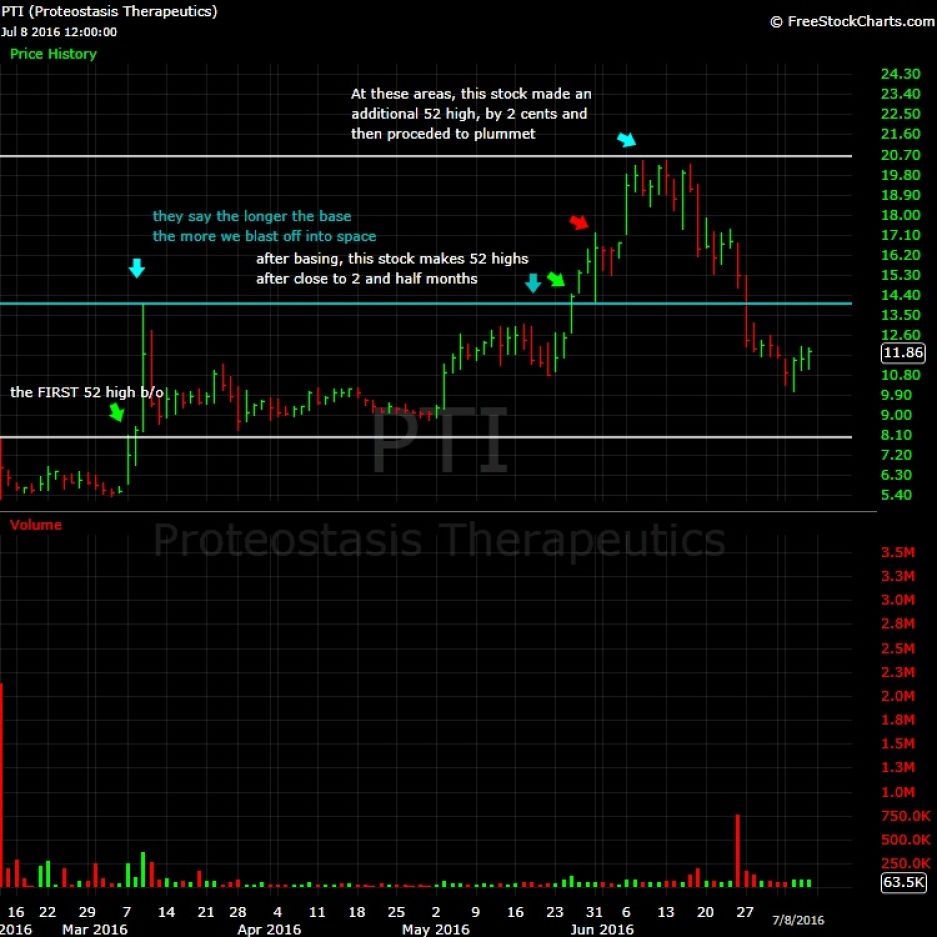
a- the stock IPOs. it makes a yearly high of 8 dollars. You can see it dances around doing pretty much nothing for about 2 weeks plus.
b- the FIRST 52 high to buy is at the first green arrow you see, at 8.01. Notice how the stock runs for several days.
c- the stock last made its 52 high of 13.99 on 3/9, the first aqua blue arrow and did NOTHING at all until 5/25. Notice how months passed before another 52 high was made and when it did happen, it was a powerful move up. That was a 52 high you could buy properly in the uptrend because the the huge BASE you see. The longer time goes between 52 high b/o's the better in this case. YES, we have moved farther from the FIRST 52 high back in 2/11 but we can see a lot of time has passed, allowing for healthy growth of the uptrend.
c- notice the red arrow. That was a 52 high made in the initial 52 high b/o 5/25. notice how it proceeded to run higher from there but the break out was much shorter.
d- Take a look at the aqua arrow at the white line. A few 52 highs were made by
Two Cents and then the stock broke down. That would not be a proper area to buy the 52 highs as the move had already started weeks ago and we were seeing the buyers being exhausted. That is why I say you cannot buy every 52 high and expect it to run higher. You must KNOW where you stand in the uptrend.
e- NOTICE- Despite the pull back in this stock, IF you bought just the first TWO initial 52 highs. you might have a slight profit (depending on your sizing... REMEMBER how I said when I buy I, I dont buy all at once, I put in LESS money as I ladder up) and even if you sized up slightly on your second buy, you might be a tad underwater but NOT deep in the red, especially if you were running a percentage stop. THIS is why its important to buy properly in the uptrend.
3- What you describe is swing trading. Some traders find what range an asset is in while it consolidates and buy the low end of the range and sell the high end of the range. Eventually this stops working because in an uptrend, the stock generally continues to march higher, out of that range and a new range in time develops. Fibs, bands, no sort of technical analysis is a silver bullet to determine these ranges and when it will break the range, up or down. What a swing trader does is employ a stop in case this same pattern stops working and he also monitors constantly overall market conditions that might give clues as to if the range will change or if he/she should continue trading this range.
4- It depends. Some investors, have been holding for for say, 5 years in an uptrend. they are sitting on huge profits. They might take their time in selling, waiting until the lows. However, again, there will be signs, weakness in price action, where the stock or any asset for that matter, have been exhibiting patterns consistent with a downtrend. I believe I mentioned earlier but I will say it again. There will be points, in price, in any asset, where important trend lines get broken, expressed in price, WAY BEFORE the 52 lows that tell you to get out. Furthermore, you will notice a change in behavior, you will notice more weakness, and if you have sharpned your observation skills of price, you will notice an asset breaking down exhibts the same pattern of lower highs and lower lows, versus higher highs and highers lows, which you see in an uptrend. The 52 lows are your official, without a DOUBT, confirmation that the trend has changed and you can leave without any doubt in your mind that the asset is done going up for the time being, JUST AS 52 highs are official, without any DOUBT that the up trend has started.
The final point is this- WHAT IS YOUR TIME FRAME? Some intra-day traders (the term day traders is outdated and incorrect so get with the times) Some traders will try and play a 52 high break out that happens every time. In this scenario, they are only looking to scalp some dimes, 50 cents, etc depending on what they can squeeze out. Keep in mind they might be holding for an hour, a few minutes etc and then are gone. Again, everyone has different time frames.
Other traders, I am one of those, will play every single 52 high break out PROVIDED it has shown some sort of basing. Generally speaking the longer the base, the more capital I will put to work. Other traders bought the first 2 52 high break outs and are just sitting and watching.
Keep in mind in all the above scenarios, a great trader is always working with a stop in place, an exit point. Every time I take a trade, I have a stop in place. IF the break out doesn't pan out as I planned, for whatever reason, I am OUT with no questions or doubts in my mind. Stops are what helps you manage risk and you CANNOT ESCAPE losses from stops in trading. Stops PROTECT you and are necessary to stay in the game.
So buying 52 highs is still the way to go. However, you must be cognizant of when the trend started, map out and keep track of how far each 52 high goes and look for bases in between to make your purchases. Its not that easy as just simply buying every single 52 high and waiting to be rich.
One MUST become a student of price action and when it is your money in the market, you must learn what personality matches the asset you have money in, how does it act and learn to watch for changes in the price action.







 First Page
 Previous Page


 Posted 07/08/2016 7:02 pm





