| Author |
 Replies: 3,989 / Views: 393,386 Replies: 3,989 / Views: 393,386 |
|
|
|
Bedrock of the Community
United States
11951 Posts |
Very nice looking coin Muddler  Nothing wrong with a nice Ben Franklin Is that a type one .... or two? |
|
Pillar of the Community
United States
7330 Posts |
I'm pretty sure it's a type two. Also really like your 57 half the reverse design is awesome.
|
|
Pillar of the Community
Canada
2805 Posts |
 German Democratic Republic, 1 mark, 1956 The first of the DDR 1-mark coins. East Germany often made some perplexing choices on their coins. For instance, while this coin has a nice edge patterned with stars, the more valuable 2-mark coin has a boring reeded edge! In West Germany, the 1-mark coin had a similar wordless pattern, while the 2-mark coin had the motto of West Germany around the edge, which makes a bit more sense. The first 5-mark coin, being more valuable than the aluminum 2-mark coin, was made of more expensive brass (and later became copper-nickel). The 20-pfennig coin was also made of brass, despite being worth less than the aluminum 50pf, 1 mark, and 2 mark coins! This may be because the 20pf coin had no direct analogue in the West German system (where it went straight from 10pf to 50pf). Maybe this is why communism failed... they couldn't get their act together on their coins! |
|
Pillar of the Community
Belgium
506 Posts |
Quote:
The first 5-mark coin, being more valuable than the aluminum 2-mark coin, was made of more expensive brass (and later became copper-nickel). The 20-pfennig coin was also made of brass, despite being worth less than the aluminum 50pf, 1 mark, and 2 mark coins! This may be because the 20pf coin had no direct analogue in the West German system (where it went straight from 10pf to 50pf). Maybe this is why communism failed... they couldn't get their act together on their coins! During decades, 20 pf used to be the fare for public transport in cities in the GDR: both trams and buses and the East-Berlin subway and city rail (U-Bahn, S-Bahn). The slot machines often blocked, whenever only slightly bent or damaged light weight aluminum coins were thrown in. I 've yet to learn whether the 20 pf was coined in brass on demand of the public transport authorities or if the easily flowing brass coin only was the reason never to raise the fare. Edited by Gwyde
12/23/2013 3:10 pm
|
|
Pillar of the Community
 United States
1910 Posts |
ITALY 1956 100 lire; stainless steel; ~28mm; mintage = 99.8 mil. : 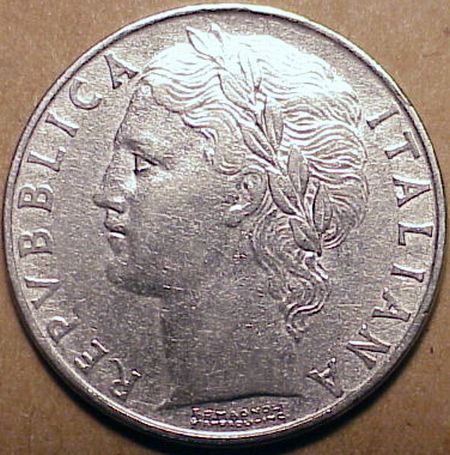 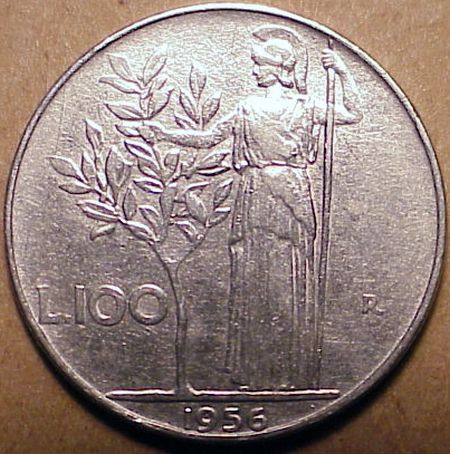 This lovely workhorse coin had a 34-year run. I don't have all the years yet, but I'm workin' on it. ;-) Wish I had a less circulated example of this year. In BU these highly polished coins look like they are made of liquid mercury in solid form. The Italians treat coins as miniature art canvases... which is the way it should be. It's a fun country to collect. Tremendous variety and affordability.
Edited by mysilveryears
12/23/2013 10:54 pm
|
|
Bedrock of the Community
United States
11951 Posts |
|
|
Pillar of the Community
Canada
2805 Posts |
Merry Christmas (Eve)! This is one of my favourite melt purchases. A coin store had a big, big box of KGVI and QEII halves at $7 each, and I went through it looking for the nicest "old-style" half.  The Canadian grading guys put it at MS-62, which might make it a $20 coin - so I am happy to have purchased it at silver value! So, here's the Canadian half story: Before Canadian Confederation, when we were a bunch of bickering colonies instead of a bunch of bickering provinces, we got to use a mish-mash of (technically illegal) copper tokens, foreign currency, and pound sterling tokens. In 1858, we got real coins, and in 1867, the Province of Canada, Nova Scotia and New Brunswick became the Dominion of Canada (although the coins made after that with Victoria on them look the exact same). The 50-cent coin (which was never denominated as a "half dollar") was the largest silver coin at the time, and all Canadian coins looked pretty much the same - a wreath of some sort of leaves, with a little crown on the silver denominations. This changed in 1937, when the accession of George VI was considered a good time to just toss everything out and make some nice, non-generic, uniquely Canadian designs, so they called up everyone's favourite engraver George Kruger-Gray. This is how we got the basic coin designs that are still used today (except the dollar)! The 50-cent coin was originally designed with a very big coat of arms, taking up most of the coin (as you can see above). However, the laureate portrait of Queen Elizabeth II is pretty high-relief... so weak strikes became a problem. Since the 50-cent coin was the only Canadian coin with this problem, something had to be done! So the coat of arms was shrunken significantly in 1959, and the design was changed once more to update the arms in 1999, and that's how we got the half dollar we see today  |
|
Bedrock of the Community
United Kingdom
18926 Posts |
Nice coins everyone! Here's my contribution - a 1955 50-cent coin from the British Caribbean Territories:  The first British Caribbean Territories coins were issued in 1955 to replace British sterling coins then circulating in these colonies. The new currency unit was a dollar, equivalent to four shillings - so the 25- and 50-cent coins were the size of the British shilling and florin. There was also a dime-sized 10c, a nickel-brass 5c, and bronze 2, 1 and half-cent coins similar to the British penny, halfpenny and farthing. The half-cent coin was discontinued in 1958, and the 50c coin seems to have been unpopular - it was only struck in 1955 and 1965. When the islands' currency was updated in 1981, the 1, 2 and 5 cent coins were changed to aluminium and a dollar coin was introduced, but no 50c coin was issued. |
|
Pillar of the Community
United States
7330 Posts |
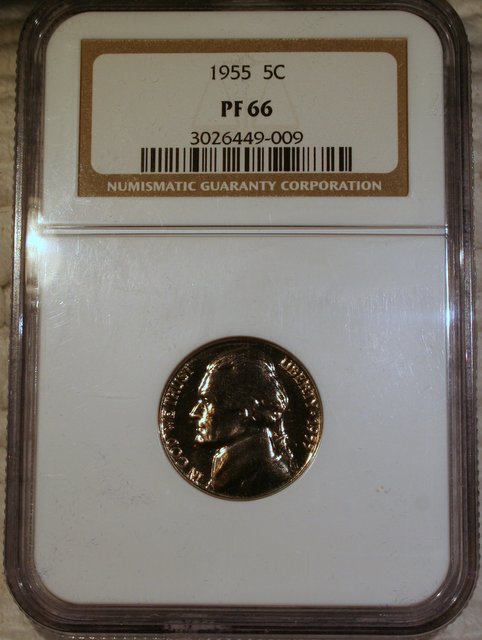
My most recent addition to my Cameo proof Franklin set.   |
|
Pillar of the Community
Australia
9841 Posts |
|
|
Bedrock of the Community
United States
11951 Posts |
Quote:
I'm pretty sure it's a type two. Also really like your 57 half the reverse design is awesome. After checking I agree your 1956 looks like a type II. I am glad I checked, I see I had mine labeled wrong. On the reverse, a type I will have four wingtips to the left of the perch. I also like the reverse of those Canadian half dollars, and will be posting a few more. I try to pick them up when I see them in the melt buckets. |
|
Pillar of the Community
Canada
2805 Posts |
Okay, I have already posted a silver coin, so here is a copper coin. My excuse: the 1955 50c coin was posted just before going to bed last night, so it feels like a bright new day to me.  These are nice even when circulated. This particular 20c coin is a rare variety (KM#439): the Mexican coinage coat of arms was changed early in 1955, so most 1955 coins have the new coat of arms; but this one does not. It's worth $7 in XF, compared to $1.75 for the other type |
|
Pillar of the Community
United Kingdom
2932 Posts |
Norway 1956 25 Ore 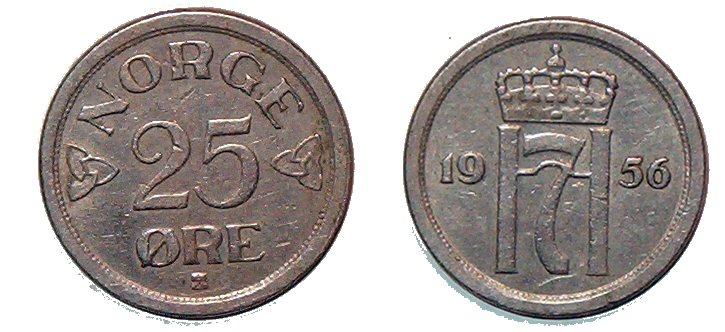 |
|
Pillar of the Community
United States
1910 Posts |
nalaberong, I like that 1955 Canada 50 cent'r you posted. And since I'm too lazy tonight to do a proper box search for something different, here's my heavily tarnished toned example, straight from the melt bucket in the heady days of the recent silver run-up: 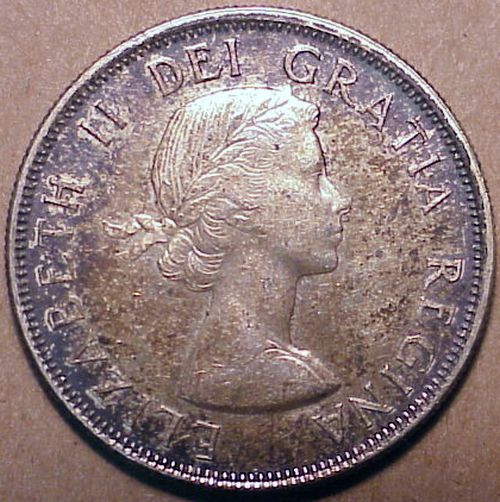 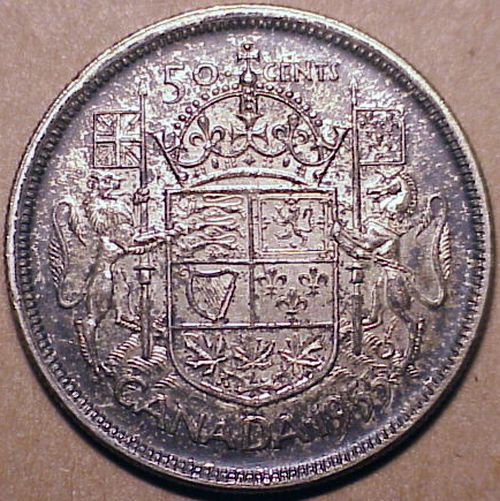 I have -most- of a date set of these from '37 up picked from scrap sources. Anything before that just never shows up with a readable date.
|
|
Pillar of the Community
United States
1393 Posts |
Here's my contribution. 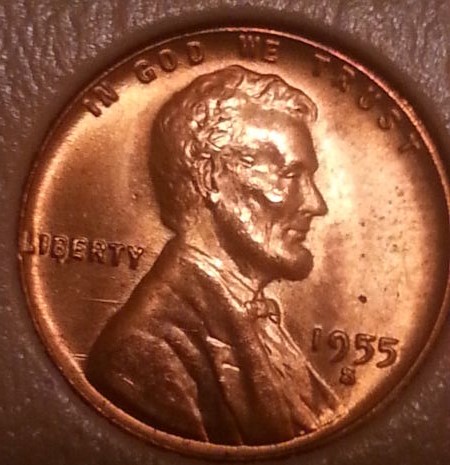 Dansco - fresh 1955 - S wheat. Happy Holidays! Edited by The Silver Searcher
12/24/2013 8:34 pm
|
| |
Replies: 3,989 / Views: 393,386 |







 First Page
 Previous Page


 Posted 12/23/2013 11:33 am