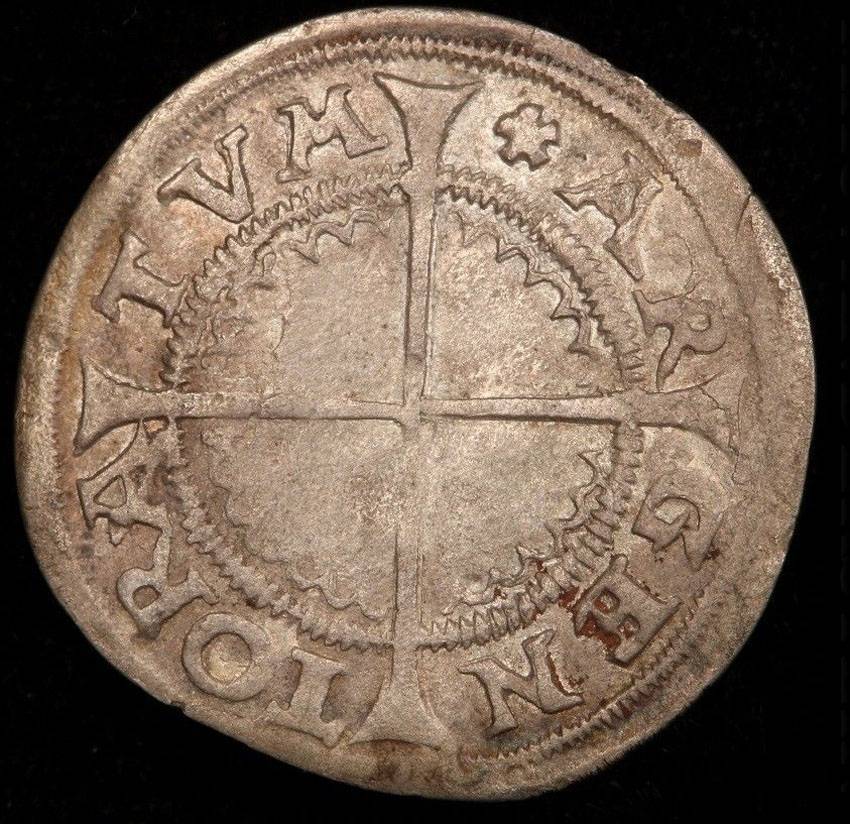
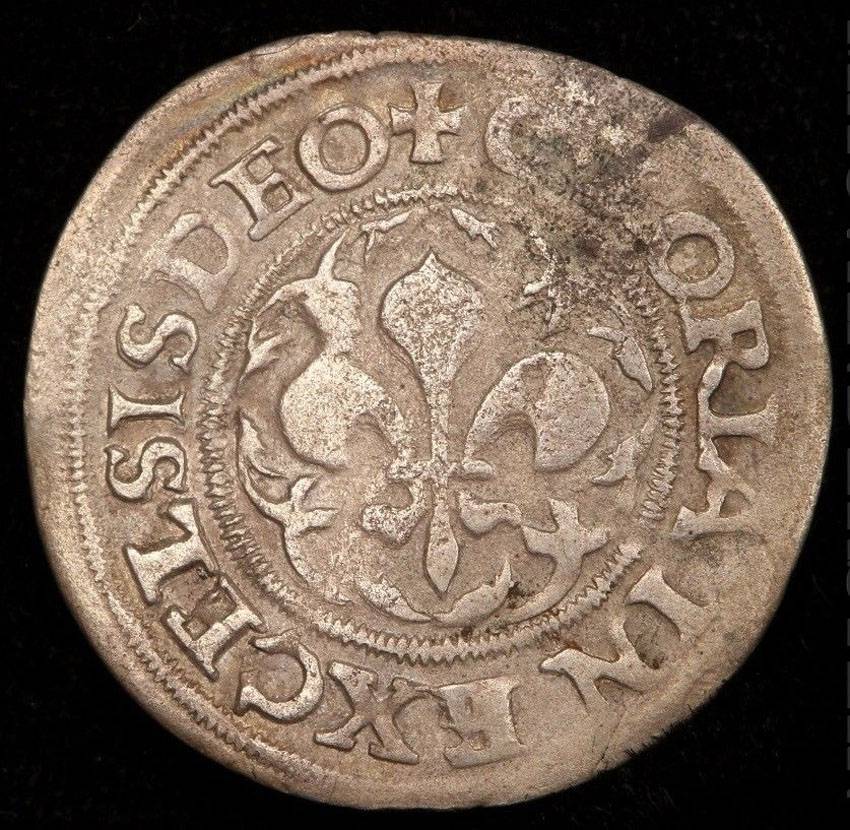
Vierer (2 Kreuzer) of Strasbourg.
Minted approx. 1560-1620.
AR, 20.1mm, 1.19g
Obv: GLORIA IN EXCELSIS DEO (cross) - Glory in the Highest to God. Fleur-de-lis centered in a four-lobed circular design.
Rev: (star) ARGENTORATVM - Argentoratum was the Latin name for Strasbourg prior to about the 5th c. but remained in use through Medieval times. A long cross pattee divides a pattern of two circular designs.
The last of an era - before the Thaler took over the (German/Austrian) world.
Up until the mid 17th c. the monetary systems of Verona, in Italy, were the basis for much coinage in Germany, Austria, Italy, and elsewhere.
Early 13th c: 1 Berner (e.g. Veronese in MHD), also called a denar or a Pfennig, was the base unit. But by that time, it was a tiny little coin and hardly useful for trading. A coin valued at 20 Berner was thus struck in Tyrol: the first Groschen, featuring an eagle on one side and a cross on the other.
Later in the 13th c. a new, heavier 20 Berner coin was struck in Meran (Tyrol). The older, lighter coins (with the eagle) were devalued to 18 Berner; the new, heavier 20 Berner coins were known as "Tirolini" in Italy but "Kreuzer" elsewhere because of the double cross (Kreuz) design. There were 240 Berner to the pound = 12 Kreuzer.
In the late 15th c. the main minting was moved to Hall in Tyrol away from Meran. The new Hall mint issued coins of 1 Kreuzer (20 Berner) and a new 1/5 Kreuzer known as a Vierer (for "Vier-Berner" = 4 Berner.)
Beginning in the latter half of the 16th c. a new denomination, the Thaler, was being established by law in the various states, bishoprics, duchies, and free cities, and it rapidly became the standard unit of trade, signalling the demise of the Veronese coinage system in Austria and Germany.
This particular Strasbourg coin was still known as a Vierer, but with the introduction of the Thaler in Strasbourg the Vierer was made to pass at 2 Kreuzer instead of its original 1/5 Kreuzer, an inflationary revaluation of 10:1 which helped fund the Thirty Years' War during the "Kipper and Wipper" era. Silver coins were weighed, and the heavier ones were melted down and recast in debased alloys of copper, lead, and silver that were given the same denomination/value. Hyperinflation soon followed.
The Berner/Kreuzer system of Tyrol and Verona was replaced in Austria and Germany over the next 3 centuries by a legion of various Thalers subdivided into a bewildering array of minor denominations: pfennig, stuber, stück, groschen, kreuzer, heller, batzen, and many others besides, making the "Vierer" finally obsolete as a denomination.





 First Page
 Previous Page


 Posted 12/15/2018 10:35 am







 -
-
 -
-

 -
-
 -
-