| Author |
 Replies: 35 / Views: 4,144 Replies: 35 / Views: 4,144 |
|
|
|
Valued Member
  United States
466 Posts |
Not being an ebay seller, I was unaware of seller opinions, practices or pricing strategies. Thanks for educating me. Had we not stumbled into each other on this thread, I never would have known this. |
|
Forum Dad
United States
24222 Posts |
|
|
Valued Member
United States
466 Posts |
Thanks for the link. I wish it was less conclusory than the quacks like a duck analysis.
|
|
Bedrock of the Community
United States
17884 Posts |
The problem is without documentation that they actually attempted to create a special coin all you have to go on is the look of the coin itself. And with branch mint proofs you have the additional problem that they will NOT have the same look as the Philadelphia proofs did. Why? Because the branch mints did not have the high tonnage medal press that Philadelphia used to strike proofs. All they had were the regular coining presses. So they might polish a die, they might polish the planchet, but they really couldn't strike the coin with much more pressure than a normal coinage strike. Then add the fact that new dies were polished to remove oxidation from the hardening process and you could have a lot of trouble telling a branch mint proof for a coin struck with an overzealously polished new die. This is why they are controversial.
|
|
Valued Member
United States
466 Posts |
Conder, you have fleshed out with specifics a number of reasons supporting my concerns about unauthorized " proofs" made at branch mints.
At the end of the day, we have NGC's grading opinion that a coin struck with non-proof dies on suboptimal equipment looks so much like a proof that it grades as a proof.
To me, whether a coin is a proof is a binary question of fact: either it is or it isn't. If it is impaired, it is still a proof, although it may not grade at mint state, because of the way it was made. Its condition doesn't matter.
To NGC, apparently, appearance is dispositive. Obviously NGC knows all the arguments pro and con, it has made up its mind and can't change it (grading guarantees, you know). I am unpersuaded, but there are clearly people willing to shell out big bucks to buy that elusive branch mint proof holder.
|
|
Bedrock of the Community
13014 Posts |
Quote:
Obviously NGC knows all the arguments pro and con, it has made up its mind and can't change it (grading guarantees, you know). They could change their mind, it would just be expensive. It's happened before. Edited by basebal21
03/29/2019 01:31 am
|
|
Valued Member
United States
325 Posts |
I sell on ebay, and the idea of collecting offers is something that hadn't occurred to me before. I'll have to try it on some items... |
|
Forum Dad
United States
24222 Posts |
Quote:
To me, whether a coin is a proof is a binary question of fact: either it is or it isn't. Then there must be an exact explanation of what a proof is. You can't just say "struck with proof dies," there must be an exact definition of what a proof die is. Harder metal? Engraved deeper? Polished more? There also must be an exact definition of a proof strike. Must it be 300 tons? 400? 500? Is it struck twice? Three times? Is a coin proof just because whoever minted it says it is? No? If these are questions that can't be answered then it cannot be a binary question of fact since it would always be open to interpretation. This is the issue with this coin. NGC says it's a proof, Would PCGS? Would ANACS? |
|
Pillar of the Community
United States
7728 Posts |
Quote:
NGC says it's a proof, Would PCGS? Would ANACS? Maybe PCGS and/or ANACS have already seen the coin and said "'We don't think it's a proof, have a nice day". Chances are pretty good that this coin has been submitted several times over the years and most likely came back in MS plastic each time. (Don't get me wrong, it is a very nice coin.) The owner eventually got the "proof" result he wanted with an NGC submission. What changed? The coin sure didn't! |
|
Valued Member
United States
466 Posts |
You are looking at it like NGC looks at it. Which is fine. They are unquestionably qualified experts.
Philosophically, and as a matter of transparent accuracy,
I don't think what the coin looks like should be the determinative factor. Besides, there are so many different kinds of proof (matte proof, sandblast proof, deep cameo proof, I'm sure there are others) that we would need several inconsistent definitions to cover them all.
My opinion, and you and NGC are entitled to yours, is that before S.F. started making proofs in 1968, proofs only came from the Philadelphia Mint. No other mint was authorized, had the equipment, or formally or otherwise (1) designated coins as proof; or (2) kept records of issuing proofs. Anything else being passed off as a proof either isn't really a proof or is a knockoff. Maybe it has the "look," even more so than being "proof-like," but the counterfeit designer handbags that are for sale in countries with loose intellectual property law enforcement have the "look," too. I don't see "PF" as a grade. PF-65 is a grade based on an opinion of quality. PF, standing alone is a statement of fact. I believe PCGS sees it more or less the same way, as my understanding is that PCGS doesn't recognize branch mint proofs.
If someone painted an exact copy of the Mona Lisa, indistinguishable from the true Mona Lisa, would it be the Mona Lisa? Not to me, even though it "quacks like a duck."
We know zero about the history of the coin in question, or how in came into existence. We don't even know if it was intended to be a proof, be special or commemorate anything. Giving it the same designation as a true Philadelphia proof seems incorrect, although I can't call it misleading because anyone shelling out the bucks to buy one of these very rare birds certainly knows exactly what they are getting.
It's probably a matter of definitional semantics. If these "special" coins were given a different designation than Philadelphia proofs, "special proof," "branch mint proof," or whatever, it would seem much more accurate and appropriate to me.
Does anyone doubt that officially designated and recorded Philadelphia proofs are really proofs? You ask: "Is a coin proof just because whoever minted it says it was? No?" I would answer your question "yes" with respect to Philadelphia coins and "no" with respect to others.
I guess, to sum up, that NCG appears to view whether a coin is proof as a grading opinion. I see it as a question of fact based on the legal authority and intentions of the coin's creators.
|
|
Forum Dad
United States
24222 Posts |
Quote:
I see it as a question of fact based on the legal authority and intentions of the coin's creators. So this fact is determined at the whim of the creator. Does that go for all creators? Or just the big ones? If you privately commission proof coins from a mint yourself, like nohope did here with the CCF coins, what happens if you don't think the finished product is proof (like this coin) but they tell you it is, what then? Sorry, but in my opinion, you can't base a fact on the opinion of random different people. There has to be a definition or it will always be open to interpretation. |
|
Valued Member
United States
466 Posts |
I think we come from different experiential backgrounds. I encountered very few rigid definitions in my lline of work. And factual determinations are often based on opinions.
I do see fact questions that may or may not be answerable.
Fact question: is it intended to be a proof? Intention or state of mind is always a question of fact, but it is a fact. This is not a whim of the maker issue. If the maker did not intend to make a proof and therefore was not trying to make a proof, how can it be called a proof? If it is, isn't it just a debatable matter of grading opinion? I don't know about privately commissoning coins from the U.S. mint, but if it comes from a private mint it isn't a coin and who knows what a private mint would call proof. Do TPGs grade such things?
Fact question: is there any authority, from a person with the right to make the decision, to make the proof at a branch mint only intended to make circulation strikes? This is a fact provable by documentation or personal memories.
It has been so long that evidence relevant to these questions, if it ever existed, may no longer be available. Absent mint records, the best place to research this may be the New Orleans Times-Picayune. In those slower news days of 1891, an occasion important enough to justify creation of a single, atypical branch mint proof might get picked up by the local paper, although the story might not have mentioned the coin.
Obviously, there are no living first hand witnesses. There may or may not be a discoverable oral tradition. Or maybe someone saw something in a document that once existed but no longer does. But it seems the most likely situation is that all that can be found is the circumstantial evidence of the coin itself.
So... does that prove enough to give a common date coin a designation that increases its value by six or even seven figures? Conder101 is correct that the issue is controversial. NGS clearly believes the coin itself is sufficient evidence. I understand that PCGS has come down on the other side of the question, but maybe I am wrong and PCGS, rather than announcing a definitive decision, just has not yet found a coin to certify as a branch mint proof.
I continue to believe that merely looking at a coin with no other context whatsoever can at best be an educated guess and could rise to the level of speculation. But that is just how I see it.
|
|
Pillar of the Community
Canada
1267 Posts |
PCGS hasn't certified a branch mint proof? 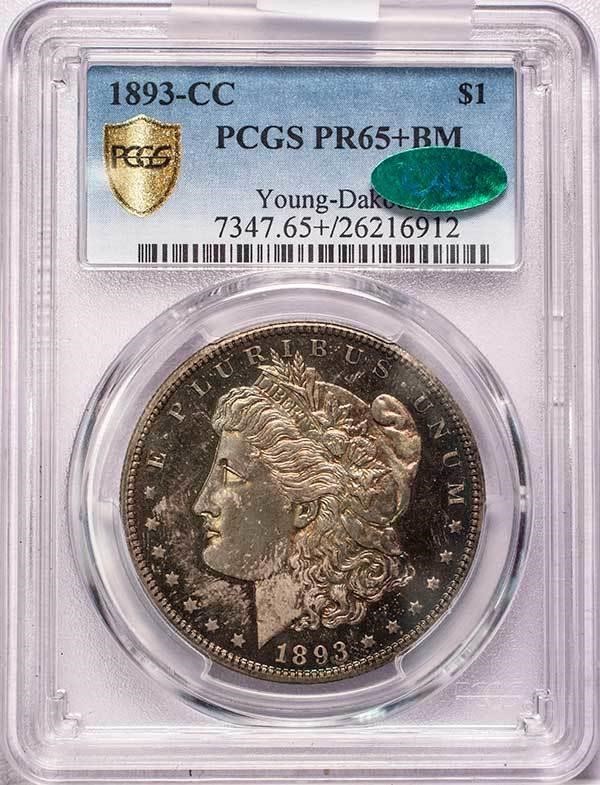 |
|
Valued Member
United States
466 Posts |
Well I was totally out of my mind on that one ...
I thought I had read it somewhere, maybe it was in a very old book. Maybe it was my feeble mind starting to fail me.
Wouldn't have said it if I didn't think I had a basis for it. Kinda embarrassing. More than kinda...
Anyway, with the two main TPGs disagreeing with me, my rather purist concerns are of no importance.
|
|
Pillar of the Community
United States
9807 Posts |
I asked my friend Mark about it and he thinks it's Proof. Gerry Fortrain has also examined it extensively and concluded the Obverse die used was unique and the reverse die is one known. Interesting, from Heritage photos I retract my call on the look of the coin, the rims and denticles are very pronounced, not really visible in the ebay photos. Mark directed me to this video made a few years ago on this very coin. Mark is the senior cataloger at Heritage, and I respect his knowledge greatly. He's a friend and a scholar of numismatics extraordinaire. https://www.youtube.com/watch?v=pJsiPIfZ4KUHere is the original Heritage Auction link from the 2016 Auction where it was hammered at $47,000 https://coins.ha.com/itm/proof-seat...auction-infoThere are a few MS67 examples in PCGS holders but I can't find any that sold recently, August 15th being the last one. MS66 in PCGS have sold in the $1800-$2400 range and PCGS price guide says $8500 for MS67. No 1891-O dimes have been certified above MS67 by either NGC or PCGS. That data considered, someone still paid a hefty premium for this coin in 2016, but in 2014 it sold for an amazing $129,250 also through Heritage. https://coins.ha.com/itm/proof-seat...ction-120115What I find stranger yet, both auction lots are accepting offers on the coin. Does that mean the original seller in 2014 sold and bought it back in 2016? Maybe they decided to put it up with no safety net, saw it selling really cheap and bought it back. That does happen in auctions, but usually a consignor will have a minimum sell price in place to prevent that from happening. So do I think it's a Branch Mint Proof now? I'm still leaning towards no but no with a very BIG maybe, I trust Mark's judgement and he has had this coin in hand several times for a length of time, and he thinks it most likely is a proof. I wouldn't spend over a $100K to find out (if I could play at those levels). I certainly wouldn't go in at $10 million, but as Bobby said the current owner is just fishing for offers. Which absolutely makes sense from a business point, since the same owner is also accepting offers through the Heritage site as well. Interesting coin, something I would not have looked at so closely with out this thread coming up, and possibly bypassed altogether if I didn't know this was a unique coin, so thank you for pushing me to educate myself on this piece. Spent some time re-reading various articles and books on branch mint proofs.  "Buy the Book Before You Buy the Coin" - Aaron R. Feldman - "And read it" - Me 2013! ANA Life Member #3288 in good standing since 1981, ANS, Early American Coppers Member (EAC), Colonial Coin Collectors Club member (C4), Conder Token Collector Club member (CTCC), Civil War Token Society (CWTS) member, Liberty Seated Collectors Club (LSCC) & Numismatic Bibliomania Society member (NBS), USMex, Member in good standing, 2¢ variety collector. See my want page: http://goccf.com/t/140440 |
| |
Replies: 35 / Views: 4,144 |







 First Page


 Posted 03/28/2019 5:54 pm





