| Author |
 Replies: 9 / Views: 4,029 Replies: 9 / Views: 4,029 |
|
|
Pillar of the Community
United States
1436 Posts |
I recently bought a Jos. Merriam medal promoting the bare knuckle world championship fight between Thomas Sayers (English champion) vs. John Heenan (American champion) in 1859. It has been graded an MS-63 by NGC. I went to the NGC site to see what the pop report indicated about it, but for some reason, they don't have the report for it. Anyone know what the pop report is for this medal, and what rarity it is? Here's the link to it on the NGC site... http://www.ngccoin.com/certlookup/i...=3702355-006Any information will be greatly appreciated. PS, For anyone interested, after more than 40 rounds the fight was ultimately called a draw because the crowd rushed into the ring. Check it out... it's an interesting piece of boxing history  Edited by Dave H
08/27/2014 10:49 am
|
|
|
|
Pillar of the Community
Canada
1118 Posts |
Very cool medal, sadly I know nothing about it. Interestingly enough bare-knuckle boxing is safer then modern boxing. I have a few Olympic coins from around the world featuring boxing scenes. Do you have a boxing coin thing going on since you show an interest in pugilism?
|
|
Pillar of the Community
United Kingdom
2490 Posts |
There are two English tokens that tell of a terrible fight: BELLA, HORRIDA BELLA (War, terrible war) refers to one of England's greatest ever prizefights. 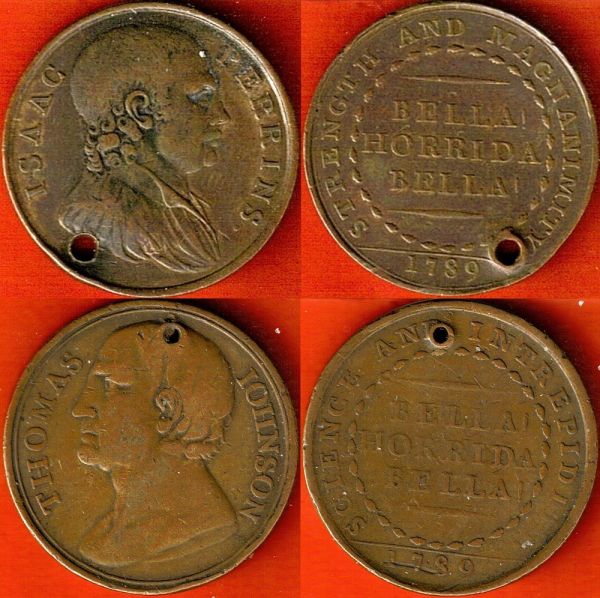
Isaac Perrins was a pugilist. In November 1789 he had a fight of 62 rounds against Tom Johnson, the Champion of England. Perrins lost, beaten by a man who knew better than to stand and fight toe to toe, as was the custom of the time. Johnson moved around the ring like a modern boxer, forcing his opponent to come after him. Perrins had overwhelming physical advantages but, owing to his naïvety, no clause was inserted in the articles of agreement to prevent "shifting" ... Moreover, Perrins was inexperienced in the subterfuges of the sport and found himself outwitted by his artful adversary. The contest lasted 62 rounds, which took a total of 75 minutes to complete, until Perrins became totally exhausted. These two contemporary tokens show how highly both men were regarded. Obverse: Bust facing right around which: ISAAC PERRINS Reverse: BELLA, HORRIDA BELLA around which: STRENGTH AND MAGNANIMITY 1789 Obverse: Bust facing left around which: THOMAS JOHNSON Reverse: BELLA, HORRIDA BELLA around which: SCIENCE AND INTREPIDITY 1789 |
|
Pillar of the Community
 United States
1436 Posts |
Quote:
Do you have a boxing coin thing going on since you show an interest in pugilism? I don't have any interest in boxing. I actually picked the Sayers medal up at the summer FUN show. The dealer actually had the Jos. Merriam Die Maker side showing in their display case, and thought it was beautifully done. I believe I got an absolute steal w/ what I paid for it, especially since it's at MS-63. There is another medal for John Heenan done by Merriam as well, and I think it'll be cool to have both fighters' medals. I have been looking, but haven't found one yet at a reasonable price, so the quest will continue. |
|
Pillar of the Community
United States
4423 Posts |
Interesting thread, this. The Merriam piece is super, and I much admire his artful work. I've seen but a few of these Sayers medals in auctions over the years. If I can find any population info, I'll report back.
|
|
Valued Member
United States
156 Posts |
There 2 known varieties of Heenan-Sayers medals, each with 1 sub variety for metal composition which are listed as So Called Dollars(HK-9/HK-10: John C.Heenan, HK-10a/HK-10b: Thomas S. Sayers) in the Hibler & Kappen reference. These were produced circa 1860's by NYC medalists F.B.Smith and Hartmann. The Joseph Merriam medal may have been produced in the same time frame, and is listed in Rulau's "United States Tokens, 1700-1900" as a Trade Token. The NGC attribution indicating the token dates to 1859 is nonsense, since the Heenan-Sayers bout didn't occur until April 17,1860, even though Merriam was actively engaged in Die Sinking earlier.
Edited by judd1552
08/31/2014 10:19 pm
|
|
Pillar of the Community
United States
1436 Posts |
Quote:
The NGC attribution indicating the token dates to 1859 is nonsense, since the Heenan-Sayers bout didn't occur until April 17,1860, even though Merriam was actively engaged in Die Sinking earlier. What I understand is that the medals were made to PROMOTE the first ever world championship fight between Sayers & Heenan scheduled for April 1860. It was also a method of advertising for Merriam, which he would want out to the general public ASAP. If that is the case, then I can see the medals being made in 1859 and not 1860. Another question... I heard back from an on-line dealer who was selling one of the Heenan medals. I inquired if he knew what rarity level and approx. how many were supposedly made. He said it was a rarity 6 w/ only about 40 ever made. If that is the case, would it make sense then that the Sayers medal would be the same (R6 & 40 made)?  |
|
Pillar of the Community
United States
4423 Posts |
You make a valid point, DaveH. The fight was being promoted, touted in 1859, and likely first conjured in 1858. It was sort of a revival of sorts for the Revolutionary War; akin to Rocky IV, wherein Rocky takes on the Russian. I can well imagine the interest of Boston folks at large.
IMHO, the issue of these Heenan-Sayers medals in 1859 or 1860 is quite feasible. That said, Merriam and other medalists could have struck these at any time thereafter. The earliest appearance of these medals that I've spotted is in a Cogan sale of 1862.
|
|
Pillar of the Community
United States
1144 Posts |
Edited by cointagous
09/08/2014 12:41 am
|
|
Pillar of the Community
United States
4423 Posts |
Cointagious .... That's a pleasing example, combining sport and an early store card, at a bargain basement price, To think, you got that historic item for the price of a common date Morgan in MS-63 is really something. Looks like traces of a mirror suface amid the letters.
|
| |
Replies: 9 / Views: 4,029 |
|










 Posted 08/27/2014 2:54 pm


