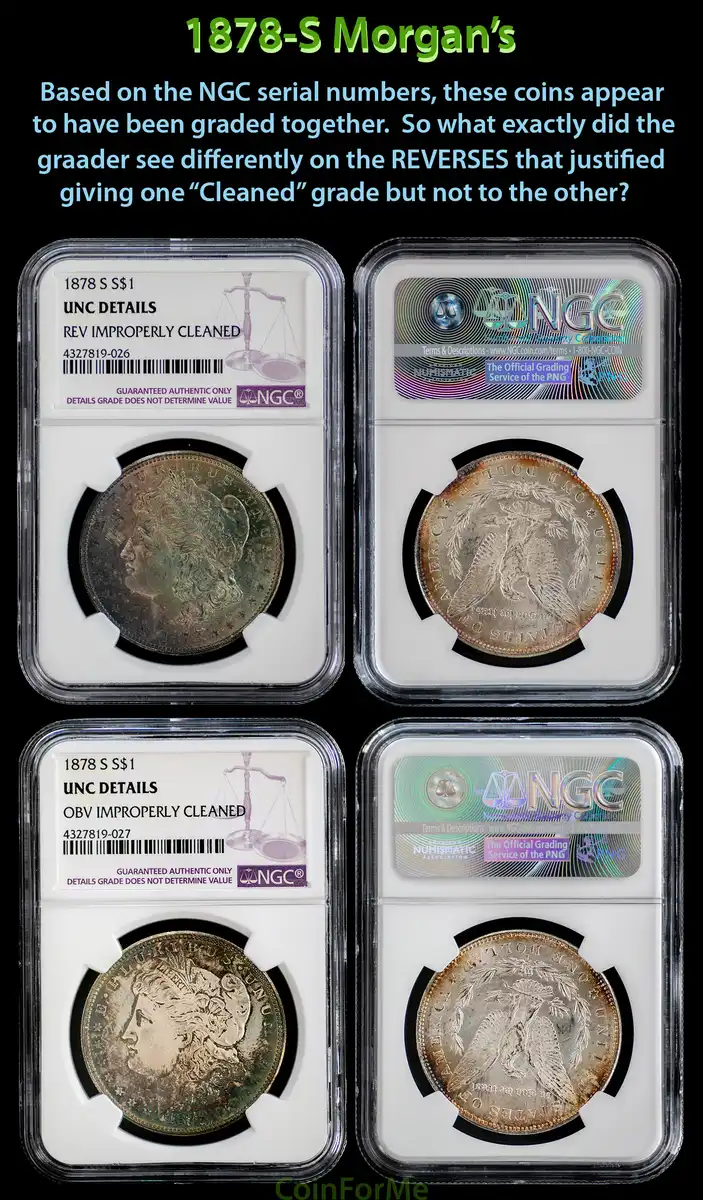
The adjectival grade should reflect the state of preservation of the coin after it left the mint, and should not differ from obverse to reverse. Split grading is an attempt to compare the appearance of each side of the coin, rather than a technical grade for the side. The result usually is a net grade, which is an attempt to capture the state of preservation. The chief exceptions are for buried or sea-treasure-clumped coins or for coins used as jewelry, including rings, money clips, and belt buckles, where only one surface of the coin is exposed to wear, and that wear is abnormal.
The issue is that our eyes don't just see the physical wear on a coin. They also see the die state, die clash polishing, and strike quality. Current grading practices are in the infancy of accurately measuring the factors affecting a coin in hand.
With the advent of increasingly high resolution photography and greater computer processing speed and capacity, it eventually will be possible to recreate a digital lifespan for each die pairing. This will eventually allow digital grading capable of measuring the die state (from 100% theoretically to zero), die polishing from each stage where the dies were polished, and strike quality for the specific date, mint, denomination, and die pair. This, in turn, will eventually allow a 100-point pinpoint grading scale with accompanying measurements of the related factors. (Yes, this will require artificial computer measurements, but on a closed-loop system, rather than the slop we see today with its hallucinations. This will be more on the model of specialized research search engines that only search a defined database.)
We aren't anywhere near that capacity now. And it's a fair question whether coin collecting as a hobby or business will even exist when this becomes feasible.








 Replies: 8 / Views: 353


 Posted 09/20/2026 07:03 am