




 First Page
 Previous Page




 Posted Yesterday 11:14 pm


A clad Washington quarter contains an outer 75% copper/25% nickel layer of approximately (~290 microns) thick on each side of its inner copper core. By comparison, a typical handheld XRF analyzer has an effective analytical depth of only about 10-50 microns in Cu-Ni clad coinage. As a result, an XRF gun generally examines only the outer portion of the clad layer, representing roughly 3-17% of its total thickness, rather than the entire clad layer or underlying copper core.
This relationship helps explain why XRF and SEM/EDS often produce different results when studying improperly annealed clad coins. SEM/EDS is highly surface-sensitive, typically analyzing only the upper few microns where oxidation, copper enrichment, and color-producing compounds are concentrated. XRF, by averaging over a deeper volume of material, provides a more bulk composition of the outer clad region. Consequently, surface oxidation effects that strongly influence SEM/EDS results may appear diluted in XRF data, while both techniques can provide complementary information about the coin's metallurgical condition and oxidative state.
Why the readings did not match 75% Cu/25% Ni - perhaps due to copper surface enrichment or the surface was not purely homogenous which is likely. Indeed XRF is WORTHLESS by itself to assay oxide films on IA error coins. Hence the three page merry-go-round of responses on your XRF gun analysis thread.
HI be aware my study will involve ALL DENOMINATIONS from nickels to dollars as the outer clad layer has the SAME Cu/Ni %'s as the entire homogenous binary alloy composition Jefferson nickel. So the same IA oxidative effects on Jeff 5C's are identical to its higher denominations with their outer clad layers higher denominations.
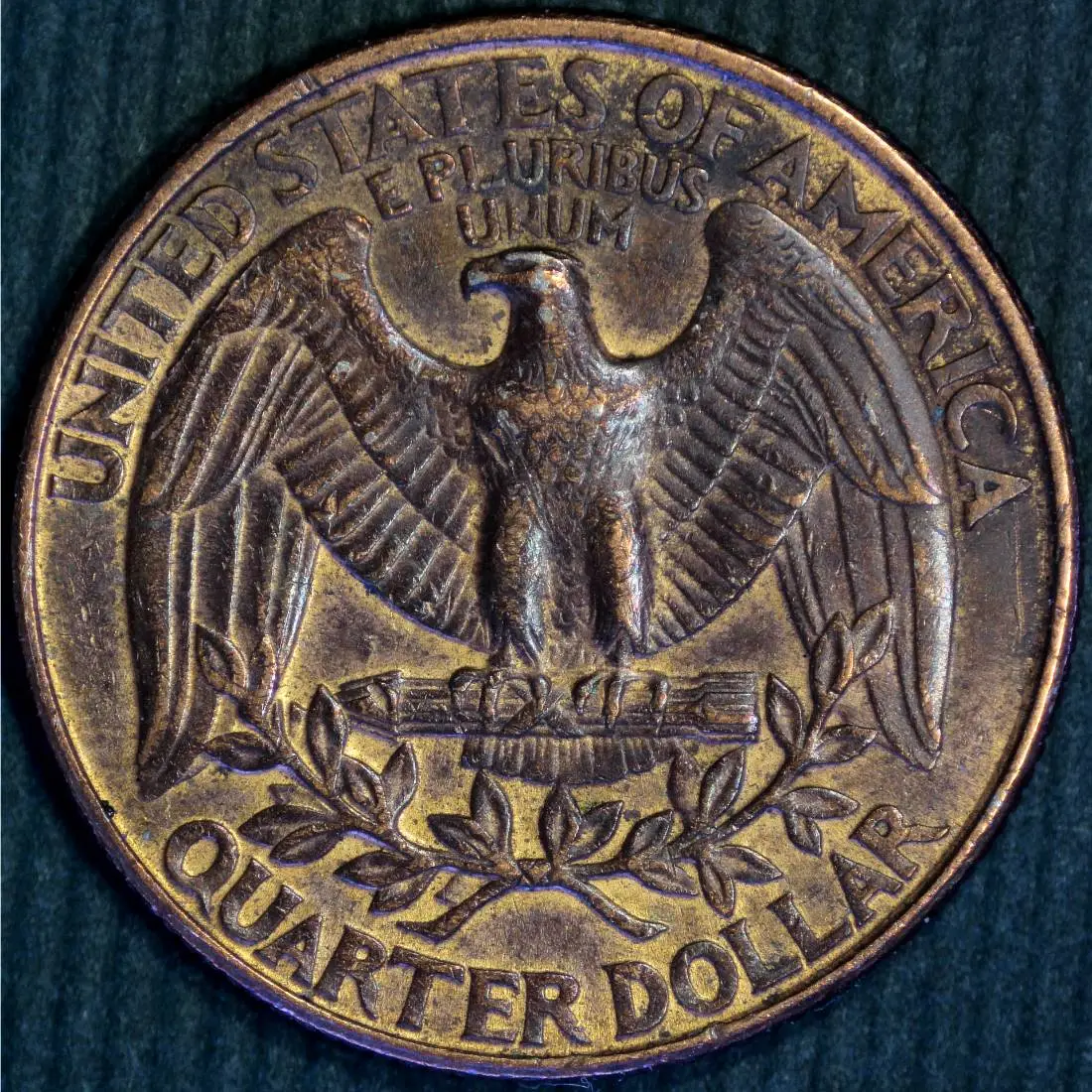
Here we see a Quarter with what I call an early oxidative state golden hue and it progresses to a dark brown/black in other areas of a later oxidative state. Its a 100% confirmed IA error coin.
Why then do an associated XRF preliminary analysis with Winston Zack? HI just to confirm Cobalt (Co) is not a player or is a player in Black Beauties giving it a blue hue or is it just optics/lighting. Also to confirm metal impurities are or are not responsible for the IA color effects seen on IA error coins. They do follow a distinct oxidative color pathway as verified by other research studies which has been verified by observing over several hundred proposed IA error coins raw and in TPG's. No need to use this example in my paper. I have it covered by other examples with similar early/late oxidative states. Keep the inquires coming ...


