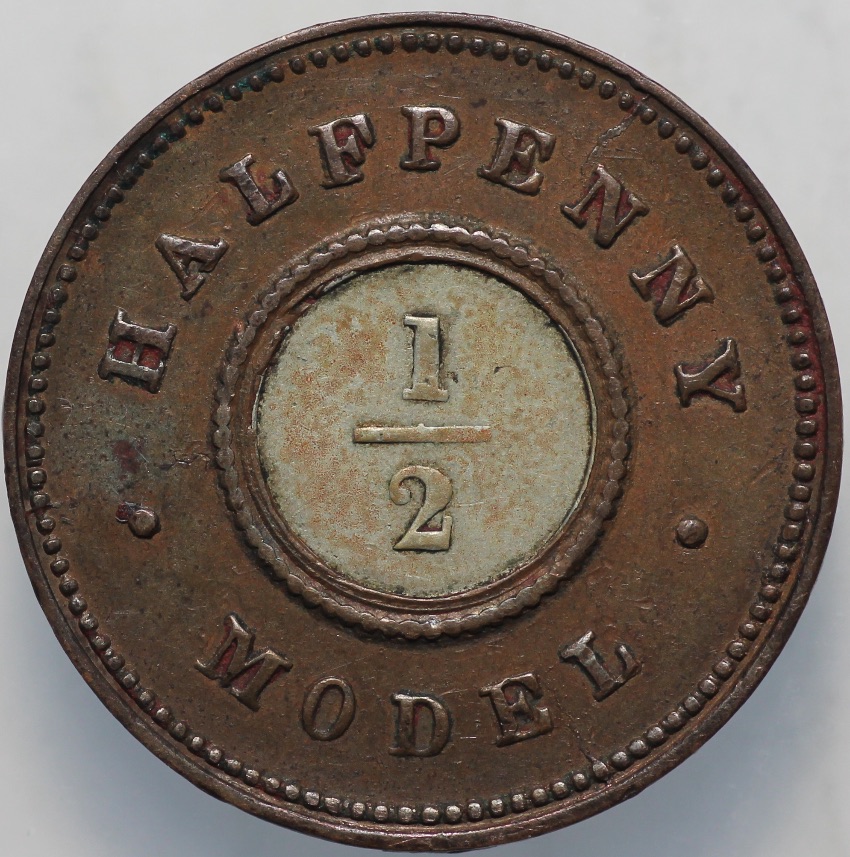
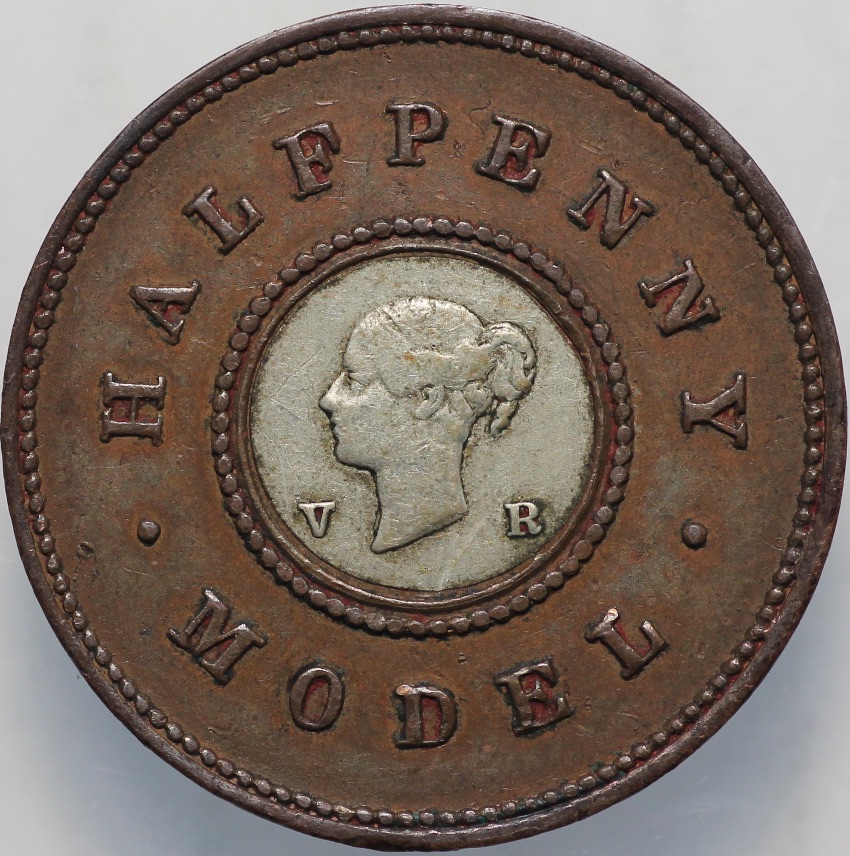
Quote:How about this 1 ----its encased -----

Yes, certainly interesting. I had to read up on that one. I found this interesting blurb about it and the penny model for anyone interested:
Quote:In the early 1840's the British
Royal Mint was coming to the conclusion that making and distributing large copper coins was no longer economical. The British copper penny was nearly the same diameter as a U.S. silver dollar, while the half penny was almost the size of a U.S. half dollar. While these large pennies were very impressive, they were as inconvenient to carry around as they were expensive to produce.
When renowned medalist Joseph Moore (of the Birmingham firm of Allen and Moore) heard that the English government was tentatively discussing plans to replace the copper penny and half penny, he liked the idea so much that he created a design of his own for the new coins, and began circulating some examples locally in 1844. Slightly smaller in diameter than a U.S. quarter, the outer ring of Moore's penny was made of copper, while the center was made of silver (or in some cases, brass). On one side of the inner ring was a youthful portrait of Victoria, and on the other, the numeral 1. The inscription on the outer ring on both sides, "ONE PENNY MODEL," protected Moore from prosecution under the British counterfeit laws. He also designed and circulated a somewhat smaller bi-metallic half penny, with the
inscription "HALF PENNY MODEL" on both sides, and the numeral ½ on the reverse.
The new bi-metallic coins were small, light, and eye-catching. People in the Birmingham area clamored for more, prompting
The Royal Mint to make an announcement that the coins were definitely not legal tender. Impressed by Moore's work, the Mint offered him a job, but he turned it down. The model pennies and half pennies continued to circulate until 1860, when England economized by down-sizing its penny and using bronze instead of copper.
Joseph Moore's popular bi-metallic coins faded into history, but looking back, it's apparent that he was a clever innovator who was simply too far ahead of his time. In 1982, Italy became the first country to mint bi-metallic coins for wide circulation. These coins proved to be extremely popular, and today over 100 countries produce bimetallic coins"
Since it wasn't actually legal tender and was "encased" by design, I can't assign any points to it.








 First Page
 Previous Page


 Posted 11/29/2017 5:45 pm


 ..... nothing encased