Quite thrilled to win this medal at auction. It's a bit of a long read but I hope you may enjoy it.

Historical art medal from the early Beaux Arts period
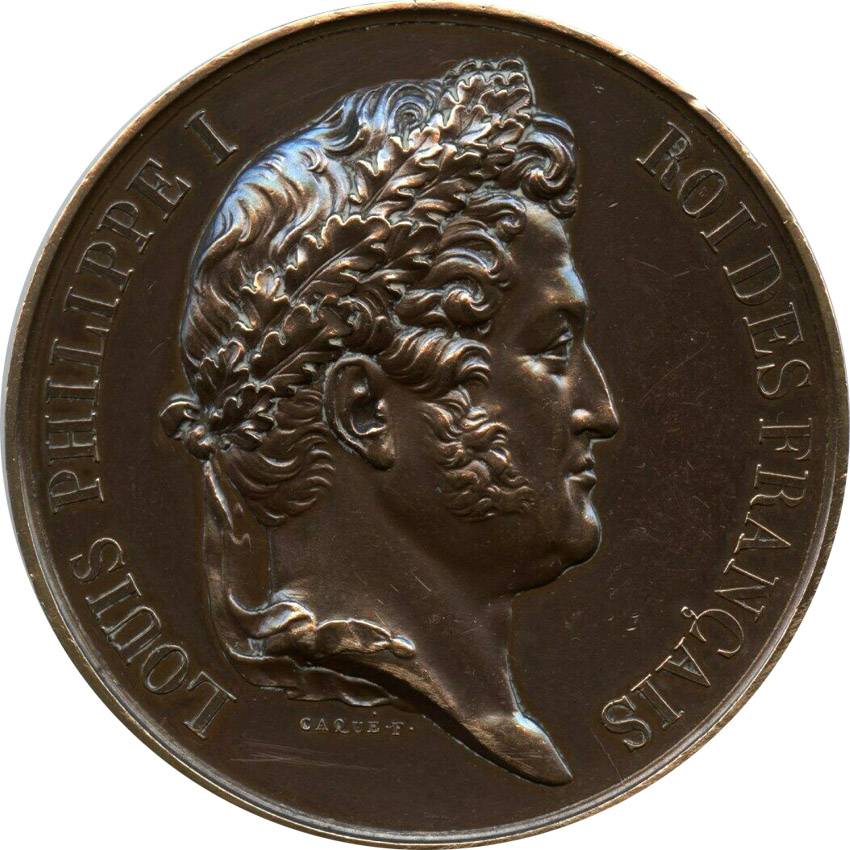
Paris, France. 1842. AE, 42mm. Paris mint mark (MdP)
More information below the photographs.
The obverse features the right-facing bust of Louis Philippe I, King of France, laureate and vested; the sculptor/engraver's signature (Caque f.) below.
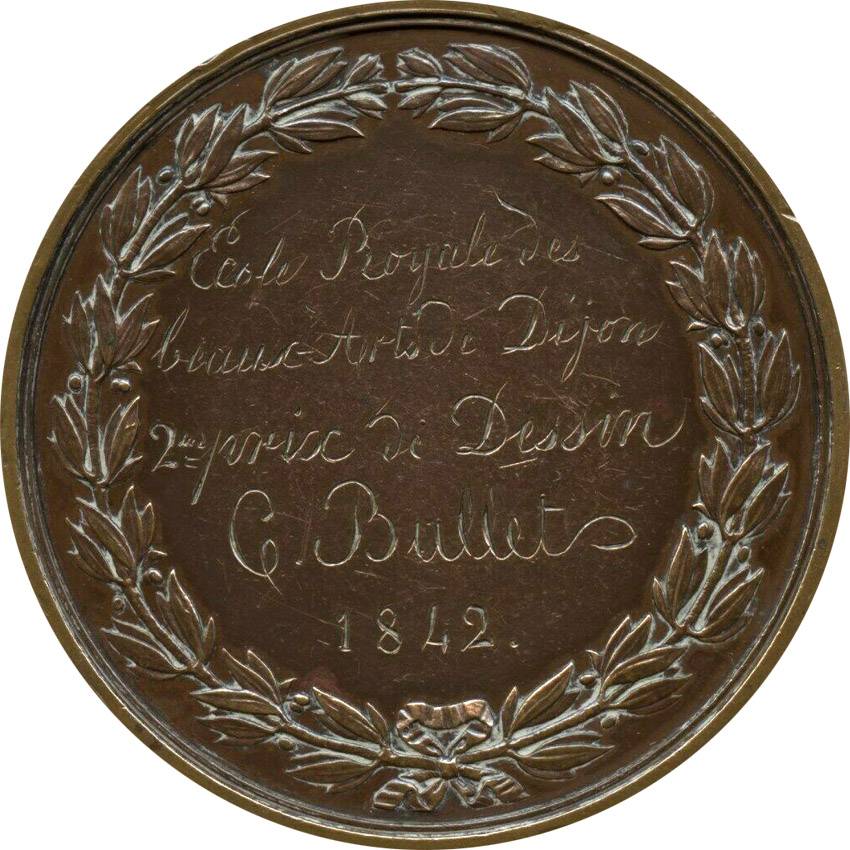
The reverse features a closed wreath of laurel, a bow at the bottom, with a French inscription on 5 lines:
Ecole Royale des beaux-Arts De Dijon
2eme Prix de Dessin
C. Bullet
1842
Royal Academy of Beaux-Arts, Dijon
2nd Prize for Drawing/Design
The edge is lettered "BRONZE"
The engraver:
Armand Auguste Caque - royal engraver for the Bourbons, most notably Napoleon III and Marie-Therèse de France, the latter by whom he was commissioned to design a 74-medal set known as the "Numismatic Kings of France" which went on exhibit at the Paris Salon from 1836-1839.
The recipient:
Charles Bullet(t) - classically trained artist, architect and chiefly sculptor in the Beaux Arts style. A student at the Ecole des Beaux Arts in Dijon, France, he won several school competitions -- no mean feat, given some of his fellow artists and sculptors at the time. His name originally had two "T's" so the spelling here is likely an engraving error.
He moved to Cincinnati, Ohio, in the late 1840s and opened a studio there, working with local marble, and executing busts, tombstones, and architectural elements. He was a notable sculptor of the Ohio capitol building at Columbia. In 1849, he was the featured sculptor for a gallery at New York's National Academy of Design.
Relocating with his business partner Michael Muldoon to Kentucky in 1860, where his son Charles Bullet II was born (see below,) he continued to sculpt marble tombs, mausoleums, monuments, busts and statues.
He eventually opened a studio in Carrara, Italy, where he was commissioned via his Louisville firm and business partner to execute Carrara marble busts of Civil War generals Halleck and Boyle (completed) and a planned many others which he did not complete; he also created models for a planned Confederate monument at Lexington and a second to honor fallen Confederate soldiers in South Carolina. He passed away in 1883 before he was able to carry out his visions. He also spent time in New Orleans and Montreal, as well as making a return trip to Paris in the 1860s for further study.
His son, Charles Bullet II (with one "T"), also of Kentucky, later achieved his own fame as a noted Florida artist whose wetlands, swamp, coastal, and beach landscapes of areas including Sanibel Island (home of his summer studio) & Ft. Myers were beautiful scenes of Florida nature, and his works from the 1910s and 1920s are very collectible and valuable in their own right. They provide an artistic insight into the Florida habitat before the loss of much of the environment to residential, commercial and industrial expansion.
A collection of silver medals awarded to Charles Bullet(t) over his career (including a silver medal from the Ecole des Beaux Arts with similar inscription to mine, but for first prize, along with one for the Ohio State Board of Agriculture in 1851, the United States Agricultural Society in Cincinnati 1860, and the Cincinnati Industrial Exposition of 1870) was sold at Sothebys in January 2015.
I am not including any other pictures due to copyright reasons but a quick Internet search should provide you with more than enough.








 First Page
 Previous Page




 Posted 01/30/2020 3:43 pm