| Author |
 Replies: 20 / Views: 3,457 Replies: 20 / Views: 3,457 |
Page 2 of 2
|
|
|
|
Pillar of the Community
 United States
1582 Posts |
No intention of selling it kookoox10 - just trying to be as accurate as I can, and to learn the little ins and outs of grading paper money - not a better place in cyberspace to learn from some very knowledgable members than Coin Community Forum.
|
|
Valued Member
United States
486 Posts |
"Wow! Very Fine 20 Apparent - and, what does Apparent mean in regards to the grade?"
The only thing Apparent to me is that they did not know how to grade it is so just called it VF ?. Unbelievable.
Very good reason to learn to grade for yourself. I would not want a note like that in my collection, and I would never pay to have a note like that graded.
I would much sooner take the money it cost to grade a note and buy a nicer note.
The Bill Collector.
Edited by The Bill Collector
01/18/2012 4:04 pm
|
|
Pillar of the Community
United States
1054 Posts |
I could imagine PCGS's terminology of "apparent" is on par with "genuine" or "improperly cleaned" with their coin grading service. I have numerous large FRN's and silver certs that are VF and XF with a light fold here and there, no tears, a little staining.
|
|
Valued Member
United States
486 Posts |
To me it's apparent that they don't have very good standards for grading Paper Money if you have some PCGS FRN's in VF condition and they look better than that
$ 20., it's also apparent that someone at PCGS needs glasses.
Imagine someone buying a note like that from a mail order list without seeing it, ( for you younger guys that's the way it was done before the age of computers ) paying the VF price for it because the seller said it was "professionally graded" by PCGS as VF, how many would be happy with what they received vs. what they paid for ?.
And it's not the first time notes like that have been graded way higher than they should be.
The Bill Collector
|
|
Pillar of the Community
United States
1582 Posts |
All puns aside guys, I still don't know what the "Apparent" means on the holder. I've no doubt it says something about the bill, otherwise the grading company wouldn't have included it in the description, but I have no idea what, nor do I know where to go (other than here) to find out. Can someone please enlighten me so I'll know the meaning should I consider buying a graded bill in the future, and it has that designation on the holder. Thank you.
|
|
Valued Member
United States
486 Posts |
Ralph, I have no idea what it really means, as far as I know it's not used by any of the other "professional" TPG's that I know of, but I don't have much faith in them, especially after seeing that bill. It has taken me just over two years to learn how to grade my own Paper Money, to where I feel I can grade at least as good as most dealers, it was fun and a very good learning experience. After seeing the way some of "professionals" grade I have no use for them. The only thing I can say is to go to the PCGS web site and ask them what the mean by "Apparent", like I've said, I don't know of anyone using that term in grading other than PCGS. One thing I can tell you for sure, no one can grade Paper Money from a photo, most times they wont even come close, if the do come close it was just luck. You really have to get it in your hands to grade it. Regards The Bill Collector |
|
Pillar of the Community
United States
5854 Posts |
I think the apparent grade is similar to the details grade when it comes to coins. All it means is that they they think it would received such and such a grade but because there is at least one problem, it cannot be put into a problem free holder. The note doesn't have to be pretty as this one is a good example of.
|
|
Rest in Peace
United States
10625 Posts |
So apparently this bill would grade VF20 if not for the stains, rips, tears, pin holes and the burned corner that has been taped?
|
|
Valued Member
United States
486 Posts |
"So apparently this bill would grade VF20 if not for the stains, rips, tears, pin holes and the burned corner that has been taped ?" Dave, If that were the case then all bills would grade better if they had no stains, rips, tears, pin holes and the burned corner that has been taped. No way would I grade that bill as VF. Check out this $ 1000. that they are grading as Fine, to my eyes it looks better than the VF $ 20. but I still would not grade it as Fine, it's a mess and to far gone for that high a grade, I'm a firm believer that you cant really grade a note just by looking at a photo, to really give it an honest grade you have to have it in your hands, but these notes are ridiculous. The Bill Collector 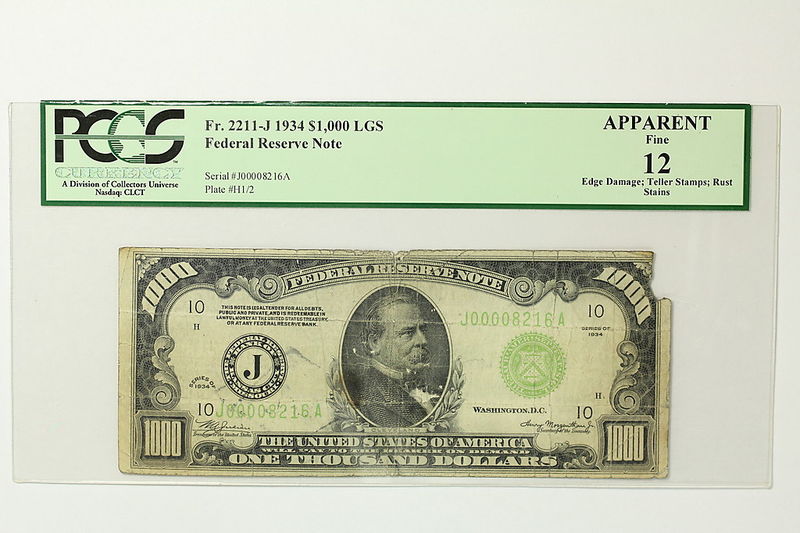 |
|
Pillar of the Community
United States
1582 Posts |
Okay guys, I googled up PCGS Currency, and found the answer to my question - sharing it with y'all. -
"Notes that have major faults such as tears, splits, holes, missing pieces or have been subject to major restoration, such as repaired tears or splits, redrawing of the design, bleaching of the paper, or even reconstruction of missing pieces, will be assigned a "problem note" designation. Such problems will be noted on the grading label. In these cases we will assign an "Apparent" grade followed by a brief and concise description of the problems or repairs. The "Apparent" grade will equate to what the note would have graded without the mentioned problems. For example, "Apparent VF30, bleached and starched" might be a description of a problem note, as might "Apparent XF45, upper-right corner restored". No net grade will be given."
So.....to me, a graded bill with "Apparent" on the holder should be avoided unless it is a very rare issue. Do you agree?
|
|
Rest in Peace
United States
9104 Posts |
Quote:
So apparently this bill would grade VF20 if not for the stains, rips, tears, pin holes and the burned corner that has been taped?
Yeah, and CU65 if it had never been folded, creased, dirtied... Quote:
VF: An attractive note [we can stop right there], but with more evidence of handling and wear. May have a number of folds both horizontally and vertically.
Paper may have minimal [!] dirt, or possible color smudging. Paper itself is still relatively crisp [like where it's burnt to a crisp?] and not floppy.
There are no tears into the border area [!], although the edges do show slight wear. [!] Corners also show wear, but not full rounding. [three corners completely gone]
Fine: Tears may not extend into the design. [!]
VG: ...tiny nicks, tears may extend into the design...
Good: No large pieces of the note may be missing [!]
Fair: Large pieces may be half torn off or missing...
Poor: May have tape holding pieces of the note together.
--Std Cat, page 2. This is the ultimate example of market grading. New Mexico is one of the toughest states, so rather than grade the note poor, which it is, they grade it vf to indicate it should bring vf money. A big problem with that is we now know we can't trust a vf note to be better than poor condition. Smaller problems: Anyone who knows absolutely nothing about paper money scarcity isn't going to understand market grading, either, so they're not helping neophytes. Anyone even vaguely familiar with nationals knows this is a rare note, and doesn't need any "help" determining its value. |
|
Rest in Peace
United States
9104 Posts |
Quote:
"Wow! Very Fine 20 Apparent - and, what does Apparent mean in regards to the grade?" Not difficult, really, what do you call a child who has a pparent? |
|
Rest in Peace
United States
10625 Posts |
The Bill Collector - You did not detect the sarcasm in my reply. I should have followed it with a  I totally agree this was a flub by PCGS. |
|
Valued Member
United States
486 Posts |
"The Bill Collector - You did not detect the sarcasm in my reply. I should have followed it with a I totally agree this was a flub by PCGS" Now I understand Dave, but it's a shame the way some of theses TPG's try an change what a notes grade really is, and then want to get paid as "experts". Now it seems that they have "invented" a new way to grade, if I understand what biggfredd is saying, they now have "market grading", that's a new one for me. I'm guessing the way it works is if a note is somewhat "rare" it gets a higher grade no matter what the real condition of the note or paper is. I'm so thankful that I learned to grade for myself and I don't need guys like them. Things like this can not be good for a beginning currency collector. Regards The Bill Collector Edited by The Bill Collector
01/20/2012 5:29 pm
|
|
Rest in Peace
United States
9104 Posts |
Quote:
Now it seems that they have "invented" a new way to grade, if I understand what biggfredd is saying, they now have
"market grading", that's a new one for me. It stared with slobbed coins. Here's an au58 coin that is so attractive that it should bring a ms63 price, so rather than grade it correctly and let the market price it, they grade it ms63. |
|
Page 2 of 2
|
Replies: 20 / Views: 3,457 |
Page 2 of 2
|





 First Page


 Posted 01/18/2012 3:59 pm


