| Author |
 Replies: 18 / Views: 2,442 Replies: 18 / Views: 2,442 |
Page 2 of 2
|
|
|
|
Bedrock of the Community
United States
20753 Posts |
Odd that in the Red Book it states that the Mint Mark should be below the Eagle. Directly below. |
|
Pillar of the Community
United States
3640 Posts |
Looks to be just a die chip.
|
|
Pillar of the Community
United States
7842 Posts |
I tried to attribute the "dropped digit in dentails" when I submitted my 20 Cent Piece through ANACS, it did not fly, but it appeared to be part of the "7" or "5" of 1875. Yours does "appear" to be rounded like the "8", but...  Edited by oih82w8
07/30/2012 10:26 am
|
|
Bedrock of the Community
United States
17884 Posts |
That is the top of an 18 down there in the denticals. Personally I think his price is very reasonable.
On the second coin that might be the top of a 5.
|
|
Bedrock of the Community
United States
10045 Posts |
 the OP's coin is clearly an MPD--these were plentiful in IHCs of this era; it's guessed it was done to check die hardness. I'm not sure what premium this merits. |
|
Valued Member
 United States
54 Posts |
MPD. Misplaced date? Plentiful sounds like no real premium.
|
|
Bedrock of the Community
United States
10045 Posts |
I don't know the demand...this one isn't in my Cherry Picker's Guide.
|
|
Valued Member
United States
203 Posts |
I was almost thinking that this one is an S over S just by how mushy and elongated that S looks.
|
|
Valued Member
United States
54 Posts |
slow: I didn't think about that... again I don't think I've ever seen and S/S on a 20c before either.
DV: I checked mine as well. Nothing. Maybe I could contact that seated liberty club, and see what they say.
|
|
Pillar of the Community
United States
1432 Posts |
I checked mine. Something in the denticles but doesn't seem to be rounded enough to be the top of an 8. Also the M/M is in the same location, just not as mushy. 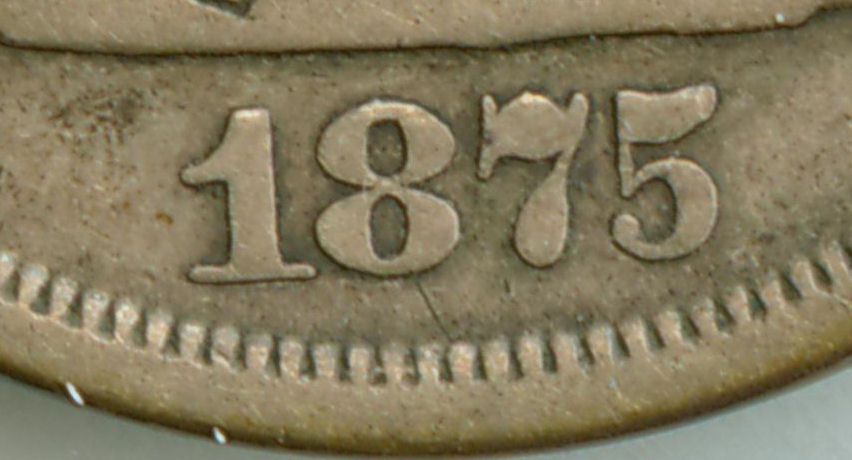 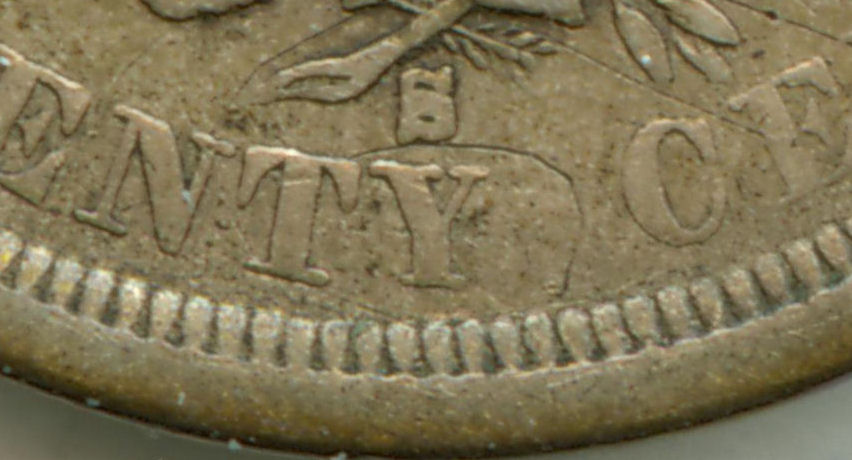 |
|
Pillar of the Community
United States
7842 Posts |
There were a couple different S/S on the 1875 Twenty Cent Piece. Mine is the obvious version, but there are the "$" dollar sign, and a mushy one as well;  |
|
Bedrock of the Community
United States
10045 Posts |
Jeffrose--that could be an MPD too. A denticle may be hiding the curve. As I said--there were a lot of problems with die hardening in the 1870s, and they did a lot of hardness tests in the denticles. The more dramatic the MPD, the more the interest and premium. Here is a very dramatic example on an IHC--every one of those ridges crossing the denticles is an MPD.  |
|
Valued Member
United States
203 Posts |
My thinking was that it looked similar to jeff's, but a much more squashed MM. It looks very elongated compared to a normal plain S. I have seen one or two posted on here, but never as smashed looking as that one.
|
|
Bedrock of the Community
United States
17884 Posts |
Quote:
As I said--there were a lot of problems with die hardening in the 1870s, and they did a lot of hardness tests in the denticles. It should be understood that these tests were actually done on the edge of the unhubbed die and not in the denticals themselves. After the die was hubbed it would be put on a lathe and the diameter turned down to the proper diameter. The date traces are from where the tests got in a little too far from the edge and they overlapped the area where the denticals were later impressed. Of course this does not explain those MPD which are found closer to the center of the die in the devices themselves. All I can suppose is that they thought that traces of the tests would be wiped out by the hubbing. One thing I find interesting is that the MPD's are always down close to the area of the date. If it was just hardness testing I see no reason why they would always take care to make sure that test area was in the press so the date would be in that same place. I suppose that the reason that all the MPD are in the actual date area is because that is the natural place where everyone looks for them. I think in the future eventually MPD's will be discovered in the denticals in other areas around the edge coin. |
|
Bedrock of the Community
United States
10045 Posts |
Quote:
It should be understood that these tests were actually done on the edge of the unhubbed die and not in the denticals themselves. Honestly, I have never heard Rick Snow or others describe it this way--what is the source? Per Rick Snow's books, my understanding is the hardness tests were performed during hubbing, not die blanks--and making a test impression in the denticles strikes me as a good place to test. Quote:
I suppose that the reason that all the MPD are in the actual date area is because that is the natural place where everyone looks for them. Rick Snow and the IHC variety collectors look everywhere for these MPDs. The majority are found in denticles, but a few are found in other hubbed areas of the design, such as the neck, the pearl necklace, and the truncation of the diamond ribbons--areas where hubbing would obliterate prior marks. Here is an example of a multiple MPD. Clearly the intention was to hide the bases of the "1" in the necklace area; the 1882 Snow-6.  Edited by DVCollector
08/01/2012 4:58 pm
|
|
Page 2 of 2
|
Replies: 18 / Views: 2,442 |
Page 2 of 2
|







 First Page

 Posted 07/30/2012 10:10 am





