| Author |
 Replies: 19 / Views: 5,193 Replies: 19 / Views: 5,193 |
Page 2 of 2
|
|
|
|
Pillar of the Community
United States
3253 Posts |
Until very recently, all we could say was that the Fugio design was attributed to Benjamin Franklin. No one could say for sure until numismatist extraordinaire Eric P. Newman found these sketches among Franklin's own papers: 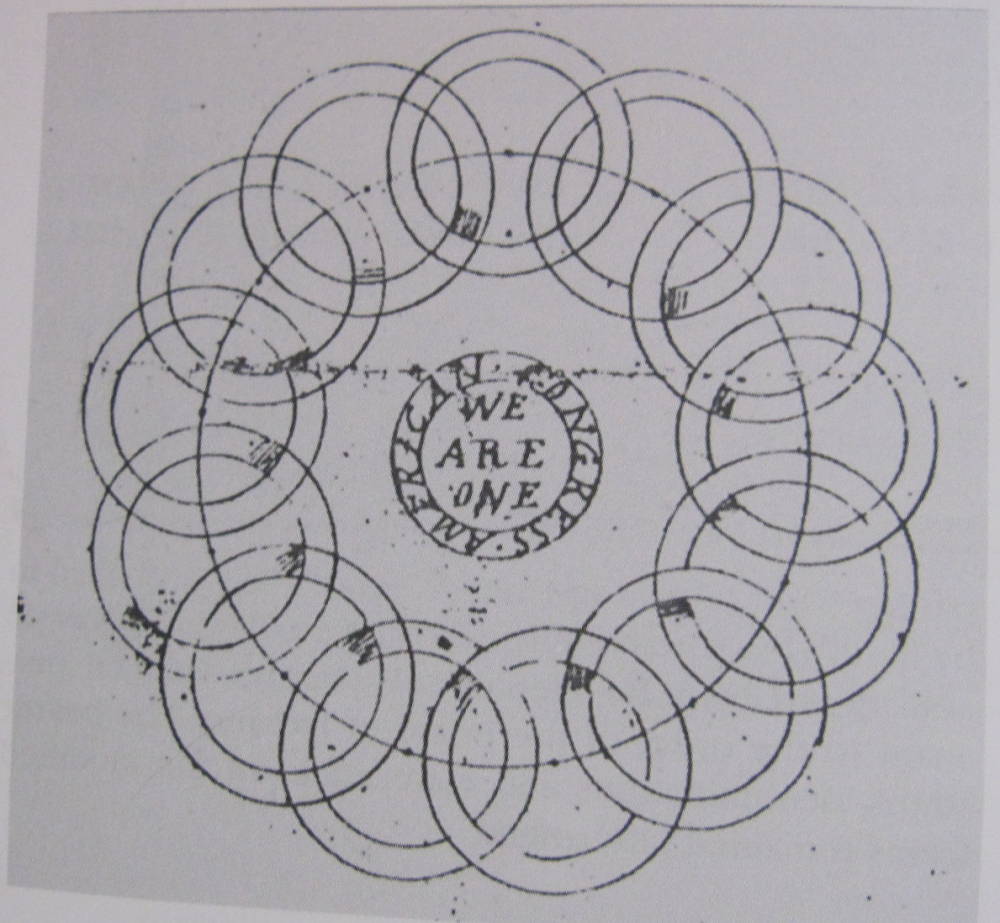 I like to picture Franklin locked in his study with his compass and protractors, and a bottle of Madeira, trying to geometrically plot out thirteen evenly-spaced rings. Newman's book on the Fugio coppers is really incomparable. He wrote the first treatise on them in 1949, then revised it... in 2008! The man just turned 101 this year! |
|
Pillar of the Community
United States
917 Posts |
As per your request here's my Fugio. Its a Newman 7T R4. I cant think of another coin that has so much history attached to it. They are extremely difficult to find without any damage and of course when you do they are a gazillion dollars. 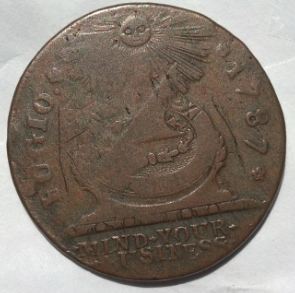 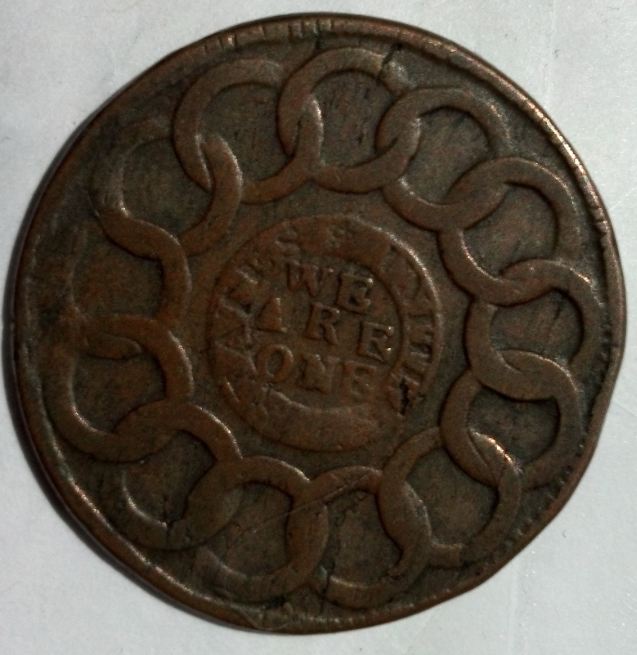 |
|
New Member
United States
4 Posts |
I am a Fugio copper enthusiast. With patience it is not difficult to find a relatively problem-free Fugio copper in mid-grade. There are numerous die combinations that are not rare and which can be found in mid-grade. The best place to find one may be at a coin show.
|
|
Pillar of the Community
 United States
2366 Posts |
I love old copper and have a couple of Connecticut colonials - see my avatar. I'm very interested in Fugios but with decent detail they always seem to be beyond my budget. I'll keep looking because the 'hunt' can be the best part of collecting.  Member ANA and EAC "You got to lose to know how to win". Dream On by Aerosmith |
|
New Member
United States
4 Posts |
It is very difficult to explain how to find material at good prices. The coin hobby and business is highly competitive. Read the book before you buy the coin is sound advice.
|
|
Pillar of the Community
United States
2077 Posts |
Interesting that UNITED STATES is inset. This would be difficult to put into the die without hubbing it, but I thought that technique came about much later.
|
|
New Member
United States
4 Posts |
Even more interesting is the "Z" or Z.1 or KN Z.1 reverse which served for the earliest Fugios: 1-Z ; 12-Z; 19-Z.
In high grades, it appears that UNITED STATES as well as the fascinating ornamentation both are engraved by hand.
How these dies were prepared is beyond my comprehension, but they are very complex, certainly more complex than any large cent.
|
|
Pillar of the Community
United States
3253 Posts |
The incuse "UNITED STATES" on the band was indeed on the hub, and not added separately to each die. Those letters, the band, and the rings are all identical for the largest proportion of Fugios; a reverse die only became unique when the letters of WE ARE ONE were punched in. The position of UNITED STATES was just a matter of rotation. The die puncher just had a problem turning the image around in his head, and most of the dies rendered coins reading STATES UNITED.
|
|
Bedrock of the Community
United States
17884 Posts |
Quote:
Interesting that UNITED STATES is inset. This would be difficult to put into the die without hubbing it, but I thought that technique came about much later. Not hub but a created punch. It would be easy to create a punch of the raised ring. The letters for UNITED STATES would then be punched into this ring and then the punch hardened. Now when it comes time to make the die this punch is pressed into the center of the die face. That gives you an incused ring with raised letters in the die. The circle of linked rings would be another punch and the letters of WE ARE ONE would be punched in individually. Abel Buell was experimenting with hubbing in the 1780's with some of the Connecticut dies. The US mint tried some experiments in 1794 and more extensive experiments in 1798 to 1800 with hubbing full dies but not with great success. Hubbing of full dies did not come to be the accepted practice until 1836. Edited by Conder101
10/22/2012 2:59 pm
|
|
Pillar of the Community
United States
3253 Posts |
Eric P. Newman seems to feel there was a hub. From his "United States Fugio Copper Coinage of 1787:" Quote:
The hub already had UNITED STATES incuse on the band, and the rings had no upside or directional indication... Physical evidence supports this conjecture as well, in that the hub seems to have had a defect on one of the rings, that was transferred to the dies. Please refer to the descriptive pages for varieties 1-L, 4-E, and 11-A (which represent the three different positions of UNITED STATES) where the defective ring is noted. When each of these rings is aligned, the words UNITED STATES will be as well. Meaning, over a broad series of dies, the rings and central band are all in the exact same position, suggesting a hub, and not punches. |
|
New Member
United States
4 Posts |
The "Z" reverse differs from all other production reverses. It is called the "raised rims reverse. It is more complex than the other reverses and requires a different explanation of its production.
|
|
Valued Member
United States
113 Posts |
My one example, bought from Q. David Bowers about a decade ago, this is the common 4 cinq variety, PCGS AU-50. They are a neat piece of history!   |
|
Pillar of the Community
United States
1510 Posts |
un- - real thanks Erik
Retired USAF 1983-2003
|
|
Moderator
 United States
16709 Posts |
Great coin! A later die state example, boldly struck. An AU55 coin IMHO.
swcoin.ecrater.com
|
|
Pillar of the Community
United States
3253 Posts |
Very pretty! Newman 8-B, right?
|
|
Page 2 of 2
|
Replies: 19 / Views: 5,193 |
Page 2 of 2
|





 First Page


 Posted 09/09/2012 11:06 am


