| Author |
 Replies: 21 / Views: 2,378 Replies: 21 / Views: 2,378 |
Page 2 of 2
|
|
|
|
Pillar of the Community
United States
2284 Posts |
Coin thickness varies from year to year and is dependent on striking characteristics and upsetting primarily. Weight is determined by size and strip thickness which does not vary from year to year (normally).
Time don't fly, it bounds and leaps.
|
|
Valued Member
United States
169 Posts |
nope...I can try that tomorrow though
|
|
Member
United States
3242 Posts |
I know that since 1999 the copper coat over zinc has been made thinner and added more zinc to keep the weight up to 2.5gm to cut cost of copper  I know you can stack 50 1998 next to 50 1999 and see an difference  |
|
Valued Member
United States
383 Posts |
quote:
Well the 82's weight 2.5 grams and the 2007 weight is 2.5 grams so to tell you the truth I just don't know that is very interesting Gary
Bruce.
Actually Bruce it is 3.1 grams for the '82. He said 1982 copper but I do not know if that should effect the thickness. |
|
Valued Member
United States
169 Posts |
Diameter test: 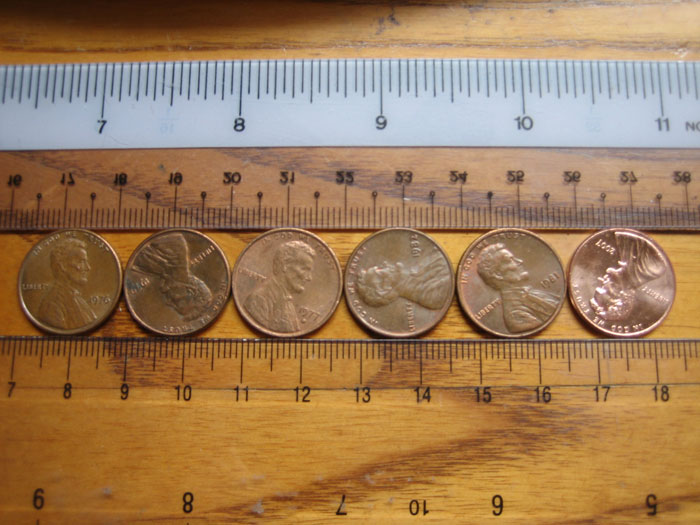 Doesn't seem like much difference. I think the pre 1982 coppers are also less uniformly thick compared to the 2007s. Not sure if that should affect the average thickness much. I stacked 4 2007s next to 4 2006s (all I have left...) and they seemed about the same. |
|
Member
United States
1154 Posts |
Could it be that older cents have more wear? making them smaller?
|
|
Valued Member
United States
169 Posts |
how to explain that the 2007 ones are thinner then? :)
|
|
Valued Member
United States
383 Posts |
I have a digital micrometer and a bu roll of '82 copper cents. I'll check some this weekend for thickness.
|
|
Valued Member
United States
169 Posts |
cool... I know the engineering labs have calipers, but I don't think I can borrow one to measure coins, haha
|
|
Pillar of the Community
United States
2284 Posts |
The coating on the zinc is just about as thin as it can be and still cover the core.
Again, coin thickness varies from year to year based on striking characteristics. This can vary dramatically from year to year. There is even a little variation within a year and in the last few years there has been some variation between mints.
The only significant change in recent times was a 1% reduction in strip thickness for 1999 and later quarters. This was within tolerance for weigh and they might have puched the blank slightly larger to compensate for the weight discrepancy though this information is not yet available.
Time don't fly, it bounds and leaps.
|
|
Valued Member
United States
383 Posts |
I don't think I even use these once a month but there nice to have around. A micrometer and scale.  I saw no real appreciable difference between the 1982 BU copper cents I have and the Zincolns I compared them to. There was alot of variation within the same coin around the rim, but nothing consistant from the copper cents to the zinc. |
|
Valued Member
United States
382 Posts |
I've noticed since 1982 with the 'zinc ' introduction thinner cents.it interested me, because after re-rolling searched rolls i'd have to add a cent to get the count right ,;according to the a hand held; roll coin counter I was using,. well after some double and triple checking it was and is indeed to the stack height difference.which is how the counter works "stack height "a roll of post '82 uncirulated cents will be shorter than say a roll from '81. by one cents thickness in a 50 'stack' count stack.now some math;say, I've searched approximately 600,000 (post 1982)thousand cents divide by 50 (per roll)12,000 rolls. at one cent per roll loss it would have cost me $120.00 .. P.S. i'am glad I noticed cause using a hand held counter allows me to easily /and speedily re-roll empty (rolls).just have better things to do than give the bank "more" of my money.when I un-roll coins, I do so carefully; as not to tear the 'bank rolls' so I can reuse them.
|
|
Valued Member
United States
169 Posts |
errorfinder... I can't even imagine going through that many cents :)...I hope you found some awesome errors, haha.
|
|
Bedrock of the Community
United States
20753 Posts |
I'm a rather pesimist when it comes to our government release of statistics. That being said I highly doubt that there is a great quality control at our Mint varifying the thickness and composition of the matalic sheets they make our coins from. You must remember they do not make the metalic sheets, they buy them and any organization that is famous for paying hundreds of dollars for a hammer just can't be trusted. I've weighed numerous brand new cents over the years with a few scales that are accurate to 0.001 Grams and have a problem aquiring that famous exact government released weight of 3.11 Grams per cent. I'm sure the thickness as well as the weight varies and they don't care. Even if you could prove that numerous cents are different from what they say, what are you going to do about it and they no there is nothing you can do. If the cents came out ten times normal size, the mint would just say your in need of glasses. Especially ones with Martinis in them.
|
|
Bedrock of the Community
United States
17884 Posts |
Yes the coins vary and "thickness" is a function of the striking pressure. The greater the striking pressure the thicker the coin and the taller the stack. But since 2002 the striking speed has increased greatly which has meant lower relief and with it lower rims because there was less time for the dies to fill, which once again can result in thinner coins
|
|
Page 2 of 2
|
Replies: 21 / Views: 2,378 |
Page 2 of 2
|





 First Page


 Posted 03/15/2007 02:16 am





