| Author |
 Replies: 17 / Views: 4,492 Replies: 17 / Views: 4,492 |
Page 2 of 2
|
|
|
|
Bedrock of the Community
 United States
12927 Posts |
Interesting info, currencyden!  |
|
Bedrock of the Community
United States
94367 Posts |
|
|
Moderator
 United States
196778 Posts |
Very interesting! |
|
Pillar of the Community
Canada
2646 Posts |
 & just 1 of the many reasons I enjoy collecting currency. Even the older series's security features are fun to explore. In fact, I have seen some bogus notes printed for the 2004 upgraded Journey $20 (& other denominations). One thing that I found was surprising is that the fake's serial number font was off/all wrong. Prefixes were incorrect & often a couple fakes will have the same # (I guess just copies meant to fool a few people at a time). You would think after they went to all the trouble of duplicating most of the design elements, they'd try a bit harder to get the SN right (a rather old simplistic security feature). |
|
Bedrock of the Community
United States
12927 Posts |
Quote:
just 1 of the many reasons I enjoy collecting currency. Even the older series's security features are fun to explore. Amen! it's very interesting to see how technology has progressed over the years as governments try to stay ahead of the counterfeiters. |
|
Valued Member
United States
64 Posts |
So, what security features are the most used? 1 SICPA Spark - It appears on at least 350 banknotes or about 25% of ALL banknotes. 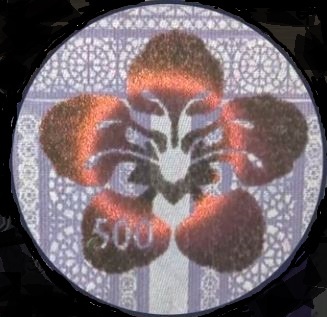 2 Crane Motion/Rapid/Surface on at least 150 Banknotes or about 11 % of ALL banknotes.  3 G&D Rolling Star appears on 50 banknotes or about 4% of ALL banknotes. 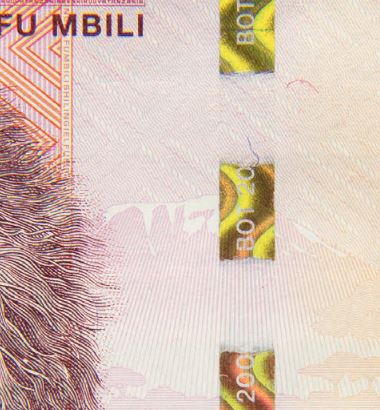 |
|
Valued Member
United Kingdom
150 Posts |
Early Irish notes from 1928-1977 had small asymmetries in the designs which presumably are security features. Each denomination had three such marks on the face. Illustrated is one of the marks on a £5 note. The notes were printed by Waterlow. 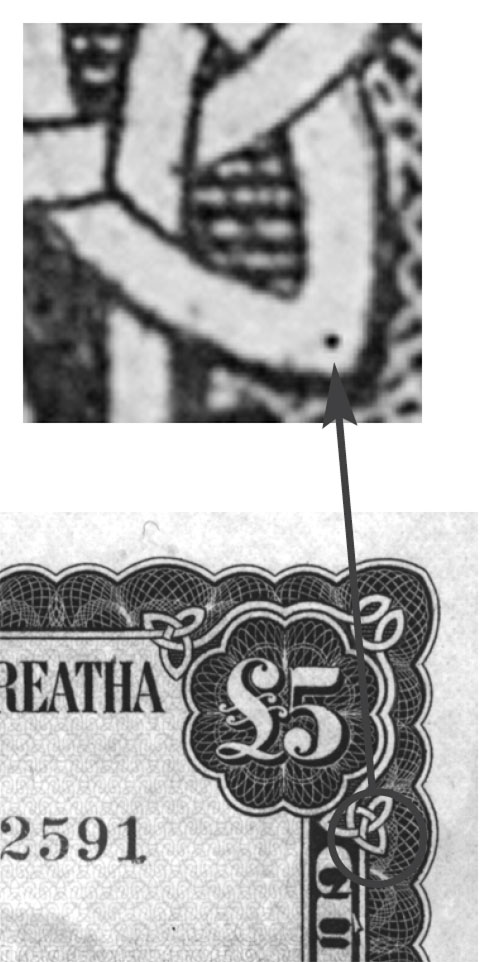 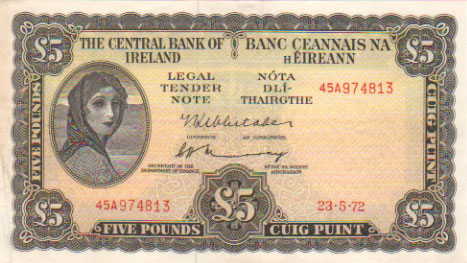 |
|
Moderator
United States
196778 Posts |
Very interesting! |
|
Valued Member
United Kingdom
150 Posts |
Yes! When someone first reported one of these marks back in the 1990s, we were all looking at notes with magnifying glasses to see if we could find others! Happy times, making new discoveries on old notes.
I have not found mention of them in any older literature. It is the sort of thing that would have been reported at the time in a magazine like Irish Numismatics.
|
|
Pillar of the Community
Canada
2646 Posts |
Quote:
Early Irish notes from 1928-1977 had small asymmetries in the designs which presumably are security features. -Interesting & certainly an inexpensive option. Did you find that the Central bank of Ireland state that this was actually a security feature used (or was this from simple observation)? From our Charlton catalogue it states that "Howard Smith bank note paper was used, in which green planchettes were embedded as a security device." These were a fairly efficient, inexpensive (uncomplicated) device which has been described on page 201 of the 31st Edition of Charlton (2019). They look like these 3 little green dots on border of this 1935 initial Bank of Canada $2.00 banknote. You can also see fainter (smaller ones) in the design above "The" & on Queen Mary's choker styled necklace: 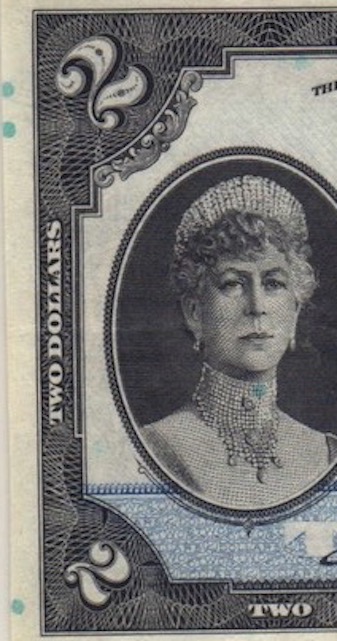 Edited by walk2dwater
11/10/2021 6:27 pm
|
|
Valued Member
United Kingdom
150 Posts |
Quote:
Did you find that the Central bank of Ireland state that this was actually a security feature used (or was this from simple observation)? No. We spotted them from observation, thought it was a minor printing error initially. But after checking a few hundred notes spread from 1928 to 1977 we found the same markings on every note. More research is needed on this, to look at other notes printed by Waterlow in the 1930s to see if similar features are present. The Irish Consolidated (Ploughman) notes also had a security feature of fibres down the center of the paper, peculiar to the 1930s, which are found on Chinese notes of the era among others. |
|
Valued Member
United States
64 Posts |
Several Germany notes between the wars used copious amounts of fibers, all on one side of the note. 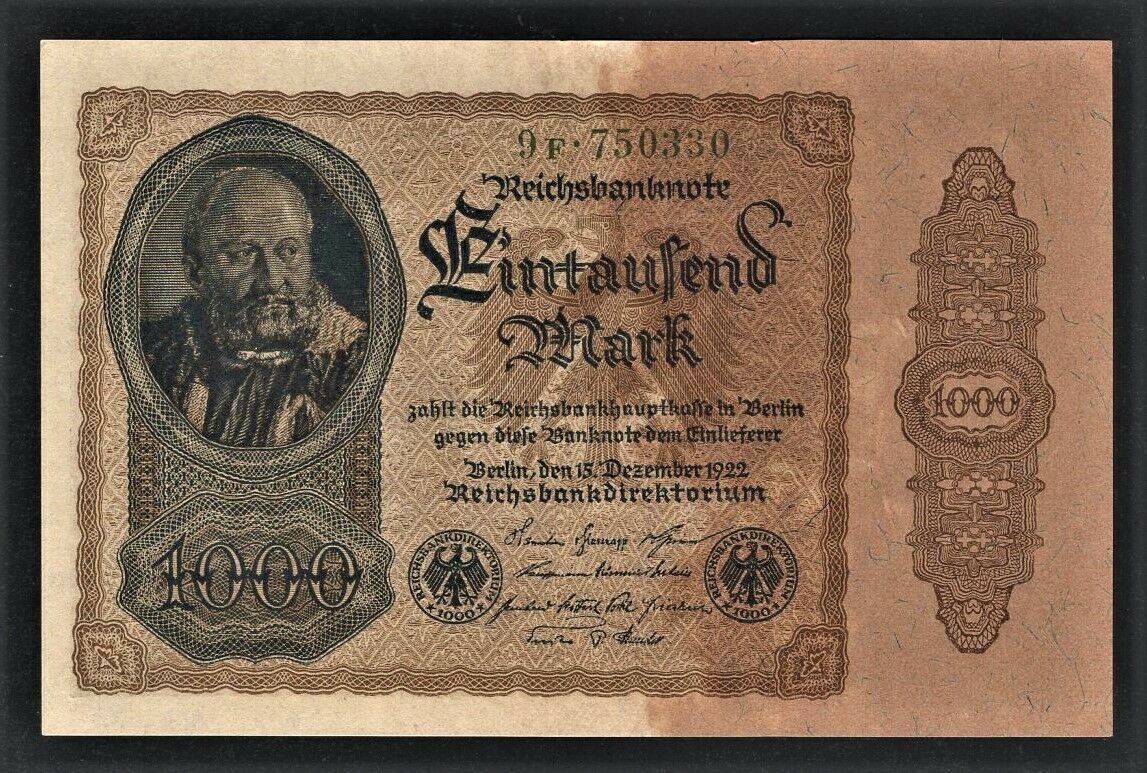 |
|
Moderator
United States
196778 Posts |
Quote:
Several Germany notes between the wars used copious amounts of fibers, all on one side of the note. Nice example! |
|
Valued Member
United Kingdom
150 Posts |
Here is an example of an Irish note which uses the type of fibres in the paper you refer to. This one has the fibres in a strip down the centre of the note. 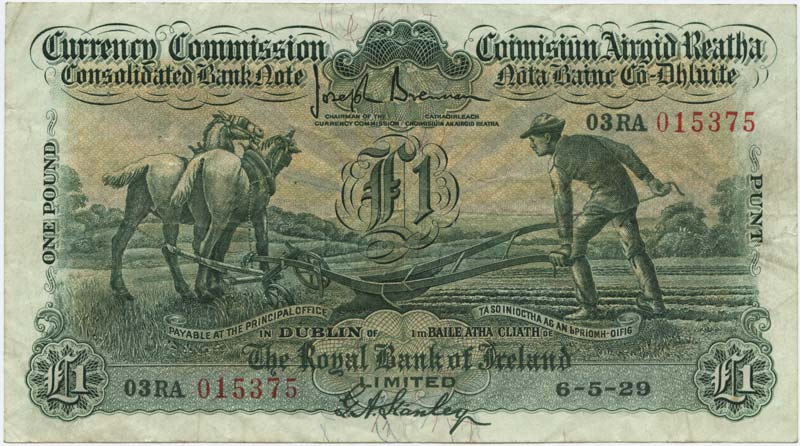 |
|
Moderator
United States
196778 Posts |
Very nice! |
|
Page 2 of 2
|
Replies: 17 / Views: 4,492 |
Page 2 of 2
|




 First Page


 Posted 05/13/2021 10:57 am





