| Author |
 Replies: 24 / Views: 3,504 Replies: 24 / Views: 3,504 |
Page 2 of 2
|
|
|
|
Pillar of the Community
United States
3486 Posts |
I watched this yesterday. Had to force myself.
What bothered me was the carefree attitude of narrator.
He made it sound as if one could do no damage at all.
During the 'cleaning' process he spoke, and as he did his breath could reach the surface of the coin.
What affect that could have over time is an open question.
To clean a coin is a gamble, and the odds are not favorable.
I do not like 'milk spots' either, but I am not about to break open a 1964 Proof Set to remove the spot from a dime.
Still, we must bear witness to unpleasantness and educate one and all to the pros and CONS on such a procedure.
|
|
Moderator
 United States
23522 Posts |
Keep in mind, the sharpest knives in the numismatic drawer have been trying to solve these milk spots for years, and the only way we know to this day is to grind them off the surface of the coin. This video is proof of that.
|
|
Pillar of the Community
United States
1373 Posts |
I think I've seen similar videos from the same guy and all I can say without being rude is "GOOFY".
On the plus side, this time he's not cleaning a coin; just some bullion. However, he's already lowered the value by cracking open the slab, then (I belief) also de-graded the item with the cleaning. Yes, it's not as bad as using steel wool or 'dipping' it, but some marks were left. Also, as stated before, the milk spots will come back in time.
|
|
Bedrock of the Community
United States
17884 Posts |
Quote:
Also, as stated before, the milk spots will come back in time. Even of they don't the hairlines aren't going anywhere. |
|
Pillar of the Community
United States
4132 Posts |
You can actually see the hairlines in the video (particularly in the fields to the left of the bust), which is remarkable given the blurriness of the footage. If he can't see them, his eyesight must be pretty bad.
|
|
Valued Member
United States
324 Posts |
The jewelers cloth is not abrasive and the milk spots are gone. He says his eyes are better and there are no scratches. Dipping it will not remove the milk spots, right? Is it so bad to improve this bullion style proof coin? It has little if any numismatic value so why not remove the milk spots if the result is not any polishing lines? He also said he removed the "other little stuff" and there is no evidence of it. So you can have a bullion piece with milk spots or do something about it. Is the jewelers cloth treated with anything?
I certainly understand all the commotion trying this with something proof of numismatic value like an older proof set. That's not the question here. That's beside the point.
Edited by BluegrassRiver
03/19/2015 5:41 pm
|
|
Pillar of the Community
United States
1391 Posts |
Quote:
The jewelers cloth is not abrasive and the milk spots are gone. You may want to rethink that one. Even rubbing a MS coin like that will leave hair lines, jewelers cloth or not. The milk spots are little bits of corrosion, those get lodged in the cloth and then are smeared back and forth over the surface of the coin, leaving the abrasion marks. Now on an older circulated coin it would probably be harder to see, but a coin like this with nice surfaces, it will show in the light (or probably in a camera photo). The funny thing is that these bullion pieces may hold more value in the long run than a lot of older proof sets. The mintage on these are lower and if they ever catch the eye of the public (it seems like a lot of people are ignoring them now) there won't be as many to go around and I can see there being a numismatic premium on some of them. Edited by allranger
03/19/2015 5:44 pm
|
|
Moderator
United States
23522 Posts |
Doesn't matter. Anything including the word "cloth" instantly trashes a Proof the moment it touches it. Just take the result out into bright sunlight. You'll see. And jeweler's cloth is going to contain something jewelers consider non-intrusive but it's lethal to original-surface coinage.
Like I said. Far better men than I can't figure a way, and the video is proof.
|
|
Pillar of the Community
 United States
1839 Posts |
It's actually not a proof, it's an MS69PL (PCGS cert # 19582098). PCGS guide price is $340, however they regularly sell for about $200 to $225. Melt on it is only $81 so for those saying who cares it's only bullion, nope this one has (or rather had) numismatic value well above melt. 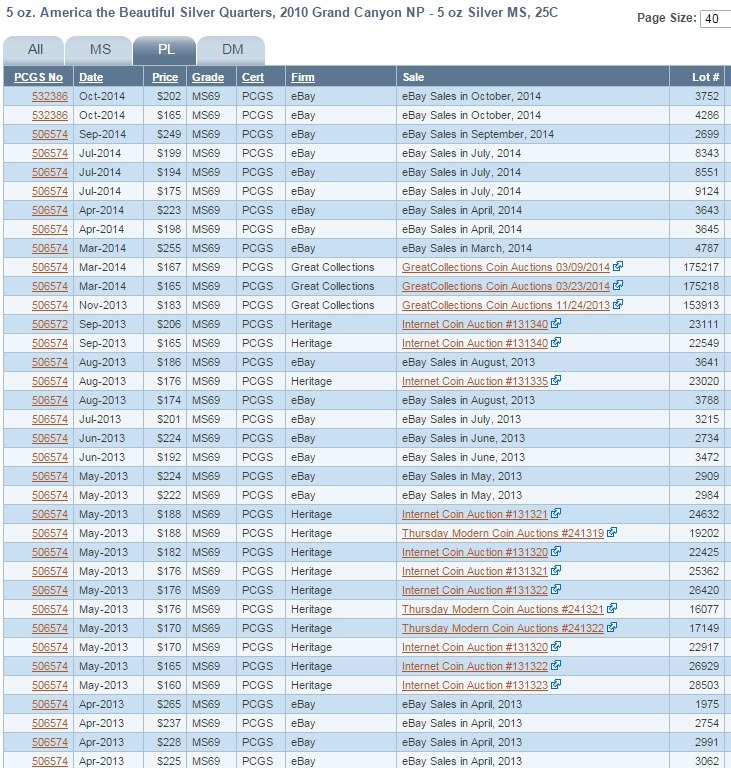 Edited by Tbone
03/19/2015 6:19 pm
|
|
Moderator
United States
23522 Posts |
That makes sense with the coin's appearance. MS69PL would be a ridiculously beautiful coin but not necessarily frosted. All the same, in near-fleur de coin Prooflike condition a Business Strike is going to take the same relative damage as a Proof.
|
|
Valued Member
United States
324 Posts |
Tbone, that's a very interesting chart, thanks. I had no idea those sold for that much more than melt. Now, I noticed you used dates about 6 months old when silver was about $18. This example also has the "coveted" First Strike designation.
|
|
Pillar of the Community
United States
1839 Posts |
That chart comes from PCGS CoinFacts. I'm thinking they don't have more current auction data to add yet.
|
|
Pillar of the Community
United States
7379 Posts |
I could say a lot about the video, but the first thing that struck me was that he almost scratched the blazes out of it when he was beating it out of the holder.
I guess they're his coins, so he can do wha............
|
|
Pillar of the Community
United States
6478 Posts |
All of the comments on the video hurt my soul.
|
|
New Member
United Kingdom
26 Posts |
Make sure my mother dont see this video,she'll be on my coin's like a fly on poop.
Can I just ask if what he just done have an impact on the value?
And would you be able to tell its been polished slightly if you came across that (for eg) coin?
|
|
Page 2 of 2
|
Replies: 24 / Views: 3,504 |
Page 2 of 2
|







 First Page


 Posted 03/19/2015 12:05 pm


