No, it is correct. Without shift, the image you see is of only a part of the coin. If you point the camera at the coin, it will have a tilt and will be slightly distorted-looking due to the tilted perspective.
It's easier to understand this concept in terms of architectural photography. If I stand near the base of a building, and look at the building, the parallel lines of the building will appear to have parallax due to converging perspective. This is the natural look of the building from my vantage point at the base of the building. I can take a picture of the building and I will see exactly the same converging perspective. If I don't like this look, I can do one of two things to fix it:
1) I can go into photoshop and stretch the image in a trapezoidal fashion. Stretching the top of the image such that the top of the building has the same width as the bottom. This will make the vertical lines of the building look parallel. I am sure photoshop has canned alogorithms for doing this.
2) I can point the lens straight toward the building, and shift the lens or the sensor so that the building comes into view.
Both of these actions result in a similar (though not exactly the same) final image. Both actions cause the natural, converging perspective view of the building to be stretched such that the converging perspective is eliminated, and the parallel lines appear parallel. Stretching the converging perspective view is a distortion of the natural image of the building.
edited to add: as Rik pointed out in the other forum, I could also use a large format camera, and a wide angle lens, and take the picture pointed straight at the building. The building would then be present in only ~50% of the image, so I could crop the rest and end up with essentially a shifted image of the building.
Contact me for photographic equipment or visit my home page at: http://macrocoins.com
Quote: However, the coin will indeed be slightly distorted in that it will be stretched due to the "sideways" perspective.
Is this distortion caused by the 3D surface of the coin? For example, as seen by the sensor, the highest points of the coin may shift away from the center faster than the lowest points. Also, sloping surfaces could change shape (or even get eclipsed) as you shift the coin away from the center.
Or, would this distortion also be seen in a perfectly flat target, like a USAF test chart?
rmpsrmps for the fourth time Please produce a diagram...... it is exasperating to have asked you for a diagram so many times and for you to not do so. Why have you ignored that request. If you haven't worked it out before now there is just no way I get what you are writing down.
You first diagram of shift coupled with your words seemed, and still does a major distortion of the laws of physics to me.
OK, see below. I was hoping to actually take pictures rather than a diagram, but this will have to do.
As I have said, the concept is easier to understand with architecture, but I have made the diagram showing the coin situation.
I have represented the distortion of the image taken with shift (versus the natural perspective) as a lengthening of the coin, but please realize that there is more than lengthening going on between these two techniques.
Contact me for photographic equipment or visit my home page at: http://macrocoins.com
ROF...... I see absolutely no "distortion" in either picture both are natural views taken from different perspectives! In your "natural" the sensor is tilted with respect to the subject. The result is not a distortion ( I now get what you are saying in that way).
Likewise in the shift there is also no distortion, shift has enabled the photographer to "change position" and produce an image ensuring the sensor and subject are parallel. This is what I understand by correcting perspective. You change the apparent viewing position
However once you have a digital photograph taken using your "natural" the only way you can get rid of the converging lines is to distort that particular image.
Shift on the other hand also produces a natural picture but the perspective is different and the converging lines ( because the sensor and subject remain parallel never occur)
The distortion you appear to referring to seems to me to an erroneous transfer of photoshop-think to an issue of composition
Quote: Shift on the other hand also produces a natural picture but the perspective is different and the converging lines ( because the sensor and subject remain parallel never occur
No, the picture is not natural. It is a distortion compared with the natural view. Or perhaps you have some sort of special eyeglasses? Do a side by side comparison and you will see they are not the same. Not sure why this is such a tough concept to understand! I was hoping a diagram (which you begged me for, and then laughed at) would help you but alas it did not.
edited to add: if you consider the shifted image as "natural", then how far can we take it and still get a natural image? Can we tilt? Can we use an anamorphic lens? Can we use a starburst filter? No, none of these are natural, because that is not what the coin or building looks like from the vantage point of the camera.
Contact me for photographic equipment or visit my home page at: http://macrocoins.com
No, the picture is not natural. It is a distortion compared with the natural view. Or perhaps you have some sort of special eyeglasses? Do a side by side comparison and you will see they are not the same. Not sure why this is such a tough concept to understand! I was hoping a diagram (which you begged me for, and then laughed at) would help you but alas it did not.
There is no need to start to get into personal attacks. You have gone this route before and it does you no credit. Read the edit. What you are saying is this to get an image, that has been taken with a perspective that has created converging lines, to look like a picture that has been taken with a perspective that does not have converginglines you have to distort that image Shift changes the perspective( apparent position the photograph was taken from) before the photograph was taken so there is no need to distort the image in Photoshop)
Quote: What you are saying is this to get an image, that has been taken with a perspective that has created converging lines, to look like a picture that has been taken with a perspective that does not have converginglines you have to distort that image Shift changes the perspective( apparent position the photograph was taken from) before the photograph was taken so there is no need to distort the image in Photoshop)
Yes, this is precisely what I am saying. But using shift to change the perspective is distorting the natural look of the object. Whether you distort the image after it is taken, or during taking with a photographic technique, it is still distortion, ie it is different from the way the object looks naturally.
My exasperated statements were in response to your apparent misunderstanding of the simple concept I created the diagram to explain, combined with your laughing at it. I consider laughing at someone, especially when you are laughing at something you requested, to be very rude.
Contact me for photographic equipment or visit my home page at: http://macrocoins.com
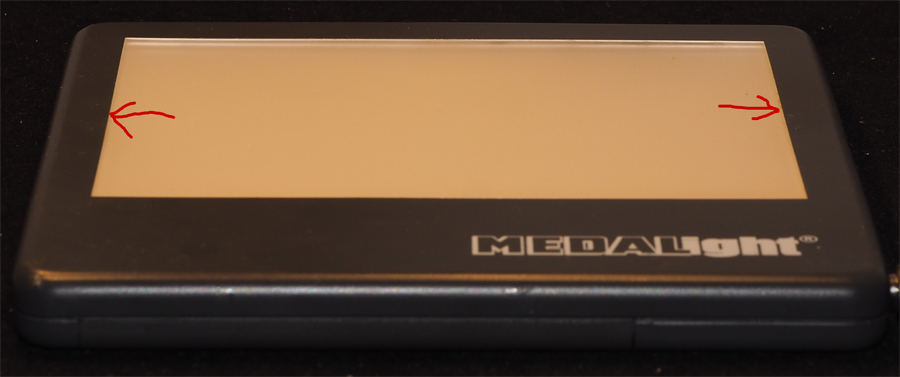
It should be obvious to everyone that itis extremely confusing for me to understand it your way. I find it a lot simpler and much more consistent with standard tilt shift terminology to refer to the process as "controlling perspective". Here is a shot of my back light taken in such away as to imitate the subject-sensor relationship indicated in you diagram of "natural".
I will not use the word distort in this part of my post to save confusion. you can see the white part of the back light makes a trapezoid shape. The 3D image of the medal light translated onto the sensor( which is tilted) as a trapezoid. The edges I have indicated are equivalent to converging verticals( imagine the back light as a building and I have lain on my back in the street to take the photograph of that building. This process would tilt the sensor in respect to the "building".
Now if I read your posts correctly; you regard those converging verticals as "natural" yet a coin in the same optical set up rendered as an ellipse would be distorted ( see next paragraph)
If it was a coin that I had imaged the coin would be translated into an elliptical shape. By my understanding of a number of different posts you have made in this forum (and once in this thread) you would not regard the elliptical rendition of the coin as natural. Perhaps I am wrong but my understanding from my reading of those other posts you appear to have referred to such an elliptical image of a coin as "distorted". In those other posts you talk about correcting the "distortion" ( your words; unless I read wrong) by either manipulation of the image in photo shop or using some form of tilt so that the image comes out circular.
Now I am sure you can see how I regard your approach to the same optical set up as being a significant contradiction. That being that you, as I have understood your posts, regard an elliptical image of a coin as distorted. Yet you do not regard the converging verticals, created by a sensor tilted with respect to the subject, as a distortion.
Now on your wording of shift distorting an image. It took a good work out at the gym. {BTW thanks the exasperation I had with this discussion appeared to translate into being able to raise the weights I was pushing up another 2.5-5 kg. I actually easily benched pressed 70kg((154 pounds) today} for my subconscious to work out what your, for me, complicated and too technical description of shift causing distortion:
I imagined using a medium format camera to image of coin the size of a cent. Placing that coin so that is on the edge of the field of view there will be some distortion when compared to a similar coin in the center of the field of view. In practical terms the amount of distortion is dependent on how flat the field of the lens is. and how far from the center of the field of view the coin is placed. With my rig and the lenses I now use ( based on my observations) that distortion has proved to be so negligible as to be practically unimportant. If I used a wide angle lens( without a flat field) with then the story would be very different and the distortion would be in practical terms unworkable.
In practical terms with the mamiya 120/4 macro the coin at the edge of the field of vies is not far enough away from the center of view to show noticable and easily measurable distortion. Likewise I have never had any noticable distortion with the Olympus Zuiko 1354.5 bellows lens.
{the oly 135 actually projects an image circle almost as large as the meduim format lens. I mount it on the mirex adapter via a maiya 645 67mm reversing ring, combined with the Oly extention tube made for that lens and a 67 mm adapter Raf camera made for me.}.
This imagining made me realize that the same distortion theoretically occurs across a coin imaged by a small lens even when that coin is place dead center. The center of the coin will not be distorted in comparison to the edge of that same coin. However, if the depth of field is sufficient and the lens has a flat field the distortion across the coin will have no practical effect.
As I noted the mamiya 120/4 I have works best at low magnifications( large depth of field). So the distortion you refer to has no practical implications. I hypothesize that at 1-1 and higher that distortion would be a concern. It may well be that the poor performance I observed at 1-1 might be due this distortion. This imagining of mine, if correct, would suggest that the 120/4 has a flat field.
AK...it seems we are in full agreement, except for the subtleties of "natural" and "distorted". Let me make a couple statements that may clear that up:
Any view of a coin can be considered natural. It could be straight-on, angled, looking at just the edge, etc. Hold the coin in your hand, look at it, and you are viewing it naturally.
Viewing the coin at an angle will cause it to appear oval shaped. This oval shape is natural. If you take a picture of the coin from this angled view, the coin would appear oval in shape just as it does when you look at it directly.
The goal of most coin photography is to present a straight-on, undistorted view. If the image of the coin is oval instead of round, then the image would be considered distorted compared with the goal, and this is undesirable. Thus the natural image of a coin taken at an angle shows undesirable distortion.
Several methods exist to adjust the natural image such that the coin will appear round. These methods modify the natural image of the coin such that it appears round. Shooting with shift technique is one of these methods.
The round shape is not what the coin looks like naturally when viewed at an angle, so this is not a natural image of the coin from the angled vantage point. It is however the desired, undistorted shape of the coin.
The stretching of the natural image of the coin to appear round is a distortion of the natural image.
The natural image (oval coin) must be distorted (stretched using some technique) so that the coin appears undistorted (round).
Edited to add: much of what I'm talking about can be gleaned from the links below:
Quote: Any view of a coin can be considered natural. It could be straight-on, angled, looking at just the edge, etc. Hold the coin in your hand, look at it, and you are viewing it naturally.
rmps this is what you just said. now a few posts back in response to your diagram with natural etc in it
I responded:
Quote: I see absolutely no "distortion" in either picture both are natural views taken from different perspectives!
You then stated that was incorrect these are your words
Quote: No, the picture is not natural. It is a distortion compared with the natural view.
I repeat: now you say this:
Quote: Any view of a coin can be considered natural. It could be straight-on, angled, looking at just the edge, etc. Hold the coin in your hand, look at it, and you are viewing it naturally.
BTW: I have been using Tilt/shift also referred to as PC ( for perspective control) for around three years my most commonly carried lens is the mamiya sekor C 35mm 3.5n with the Mirex tilt shift adapter. I had read those links a long time ago, and many other references.
AK...I stand by what I said, and it was consistent. The problem here is the subtle difference between a "view of a coin" vs a "picture" or "image" of a coin. If I hold a coin in my hand, or put it on a stage, and look at the coin, then it is a natural view. How could it be otherwise? I can rotate the coin, look at its edge, whatever I want to do, and the view will be natural when I look at it. I can then take an image of the coin by pointing a camera at it, and the image should look just like the coin does. The image itself is not distorted. However, if the coin is tilted, then the natural view of the coin, as well as the image taken of it, will look distorted vs the expectation of a flat view of the coin. You could say that the coin looks distorted, and take actions to fix the distortion.
Now, when you move the coin off-axis, the natural view would be only a part of the coin, which is not very satisfying, and the coin shows a bit of perspective distortion. If you shift the lens to bring the whole coin into view, this causes the coin image to distort slightly due to a change in perspective distortion, and it now appears undistorted. I hope this makes sense, though I do understand that it sounds confusing.
Contact me for photographic equipment or visit my home page at: http://macrocoins.com
rmpsrmps I finally read this ridiculous last post of yours do you realize that other have understood what I was saying and you avoided it. He it is. A coin photographed from an angle will be imaged as an ellipse. That is called key-stoning. You call it distortion that's fine. However you say that converging verticals (which is also Keystoning) is natural......That is the contradiction....You don't understand that converging verticals and a coin being imaged as an elepse are the same phenomenon.
For every one else. rmpsrmps's statement that shift is a for of distortion shows a complete inability to understand shift on rmpsrmps's side. Shift is a method of avoiding distrotion it is not a method of distortion: Please don't take my word for it watch this instructional video from Adorama Watch the section starting 9.10 through 11.00:
9TTB6hKxKzE
You can see quite clearly that shift avoids distortion.
Quote: rmpsrmps I finally read this ridiculous last post of yours do you realize that other have understood what I was saying and you avoided it. He it is. A coin photographed from an angle will be imaged as an ellipse. That is called key-stoning. You call it distortion that's fine. However you say that converging verticals (which is also Keystoning) is natural......That is the contradiction....You don't understand that converging verticals and a coin being imaged as an elepse are the same phenomenon.
Hmm, I thought we had hashed this out over on the other forum. The conclusion over there was that I was correct, and in fact the moderator who so violently disagreed eventually got it, and called what I was saying elementary (actually, kindergarten!). Funny what happens when the light finally comes on and you realize you've been on the wrong side of an argument.
You can ridicule anything AK, but that doesn't make you correct. In fact I do agree that the converging verticals and elliptical rendering of the coin are the same phenomenon, and it is called perspective distortion.
Quote: For every one else. rmpsrmps's statement that shift is a for of distortion shows a complete inability to understand shift on rmpsrmps's side. Shift is a method of avoiding distrotion it is not a method of distortion: Please don't take my word for it watch this instructional video from Adorama Watch the section starting 9.10 through 11.00:
I never, ever said that shift is a form of distortion.
You are just having a hard time understanding the very simple (kindergarten) concept.
Let's take this one step at a time, OK? If we can agree on a first step, then we can move to the next step.
Step 1) Distortion is a relative phenomenon. You can't look at a single image or view and say that it is distorted. You must have a second reference to work from. So something is always distorted in relation to something else.
Can you agree with this?
Contact me for photographic equipment or visit my home page at: http://macrocoins.com
Disclaimer: While a tremendous amount of effort goes into ensuring the accuracy of the information contained in this site, Coin Community assumes no liability for errors. Copyright 2005 - 2026 Coin Community Family- all rights reserved worldwide. Use of any images or content on this website without prior written permission of Coin Community or the original lender is strictly prohibited. Contact Us | Advertise Here | Privacy Policy / Terms of Use








 First Page
 Previous Page


 Posted 09/11/2016 11:13 pm


 ...... I see absolutely no "distortion" in either picture both are natural views taken from different perspectives!