| Author |
 Replies: 81 / Views: 10,067 Replies: 81 / Views: 10,067 |
|
|
|
Pillar of the Community
 United States
4051 Posts |
rocky...yes, some folks have astigmatism that is corrected by their eyeglasses. My latest prescription has zero astigmatism in both eyes.
|
|
Pillar of the Community
 Canada
2784 Posts |
ray thank you. I have been following this topic with great interest. I find for some reason it just does not work for me. I understand the theory but for some reason. when I try to do it tilt or shift. I does not work for me. I could be maybe going to far either way. I realize by following this topic you guys dont move things very far. that could be my problem. have a great one
|
|
Pillar of the Community
United States
4051 Posts |
Quote:
Wouldn't coins be the same? If you keep the sensor parallel with the coin, wouldn't the image be the same shape as the coin? Yes, it should be the same. If the lens coverage is good, and the lens is flat-field (most lenses we use for coin photography are), then the resulting image of the coin should be distortion-free. This is AK's point, though I do expect there is some amount of distortion present due to all requirements not being met, which is why I asked AK if he was sure his images were not distorted. However, this is NOT the distortion I am talking about. In order to use shift, the coin must be moved off-axis, and the lens or sensor shifted a conjugate amount. If instead of shifting the lens, you took the image of the coin in its shifted position by tilting the camera to point at the coin, it would appear distorted due to perspective. It may also have depth of field problems. This is similar to pointing the camera up at the building rather than straight toward it. This is the natural perspective of the coin/building. If you shift the lens, this natural perspective becomes distorted in such a way as to make the coin look un-distorted. Thus the process of shifting the lens causes distortion that compensates for the natural converging-perspective present in the un-shifted image of the coin/building. |
|
Pillar of the Community
2087 Posts |
I have checked and re checked . Shift does not , in its self involve distortion. Take rmpsrmps original diagram: 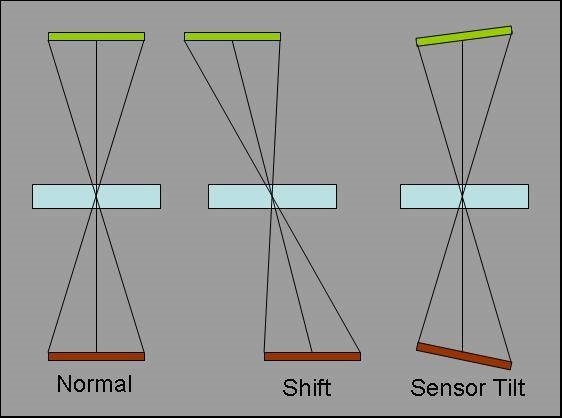 If shift involves distortion so must rmpsrmps's diagram of normal involve distortion. That may seem confusing but effective shift relies on the lens being used having a larger field of view and larger image circle than a standard lens for the sensor a camera has. In my case I use a medium format lens and a full frame( smaller) camera and Shift enables me( or any photographer) to sample one particular part of the image circle. Effectively shift is equivalent to cropping sections of a photograph taken in rmpsrmps's normal diagram. Here is my pictorial( not to scale) understanding of shift( you will see it is a sub set of rmpsrmps's normal diagram): 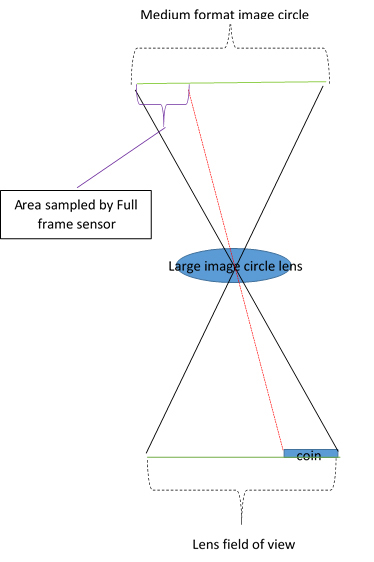 Any distortion that might occur would be due to irregularities in the lens or failure to keep the subject and sensor parallel. I repeat the technique of shift would not be the cause of distortion The failing in Rmpsrmps' diagram is he has pictured the image circle in the shift diagram as being the same size as the image circle in the normal diagram. Just using the canon native TS lenses to illustrate further: Canon TS-E 17mm f/4L Tilt-Shift Lens: image circle of 67.2mm is 50% greater than 35mm/full frame film area Canon TS-E 90mm f/2.8: Image circle dia. 58.6mm. The mamiya 120 mm F4 has an image circle much larger than the canon TS lenses. The image circle is some where around 75mm which is around double the image circle of a full frame camera lens. Edited by austrokiwi
09/11/2016 3:20 pm
|
|
Pillar of the Community
United States
4051 Posts |
First, this is "sort of true", but not quite. First order you are correct, the coin should have the same outer dimensions as long as the lens has perfectly flat field and sufficient coverage. However, the coin will indeed be slightly distorted in that it will be stretched due to the "sideways" perspective. This is a second-order effect and may not be completely obvious unless you compare the straight-on image vs the shifted image, and you will see the small distortions that occur.
But indeed this is not the distortion I was even talking about! Look back at my posts and you will see what I was referring to. It probably doesn't matter, because soon as you do a comparison you will see this second-order distortion. Maybe then we can talk about what I was really trying to get at.
|
|
Pillar of the Community
2087 Posts |
rmpsrmps you stated this ( and its wrong) Quote:
With pure shift, you distort the image to achieve parallax/perspective shifts. |
|
Pillar of the Community
United States
4051 Posts |
No, it is correct. Without shift, the image you see is of only a part of the coin. If you point the camera at the coin, it will have a tilt and will be slightly distorted-looking due to the tilted perspective.
It's easier to understand this concept in terms of architectural photography. If I stand near the base of a building, and look at the building, the parallel lines of the building will appear to have parallax due to converging perspective. This is the natural look of the building from my vantage point at the base of the building. I can take a picture of the building and I will see exactly the same converging perspective. If I don't like this look, I can do one of two things to fix it:
1) I can go into photoshop and stretch the image in a trapezoidal fashion. Stretching the top of the image such that the top of the building has the same width as the bottom. This will make the vertical lines of the building look parallel. I am sure photoshop has canned alogorithms for doing this.
2) I can point the lens straight toward the building, and shift the lens or the sensor so that the building comes into view.
Both of these actions result in a similar (though not exactly the same) final image. Both actions cause the natural, converging perspective view of the building to be stretched such that the converging perspective is eliminated, and the parallel lines appear parallel. Stretching the converging perspective view is a distortion of the natural image of the building.
edited to add: as Rik pointed out in the other forum, I could also use a large format camera, and a wide angle lens, and take the picture pointed straight at the building. The building would then be present in only ~50% of the image, so I could crop the rest and end up with essentially a shifted image of the building.
Edited by rmpsrpms
09/11/2016 4:40 pm
|
|
Pillar of the Community
United States
9395 Posts |
Quote:
However, the coin will indeed be slightly distorted in that it will be stretched due to the "sideways" perspective. Is this distortion caused by the 3D surface of the coin? For example, as seen by the sensor, the highest points of the coin may shift away from the center faster than the lowest points. Also, sloping surfaces could change shape (or even get eclipsed) as you shift the coin away from the center. Or, would this distortion also be seen in a perfectly flat target, like a USAF test chart? |
|
Pillar of the Community
United States
4051 Posts |
Yes, due to 3D nature. Move the coin far enough off-axis and you will see the edge of the coin in the shifted image.
|
|
Pillar of the Community
2087 Posts |
rmpsrmps for the fourth time Please produce a diagram...... it is exasperating to have asked you for a diagram so many times and for you to not do so. Why have you ignored that request. If you haven't worked it out before now there is just no way I get what you are writing down.
You first diagram of shift coupled with your words seemed, and still does a major distortion of the laws of physics to me.
|
|
Pillar of the Community
United States
4051 Posts |
OK, see below. I was hoping to actually take pictures rather than a diagram, but this will have to do. As I have said, the concept is easier to understand with architecture, but I have made the diagram showing the coin situation. I have represented the distortion of the image taken with shift (versus the natural perspective) as a lengthening of the coin, but please realize that there is more than lengthening going on between these two techniques.  |
|
Pillar of the Community
2087 Posts |
ROF  ...... I see absolutely no "distortion" in either picture both are natural views taken from different perspectives! In your "natural" the sensor is tilted with respect to the subject. The result is not a distortion ( I now get what you are saying in that way). Likewise in the shift there is also no distortion, shift has enabled the photographer to "change position" and produce an image ensuring the sensor and subject are parallel. This is what I understand by correcting perspective. You change the apparent viewing position However once you have a digital photograph taken using your "natural" the only way you can get rid of the converging lines is to distort that particular image. Shift on the other hand also produces a natural picture but the perspective is different and the converging lines ( because the sensor and subject remain parallel never occur) The distortion you appear to referring to seems to me to an erroneous transfer of photoshop-think to an issue of composition Edited by austrokiwi
09/12/2016 01:20 am
|
|
Pillar of the Community
United States
4051 Posts |
Quote:
Shift on the other hand also produces a natural picture but the perspective is different and the converging lines ( because the sensor and subject remain parallel never occur No, the picture is not natural. It is a distortion compared with the natural view. Or perhaps you have some sort of special eyeglasses? Do a side by side comparison and you will see they are not the same. Not sure why this is such a tough concept to understand! I was hoping a diagram (which you begged me for, and then laughed at) would help you but alas it did not. edited to add: if you consider the shifted image as "natural", then how far can we take it and still get a natural image? Can we tilt? Can we use an anamorphic lens? Can we use a starburst filter? No, none of these are natural, because that is not what the coin or building looks like from the vantage point of the camera. Edited by rmpsrpms
09/12/2016 01:31 am
|
|
Pillar of the Community
2087 Posts |
Quote:
No, the picture is not natural. It is a distortion compared with the natural view. Or perhaps you have some sort of special eyeglasses? Do a side by side comparison and you will see they are not the same. Not sure why this is such a tough concept to understand! I was hoping a diagram (which you begged me for, and then laughed at) would help you but alas it did not. There is no need to start to get into personal attacks. You have gone this route before and it does you no credit. Read the edit. What you are saying is this to get an image, that has been taken with a perspective that has created converging lines, to look like a picture that has been taken with a perspective that does not have converginglines you have to distort that image Shift changes the perspective( apparent position the photograph was taken from) before the photograph was taken so there is no need to distort the image in Photoshop) |
|
Pillar of the Community
United States
4051 Posts |
Quote:
What you are saying is this to get an image, that has been taken with a perspective that has created converging lines, to look like a picture that has been taken with a perspective that does not have converginglines you have to distort that image
Shift changes the perspective( apparent position the photograph was taken from) before the photograph was taken so there is no need to distort the image in Photoshop) Yes, this is precisely what I am saying. But using shift to change the perspective is distorting the natural look of the object. Whether you distort the image after it is taken, or during taking with a photographic technique, it is still distortion, ie it is different from the way the object looks naturally. My exasperated statements were in response to your apparent misunderstanding of the simple concept I created the diagram to explain, combined with your laughing at it. I consider laughing at someone, especially when you are laughing at something you requested, to be very rude. |
| |
Replies: 81 / Views: 10,067 |








 First Page
 Previous Page


 Posted 09/10/2016 12:10 pm


