| Author |
 Replies: 28 / Views: 10,315 Replies: 28 / Views: 10,315 |
Page 2 of 2
|
|
|
|
Moderator
  United States
23731 Posts |
Interesting comment on the subject, thanks for all the input. Here is another interesting one. 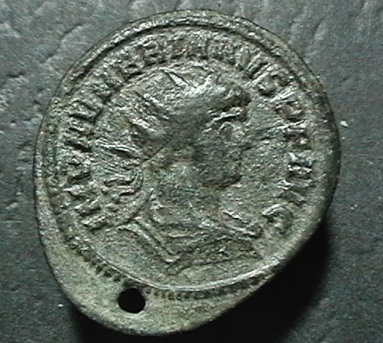 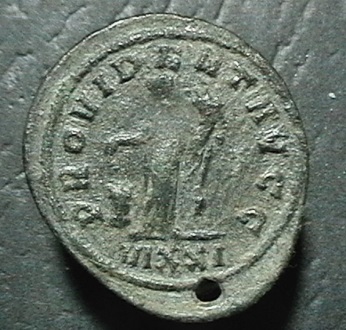 |
|
Pillar of the Community
United States
949 Posts |
Why assume the holing is contemporaneous with a time when the coin was in circulation?
As jewelry (earrings, bracelets, belts, pendants, etc) or ornamental decoration (medallions, bangle insets, noisemakers, etc) they could have been holed and put to use any time. We have nearly 2000 years to play with. Hoards have been stumbled upon as "buried treasure" for centuries. Excavated coins still had a decorative function even if they no longer had fiscal value, and some had value as melt 1000 years ago even as they might today.
|
|
Moderator
United States
23731 Posts |
Of course it's just my opinion, of which I'm basing on the patina on the coin. If the holes where done later the patina would be IMO different.
|
|
New Member
United States
10 Posts |
Echizento - thanks for the welcome.  I can answer your question regarding the countersink, on the coins where the clean countersink is close to the diameter of the through hole. (Some seemed to be this way - I realize that others are a larger diameter countersink then the through hole). By viewing the pics provided, I can tell that these are "punched" holes. On the back, you see the rupture petals of metal where the punch exited. On the Face of the coin, the punch will drive into the metal - straight down - until the metal has reached its tensile strength (point where the metal would rather shear than to compress any farther). It will then shear the plug of metal exactly under the punch. This will create the impression that there is a clean countersink down to a certain depth. IF they had had a holed material (hole the size of the punch) under the punch, then that plug of metal would have cleanly sheared out, leaving a clean rim. Since they didn't have that backer plate under these coins, then that plug just ruptured out, leaving the petals Edited by Coinmaker
04/28/2016 3:09 pm
|
|
Pillar of the Community
United States
949 Posts |
Quote:
If the holes where done later the patina would be IMO different Opinions can be good. If they are based on something. If the coin had been punched 500 years after manufacture, what would be different? How could you distinguish that from a punch made at the time it was in circulation? If one cannot tell, how can one be sure it wasn't? Maybe someone can tell? An archaeologist would look at this piece, see the punch and say something like "... of course we can't tell for sure WHEN it was punched/drilled/holed, but the find data indicate that it was found in such-and-such context ..." |
|
Moderator
United States
23731 Posts |
Interesting point, but I'm going to have to disagree. If the coin was punched you would expect to see some type of deformity to the coin along with a raised lip of metal where the punch exited. That's not the case here the edges are smooth and flush with the surface. Difficult to see on the picture, more evident in hand. This still makes me believe it was drilled. Of course I can be wrong so I would like to hear what others think. you can be right.
|
|
Moderator
United States
23731 Posts |
Here one with a tiny center hole. 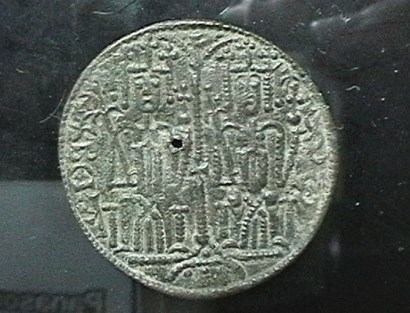 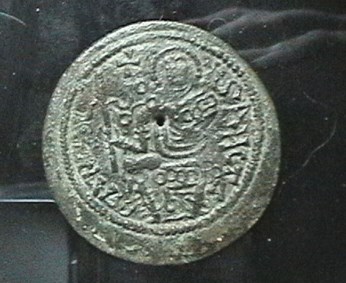 |
|
Pillar of the Community
United States
5010 Posts |
i purchased my first holed coin the day I saw this thread, I have it now so thought i'd come back at post it. it's a nice looking sassanian coin, I didn't even notice the hole when I first saw it. placed in the position it is, it didn't really detract from the coin for me.  |
|
Moderator
United States
23731 Posts |
|
|
Bedrock of the Community
Australia
21792 Posts |
I think that some holes in ancient (mostly thin) coins, are much more more recent than the coins themselves.
It is a tradition that brides throughout the Middel East, often wore holed gold and / or silver coins strung together, as an adornment at the their wedding ceremony.
|
|
Valued Member
United States
61 Posts |
Other than the obvious answer "as jewelry" many coins were holed to turn into armor. Threaded together with wire they could be fastened onto leather for a poor man's version of chainmail (one hole) or on shields (two holes) to strengthen against blows.
Ras
|
|
Pillar of the Community
United States
870 Posts |
I think this Galba Sestertius is the only holed coin I have.  |
|
Pillar of the Community
United States
870 Posts |
Chris, that coin is awesome.
|
|
Pillar of the Community
United States
5010 Posts |
thanks MV...and likewise, that galba sestertius is pretty sweet!
|
|
Pillar of the Community
United States
6130 Posts |
Finally found my holed ancients:   Small one is Licinius I / VOT standard with captives Larger two are Byzantine, haven't really done the work to ID them. |
|
Page 2 of 2
|
Replies: 28 / Views: 10,315 |
Page 2 of 2
|







 First Page


 Posted 04/28/2016 1:21 pm


