|
This page may contain links that result in small commissions to keep this free site up and running.

Welcome Guest! Registering and/or logging in will remove the anchor (bottom) ads and the security checks. It's Free!
To participate in the forum you must log in or register.| Author |
 Replies: 22 / Views: 6,567 Replies: 22 / Views: 6,567 |
Page 2 of 2
|
|
|
|
Valued Member
United States
71 Posts |
Thanks for this post, Ray. It really broadened my view on diffraction. I have a questions, though. Given the formula of the effective aperture, it does not seem possible to avoid diffraction once M goes beyond 5x. If M is 5x, even a lens with an optimal aperture of F2.8 would reach F2.8*(5+1) = F16.8. On the other hand, short focus lenses (like the Canon 20mm Marophoto lens) can easily reach 8x-10x used on a long bellows. If magnification beyond 5x is not desirable due to diffraction, is there any point spending extra on such extremely short focus lenses? (In fact the Canon 20mm is F3.5.) Is there any way to take pictures beyond 5x except using teleconverters and microscope objectives?
Lester Leftkowitz gives an example of diffraction in his book (page 259 on diffraction). He showed a picture taken with M=10x at F22, with severe diffraction. But when the aperture is set at F4, the resolution is greatly improved and the picture looks pretty acceptable. At F4, the effective aperture is still F4*(10+1) = F44. How do we explain this?
|
|
Pillar of the Community
United States
9395 Posts |
Quote:
. Given the formula of the effective aperture, it does not seem possible to avoid diffraction once M goes beyond 5x. If M is 5x The real problem is getting good resolution at higher magnification, decent working distance, and reasonable cost. You can get a used 10x plan APO microscope objective at NA=0.45 or so at reasonable cost, but the working distance might be just a few millimeters, and you might need to put a cover slip over the coin, to avoid severe image degradation. For $8000 or so, you can get a 10x/0.42 Mitutoyo high resolution metallurgical (no cover slip required) objective with about 15mm working distance. Above 10x, it gets a lot tougher. Maybe you could arrange some sort of epi-illumination to avoid some of the working distance issues, but I don't know how good the results would be with coins. |
|
Pillar of the Community
  United States
4051 Posts |
Quote:
Thanks for this post, Ray. It really broadened my view on diffraction. I have a questions, though. Given the formula of the effective aperture, it does not seem possible to avoid diffraction once M goes beyond 5x. If M is 5x, even a lens with an optimal aperture of F2.8 would reach F2.8*(5+1) = F16.8. On the other hand, short focus lenses (like the Canon 20mm Marophoto lens) can easily reach 8x-10x used on a long bellows. If magnification beyond 5x is not desirable due to diffraction, is there any point spending extra on such extremely short focus lenses? (In fact the Canon 20mm is F3.5.) Is there any way to take pictures beyond 5x except using teleconverters and microscope objectives?
Lester Leftkowitz gives an example of diffraction in his book (page 259 on diffraction). He showed a picture taken with M=10x at F22, with severe diffraction. But when the aperture is set at F4, the resolution is greatly improved and the picture looks pretty acceptable. At F4, the effective aperture is still F4*(10+1) = F44. How do we explain this? The way diffraction "appears" depends on how much the final image was reduced from the original. Let's take an example: Nominal aperture f2.8 Magnification 5x Effective aperture f16.8 Sensor specs: 18MP, 5184x3456, APS-C, 4.3um pixel pitch DLA: f6.7 At f16.8 we are more than 2 stops beyond the DLA, so diffraction has caused adjacent pixels to merge significantly, essentially to the point that the image no longer has 18MP of information, but more like 4.5MP. If viewed at 100% pixel level, this reduction in information shows up as strong diffraction blurring. But if viewed at 50% pixel level (or downsized 50% to 2592x1728 and viewed at 100%) the image will appear sharp. Now, 2592x1728 is still a very large image. A more typical size for web publishing would be 1296x864, representing another 50% downsizing of the image. This additional downsizing would allow you to shoot the image stopped-down 2 more stops to f33.6 and still appear just as sharp. This effect of "downsize sharpening" is an interesting one and is why your example of an image taken at f44 appears sharp. If the image had been viewed at full size, it would have shown significant diffraction blurring. But the picture printed in Lefkowitz was printed quite a bit smaller than a full-size print, and this resulted in it appearing sharp in spite of its small effective aperture. |
|
Valued Member
United States
71 Posts |
Thanks for your explanation, Ray. I really appreciate your thoughts. "Downsize sharpening" is what I have been doing, though not realizing it, as I am kind of obsessed with taking pictures of minute details on the coin surface such as flowlines and need high magnification. The 100% crop often is blurry, but at 25%, some pictures are acceptable in sharpness. This brings up another question. Should we aim at avoiding diffraction, to ensure sharpness at 100% crop, or somehow make use of the downsize sharpening effect? It looks like downsize sharping is the way to go if we venture beyond 5x.
By the way, is F2.8 the sharpest aperture for 95PN?
|
|
Pillar of the Community
United States
4051 Posts |
In my tests the sharpest aperture at 2:1 was f3.3, but f2.8 is not much degraded and so I chose it for the 2.5x2xTC shot.
At 4x and above, the lens is usually the limiting factor for sharpness, not the camera. Once the lens is diffraction-limited, all you have left is size reduction if you want max sharpness in a published image.
Almost all my photos are published at 25%, even the ones that don't need downsizing for sharpness. Pixel level detail is nice, but what you should shoot for is best sharpness at your final published size, and I recommend ~800 pixels for web publishing. I generally use 864 pixels since this is 25% of my T2i sensor height.
I find that a downsizing of 50% is required to offset the effects of the sensor demosaicing algorithm. Some later cameras seem to do better in this regard, and in fact I've seen some very sharp 100% crops. It's not clear to me these have not been processed, either in-camera or out, but the 100% quality level has been intriguing to me.
What are you using today? Are you focus stacking?
|
|
Valued Member
United States
71 Posts |
I will remember your advice, Ray. I received a fixed aperture 75ARD1 today. Even at 1x, the details are very impressive. So instead of pushing into 8x-10x and then using a picture downsized to 25%, it probably would make more sense to shoot for 3x-4x and use the 100% crops.
I have a Nikon D5200. For high mag pictures, I use a reversed Rodagon 35mm enlarger lens or a Schneider 50mm Componon-S or an el Nikkor 50mm . I have a Canon Macrophoto 35mm lens, too. I sometimes add a 2x telephoto lens to these, just for the sake of experiment. I did some stacking using a Z-axis stage, but not seriously.
|
|
Pillar of the Community
United States
4051 Posts |
Usually 100% crops are not all that sharp due to the camera/sensor aberrations. Demosaicing, AA filters, etc tend to blur the 100% images. These are mostly gone with a 50% downsize. So if you want to get 4x magnification effectively, it's better to shoot at 2x, downsize by 2x, then do the 100% crop rather than shooting at 1x and doing 100% crop.
|
|
Valued Member
United States
441 Posts |
Quote:
Usually 100% crops are not all that sharp due to the camera/sensor aberrations. Demosaicing, AA filters, etc tend to blur the 100% images. These are mostly gone with a 50% downsize. So if you want to get 4x magnification effectively, it's better to shoot at 2x, downsize by 2x, then do the 100% crop rather than shooting at 1x and doing 100% crop. Forgive my ignorance as I'm not a pro photographer. 1)How does one know if they're shooting a pic a 1x, 2x, etc? Is it based on the pic resolution size or the subject coin size? 2)When downsizing, is it better to do so when converting a RAW (3888x2592) to JPG or after converting? I use DPP with Canon tethering for my coin photographing. I have to resize down to roughly 485px square or about 19% with a locked aspect ratio to get pics to display properly in my coin tracking program (CaptureMyAssets). 3)Please explain "100% crop" versus just cropping a pic to get rid of extra stuff that's not needed in a pic. Does circle cropping in DPP, then recropping in PSP adversely affect image quality? My process: I circle crop a nickel pic in DPP and convert to JPG, it's at 3888x2592. Then, I crop again in PSP to "square" it and have an image at about 2510x2527. I then resize to 19% to allow photo to display properly in my coin tracking program. Is there a better way? Any info is greatly appreciated. EDIT: For example, this is what I end up with after resizing the JPG down to 19% before doing any further tweaking. Lens is a El Nikkor 80mm 5.6, pic shot at f8 on bellows setup:  Edited by andywoj00
05/14/2016 11:41 am
|
|
Pillar of the Community
2087 Posts |
For calculating magnification I have a very simple system. I have a red plastic ruler in mm with the markings in white. I simply place the ruler in the field and measure how many mm wide the image area is. On my ff frame sensor If I am at 1-1 the image will be 36mm wide, if 2X (2-1) the the image will be 18mm wide. For the mft sensor 1-1 is 17mm
|
|
Pillar of the Community
United States
4051 Posts |
Quote:
1)How does one know if they're shooting a pic a 1x, 2x, etc? Is it based on the pic resolution size or the subject coin size? AK gave a good explanation of the ruler method, which also works well for me. Quote:
2)When downsizing, is it better to do so when converting a RAW (3888x2592) to JPG or after converting? I use DPP with Canon tethering for my coin photographing. I have to resize down to roughly 485px square or about 19% with a locked aspect ratio to get pics to display properly in my coin tracking program (CaptureMyAssets). When using DPP, it's usually best to do everything you plan to do in one shot. Otherwise you end up with "interim" images saved here and there. Quote:
3)Please explain "100% crop" versus just cropping a pic to get rid of extra stuff that's not needed in a pic. Does circle cropping in DPP, then recropping in PSP adversely affect image quality? A 100% crop is just a small crop of the image such that it can be viewed at 100% (1 image pixel = 1 screen pixel). Quote:
My process: I circle crop a nickel pic in DPP and convert to JPG, it's at 3888x2592. Then, I crop again in PSP to "square" it and have an image at about 2510x2527. I then resize to 19% to allow photo to display properly in my coin tracking program. Is there a better way? Not using DPP. In DPP, you can't specify two crop types to be done together. So you have to either do the square crop first, save the file, then do the circle crop, or vice versa. It doesn't really matter what order you do the downsizing or other processing. Your crop numbers and downsize numbers trouble me. I think of "square" as square, ie x=y. I also don't recommend non-integer downsizing. I would recommend shooting at a little lower magnification so you have just a bit more room around the coin. I shoot at ~90% of full-screen. Doing this allows some crop flexibility. If you then crop to 2425x2425, then downsize by 5x (20%), you end up with a nice 485x485 final image. Contact me for photographic equipment or visit my home page at: http://macrocoins.com |
|
Pillar of the Community
United States
4051 Posts |
I have found an alternative lens to the Nikon 95mm Printing-Nikkor (95PN), at a much cheaper price. It is also quite small and easy to get lighting around. Some background first: The 95PN, like the 75PN and 105PN, were designed for printing film reels for distribution to cinemas. The 105PN was optimized for 1:1 transfers, eg 35mm to 35mm, 70mm to 70mm, etc. The 95PN was designed for half-conjugate prints, eg 16mm to 35mm, 70mm to 35mm, etc. The 75PN did quarter-conjugate prints, eg 8mm to 35mm. These lenses were designed to be as high quality as possible to optimize cinema print IQ. But Nikon wasn't the only company doing this work. Kodak had their own line of lenses, the Printing-Ektars. But take heed, there are actually multiple lines of Printing-Ektars. The most common are the multitude of lenses available with that nomenclature with many different focal lengths, designed for the less-demanding task of 1-hour print shop work. These lenses are good, but not great, and can be identified by their typical f4.5 fixed aperture. My interest is in a different line of Printing-Ektars that were made for the same work as the Printing-Nikkors. There are at least 2 versions of these: the 89mm f/3.8 (89PE) and the 103mm f/2.8 (103PE). I have never tested a 103PE, though I've read some positive online reviews, but I am now the proud owner of an 89PE. The 103PE is optimized for 1:1 film transfers similar to the 105PN, while the 89PE is optimized for half-conjugates like the 95PN. My testing has shown that the 89PE, like the 95PN, is apochromatic, and has similar superbly flat and wide-field characteristics. I have not done a head-to-head shootout between the two, and I do expect the 95PN to win given its larger f/2.8 (vs f/3.8) aperture, but I can tell you the 89PE has quickly become a favorite coin lens due to its small size and excellent IQ. The optimum aperture at 0.7:1 (full Cent shot) is f/4.7, which is ideal for a good compromise between DOF and typical sensor DLA, allowing single shots to have very high IQ. Color rendition is excellent, as is immunity to highlight bloom. One of the criteria I use for determining lens quality is how much the focal length changes as the lens is stopped-down. Like the 95PN and 105PN, the 89PE has virtually zero shift in FL from f/3.8 to f/22. The focus plane does not shift, nor does the magnification. Very few lenses have this quality. Below is a full-coin shot of a 1949-S Lincoln Cent (same one used for my 100mm shootout) taken with the 89PE. This was at f/5.6, and is un-adjusted:  And below is the same coin, with lens reversed, at 2:1. This shot is at f/4, which is the optimum aperture with lens in reverse:  Edited by rmpsrpms
09/10/2016 6:29 pm
|
|
Pillar of the Community
Canada
2784 Posts |
ray like to ask you a question. see I dont understand I am looking at a lens. they say the lens produces 800 lines of resolution. ray how would that lens of 800 line of resolution compare. say to a standard macros lens or a enlarger lens.
|
|
Pillar of the Community
Canada
2784 Posts |
ray this lens you are demonstrating is simply incredible. wow totally excellent.
|
|
Pillar of the Community
United States
4051 Posts |
Quote:
ray like to ask you a question. see I dont understand I am looking at a lens. they say the lens produces 800 lines of resolution. ray how would that lens of 800 line of resolution compare. say to a standard macros lens or a enlarger lens. I'm not sure what they mean by 800 lines. Usually the way resolution is specified is in line pairs per mm (lp/mm) or sometimes line pairs per picture height (lp/ph). I think AK has done more with interpreting these kind of specs...perhaps he can chime in? Contact me for photographic equipment or visit my home page at: http://macrocoins.com |
|
Pillar of the Community
2087 Posts |
Quote:
............ they say the lens produces 800 lines of resolution. ray how would that lens of 800 line of resolution compare. say to a standard macros lens or a enlarger lens. Actually there isn't enough info in that statement to be sure I am answering correctly. My answer assumes that a resolution rating is a frequency. Have a look at this: 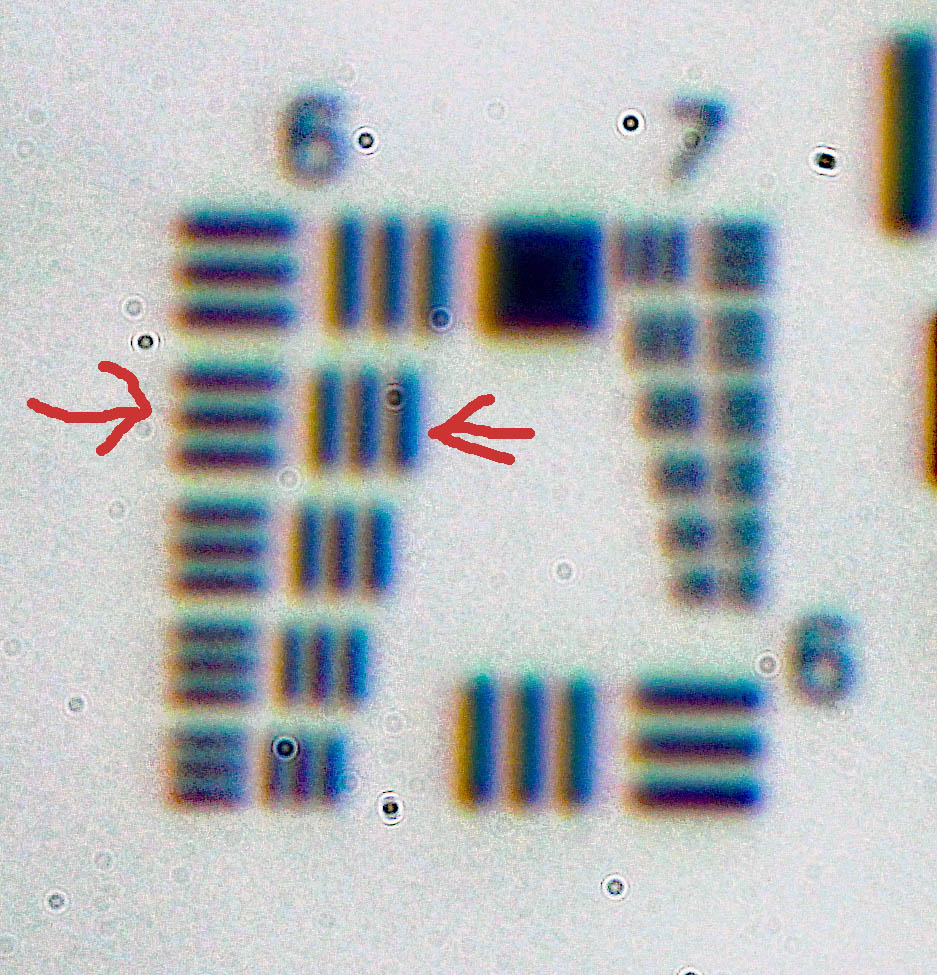 That center crop of my resolution target is the same one I posted in the Mamiya 120mm thread. Have a look at the group of lines that is indicated by the arrows. That set of lines is formally labeled group 6 element three ( note group 6 element 1 is under group 7 ). Group 6 element 3 indicates 80.6 cycles per millimeter. A cycle consists of a black line followed by a white line(the white line is a space on the target I use). As I interpret it each resolution target element consists of 2.5 horizontal cycles ( three horizontal black lines and two spaces) and 2.5 vertical cycles. Now some people appear to confuse cycles with lines, with the result that one can not be absolutely sure what they mean. I suspect when someone says 800 lines per millimeter being confused with cycles( unless they are referring to scan rate of a machine vision lens). I with my limited experience have never heard of a resolution target that would be able to actually measure 800 lines per millimeter which would equate to some where around( fuzzy maths) 1200-1600 cycles per mm. I suspect 1600 cycles per millimeter is getting into territory that requires you to switch to an electron microscope to have a hope of creating an image. Therefore I anticipate that when someone says 800 lines they actually are referring to some where around 400 cycles per millimeter. To really understand the <b>practical</b> relevance of a resolution measurement of a lens you need to know two things. What the resolution limit of the lens is and what the resolution limit of your cameras sensor is. As far as resolution goes: A lens that exceeds your cameras ability to resolve by one group is going to perform on your camera as well as a lens that exceeds your camera by 5 groups. I have been told the resolution limit of my Sony A7rII at 42mp) is around 80.6 cycles ( group 6 element 3) You will see in the picture above that the Mamiya 120mm is in my test resolving at group 7 element 1 which equates to 128 cycles per mm. At this point someone may be confused: how can you take a picture that exceeds the resolution of the camera? Simple I placed the mamiya on one bellows having adjusted it for 1-1 magnification. I them placed a second bellows with a microscope objective in such away that the microscope objective sat where the cameras sensor would normally be in relation to the mamiya 120mm lens. The microscope lens by magnifying the image from the lens being assessed drops the frequency below the limit of my sensor... so that way I can get a measure of what the lenses limit real is. With out using the microscope objective this is what I would get: 1st the full photo( 36mm wide X 24mm high)  You will note groups 6 and seven are barely visible. Now a Crop from that image  I used my Sony FE 90mm F 2.8 lens for that shot and that tiny crop is the best I can get. I know from previous experience every other lens II have ( except for two) when set to 1-1 magnification will produce the same result... that being a maximum resolution of group 6 element 3. I hope you understand where I am going. As long as a lens exceeds you cameras sensor resolution, it really doesn't matter by how much. In my experience nearly all Enlarger lenses exceed the resolution of the sensors of my A7rII and my Olympus OMD-E10II. I have had lenses that resolved to lower frequencies than my cameras sensors, these were: Minolta MC 50mm and 100 mm macros Minolta 75mm enlarger lens and a Meopta 80mm enlarger lens. A lenses ability to resolve is only one factor.....That is why you see rmpsrmps showing pictures of coins at different F stops and also showing animations that display the CA. When you talk about the perfect lens..... I think a combination of, at least, the following factors are the most important: Image IQ( also known as sharpness) this is a combination resolution and contrast. Note: according to Edmund optical as resolution increases contrast decreases. So IQ is an optimal balance of contrast and resolution. One of the issues I was worried about with the Mamiya 120mm was the possibility of a loss of contrast.... there was a risk that that medium format lens would flood internal area of my camera with too much light resulting in a decrease in contrast. Luckily the adapters I used acted as a light choke. However it might be the case that with some DSLrs that problem might arise Control of Chromatic aberration particularly axial CA( if I have got the right one)). Axial Ca can't be fixed in post processing. The speed of the lens. I mean the maximum aperture, these days with large MP counts becoming more and more common, fast lenses are becoming more and more important. For coins I tend to avoid lenses that start at F 5.6 and I am mildly worried at F4 lenses. The optimal magnification range of the lens. For example I am really pleased with the SK 40/2.8. It can clearly manage magnifications up to 10X( when reversed. Last week I tried reversing a 24mm wide angle and coupling it with the SK210 enlarger lens. It didn't take me long to realize I had taken the 24mm well outside of its optimal magnification range... the results were horrible. The size and weight of a lens. This comes down to the rig you use and your camera, as well as your personal preference and coin interest. I have a range of coin sizes in my collection. The smallest(from Harar in Ethiopia) are less that 5mm in diametre and the largest medals are almost 80mm. I could go on... what I am saying is resolution is only one factor among many and as long as a lens resolves to a level higher than your camera that's all you need worry about with regards to resolution. You will note a number of us use the Printing Nikkors... they are so usable because they balance out a number of factors( not just resolution) Edited by austrokiwi
09/11/2016 06:33 am
|
|
Page 2 of 2
|
Replies: 22 / Views: 6,567 |
Page 2 of 2
|
To participate in the forum you must log in or register.
Disclaimer: While a tremendous amount of effort goes into ensuring the accuracy of the information contained in this site, Coin Community assumes no liability for errors. Copyright 2005 - 2026 Coin Community Family- all rights reserved worldwide. Use of any images or content on this website without prior written permission of Coin Community or the original lender is strictly prohibited.
Contact Us | Advertise Here | Privacy Policy / Terms of Use
|
| Coin Community Forum |
© 2005 - 2026 Coin Community Forums |
| It took 0.44 seconds to rattle this change. |
 |
|
| |
| |




 First Page

 Posted 05/11/2016 9:17 pm


