| Author |
 Replies: 19 / Views: 3,092 Replies: 19 / Views: 3,092 |
Page 2 of 2
|
|
|
|
Pillar of the Community
Canada
3234 Posts |
Quote:It has the look of PMD (I say that as the seller). Nevertheless...if someone knows how the 2nd set of beads and a 2nd raised "REGINA" ended up on the obverse, I would love to know... I agree.. I still place it in the "amazing category"..until Roger or another expert tells us differently.. |
|
Pillar of the Community
Australia
7096 Posts |
I am struggling to see what has happened here. There is NO doubling of the Queens bust although half of it is in the affected area and what on earth is that "U" shaped mark on the Queens neck? It doesn't belong to any part of this coins design. There does appear to be some doubling but only in a small area on the right hand side of the obverse but Nothing but crushed metal on the reverse with the metal being extruded outwards as if crushed/struck with some degree of force. There is also NO evidence of any doubling on the left hand side of the obverse to match up with the extra beads on the other side of the coin. All in all a very strange piece and I look forward to a logical explanation as to how something like this could have possibly occurred in the press .  Edited by trout1105
10/02/2016 10:40 am
|
|
Pillar of the Community
Canada
2303 Posts |
|
|
Pillar of the Community
Canada
1463 Posts |
Looks like they made a false die, and wacked the penny into it
|
|
Pillar of the Community
Canada
867 Posts |
yeah, it's double struck....with a hammer....
|
|
Pillar of the Community
Canada
4912 Posts |
Feel free to call me Will.
|
|
Moderator
 Canada
10477 Posts |
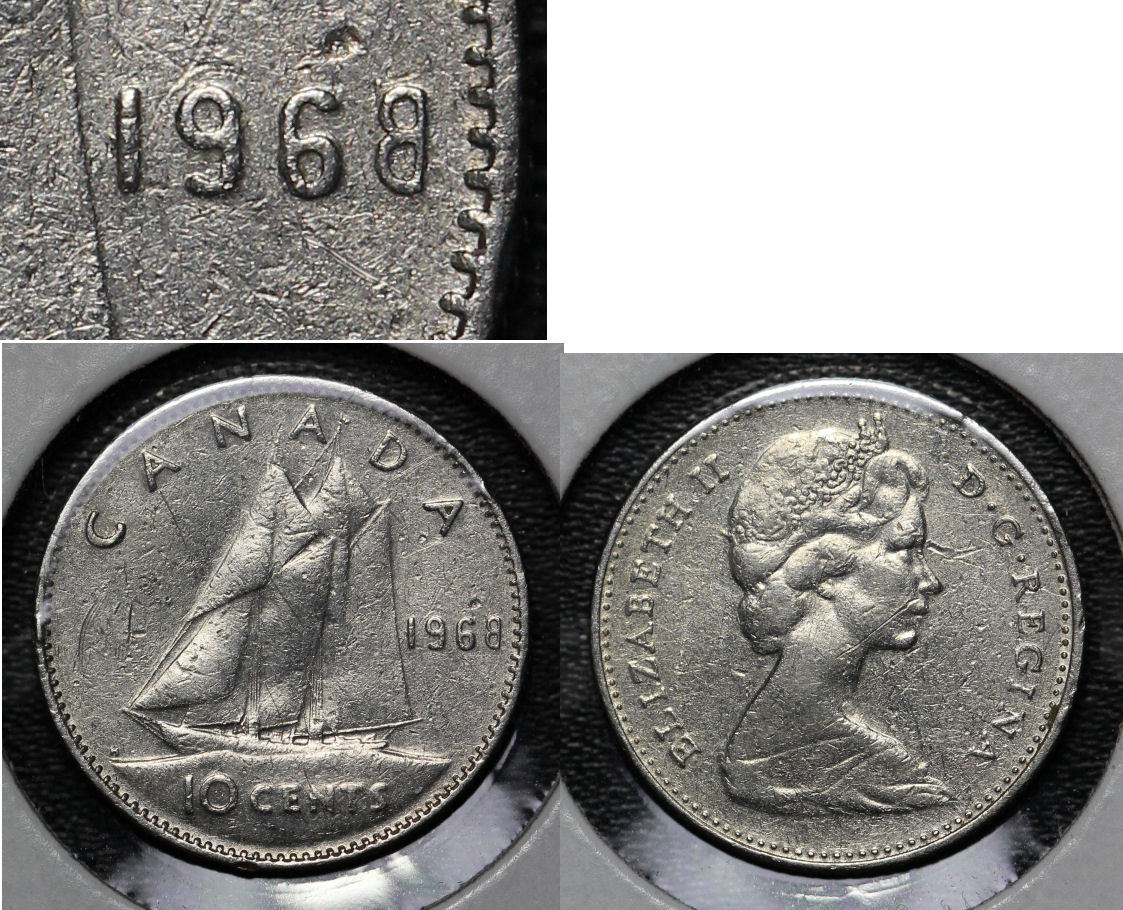
That 10-cent with the deformed 8 is definitely coin Rolling Machine Damage, metal displacement by shearing. I wrote about that phenomena in the September 2014 CN Journal. You also see the same things on the silver coins. 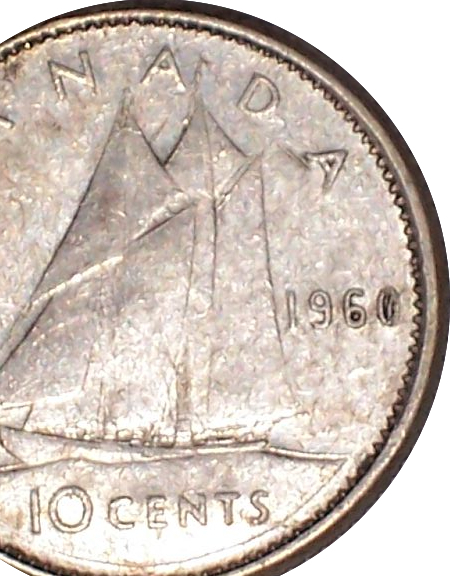 "Discovery follows discovery, each both raising and answering questions, each ending a long search, and each providing the new instruments for a new search." -- J. Robert OppenheimerContent of this post is licensed under a Creative Commons Attribution-NonCommercial 3.0 Unported License. See: http://creativecommons.org/licenses...0/deed.en_USMy eBay store
|
|
Moderator
Canada
10477 Posts |
The large cent is definitely post-mint alteration. THIS is what double struck Victorian coins look like (courtesy of Zonad's PCGS error showcase): http://www.PCGS.com/setregistry/coi...433972&sid=0There is incredible force when dies strike a blank or a coin. The rim and the gradational transition on the reverse speak nothing of being double struck, and speak everything of being squeezed by pressure a whole lot less than dies. "Discovery follows discovery, each both raising and answering questions, each ending a long search, and each providing the new instruments for a new search." -- J. Robert OppenheimerContent of this post is licensed under a Creative Commons Attribution-NonCommercial 3.0 Unported License. See: http://creativecommons.org/licenses...0/deed.en_USMy eBay store
|
|
Pillar of the Community
Canada
1049 Posts |
 there's no reason or perhaps argument for how this PMD error came about, it can't stand to reason without failure. |
|
Moderator
Canada
10477 Posts |
"Discovery follows discovery, each both raising and answering questions, each ending a long search, and each providing the new instruments for a new search." -- J. Robert OppenheimerContent of this post is licensed under a Creative Commons Attribution-NonCommercial 3.0 Unported License. See: http://creativecommons.org/licenses...0/deed.en_USMy eBay store
|
|
Pillar of the Community
Canada
1049 Posts |
Similarity is non-existent, yet similar in event is there, somehow this one rings PMD all over it, wish I had the reasoned answer for it. |
|
Pillar of the Community
Canada
1442 Posts |
struck/hammered with a "False Die"...yes...but why make a false die that ONLY duplicates the REGINA, the beads around the portrait and the denticles ? Why would someone make a "fraction" of a false die...then hammer this coin with it? So far, I dont see any good explanations.  for the 1968 dime, there is no displaced metal under high magnification (in your example the metal is literally coming off the coin)...the shape of the 8 is very odd.. btw...Roger..I recognize this 1976 Double struck quarter...i wanted to add it to my collection back when it was selling for half the price a year or two ago  ... Edited by canadian-varieties
10/02/2016 9:29 pm
|
|
Moderator
Canada
10477 Posts |
When analyzing error coins, I don't ask myself "how was this made?"
I ask myself, "Knowing the blank production process and coin striking process, could this have occurred at the mint during the rolling, punching and rimming of the blank or in the striking chamber, by the dies?" If the answer is "not a chance" - then I don't buy the error.
"Discovery follows discovery, each both raising and answering questions, each ending a long search, and each providing the new instruments for a new search." -- J. Robert OppenheimerContent of this post is licensed under a Creative Commons Attribution-NonCommercial 3.0 Unported License. See: http://creativecommons.org/licenses...0/deed.en_USMy eBay store
|
|
Pillar of the Community
Canada
4912 Posts |
simple, the force of the strike by the false die was not very high and most of it went to that part of the false die.
Feel free to call me Will.
|
|
Pillar of the Community
Canada
1049 Posts |
It makes no sense as to how ....... be it the obverse or the reverse get's an extra hit of the partial extending to the right of a strike without impacting the left side of the strike. How can such a strike be explained within reason. Keeping it within the chatter of the original and secondary strike without fields being affected by such.
Would that be a die clash that had A full strike of the anvil die and transferred the strike to the planchet that was in mid spit out of striking the complete and angled?
|
|
Page 2 of 2
|
Replies: 19 / Views: 3,092 |
Page 2 of 2
|








 First Page


 Posted 10/02/2016 10:39 am