| Author |
 Replies: 35 / Views: 8,475 Replies: 35 / Views: 8,475 |
Page 3 of 3
|
|
|
|
Valued Member
Australia
432 Posts |
Libertad Peso - Not quite disintegrate, but corrosion will remove all trace of the detail on the faces... Whatever you do, DONT expose them to moisture or worse, WARMTH and MOISTURE... Make sure theyre as dry as they can be (if heard of guys putting them in a oven about 120deg to dry them, then dunking them in light oil to seal them too) and SEAL THEM into something air-tight...
Ive also heard 'Hair Spray Lacquer', but I'm not game to try!! :)
|
|
Pillar of the Community
Australia
1262 Posts |
You are correct Zaggy...15-18K...I did say OVER $10,000
Will email you what I have. Need to check it is up to date.
And I have just purchased the last coin I was after and now have a complete set. Glad that's over...now what is next?
Edited by humpybong
04/09/2008 11:17 pm
|
|
Valued Member
Australia
432 Posts |
You got that 39G? NICE WORK MATE!
Reichskreditkassen or Allierten Besetzung Next? Or my approach; Currency Reform sets!
No email from you yet, but you do have to check it up to date... :)
|
|
Valued Member
Spain
58 Posts |
Hello, Humpybong.
If I were you I would start with Third Reich coins in territories that were occupied during the War: Poland, Belgium, etc, and "satellite countries" (Bohemia, Slovakia, etc.).
|
|
Valued Member
Australia
432 Posts |
Kreuzer, SHHHH, I'm working on bits of that! I don't need Humpy providing competition! :) I do have a few B&M issues, Netherlands, Denmark and a single Poland Issue... Also have most of the French stuff minted while occupied by Germany...
|
|
Pillar of the Community
Australia
1262 Posts |
Hmmmmm.....good idea Kreuzer
|
|
Valued Member
Spain
58 Posts |
Hey Zaggy, did you say Netherlands?
I haven´t got my collection here with me so I can´t post images, but, are we talking about 1,5, 10 and 25 cents zinc coins? I ask you this because I´m not sure these coins were minted by Third Reich.
Edited by Kreuzer
04/13/2008 10:38 am
|
|
Bedrock of the Community
United States
14454 Posts |
|
|
Valued Member
Spain
58 Posts |
Many collectors feel attracted by Third Reich coins and I suppose there are many reasons for this.
In my case these coins have their place in my collection because I am interested in studying the relationships between European coin designs in 1900-1945.
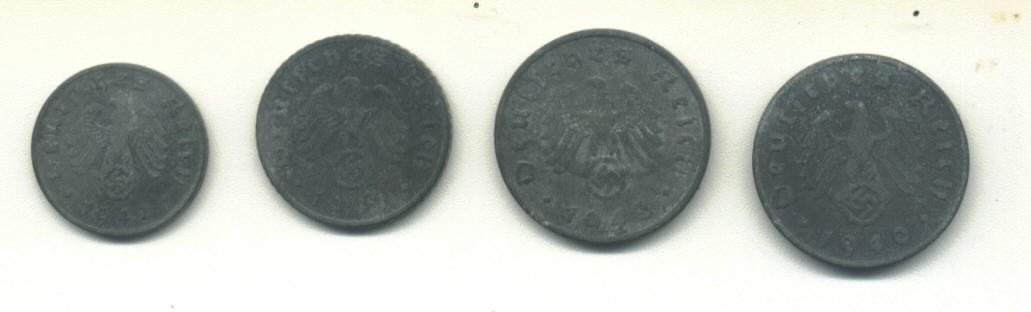
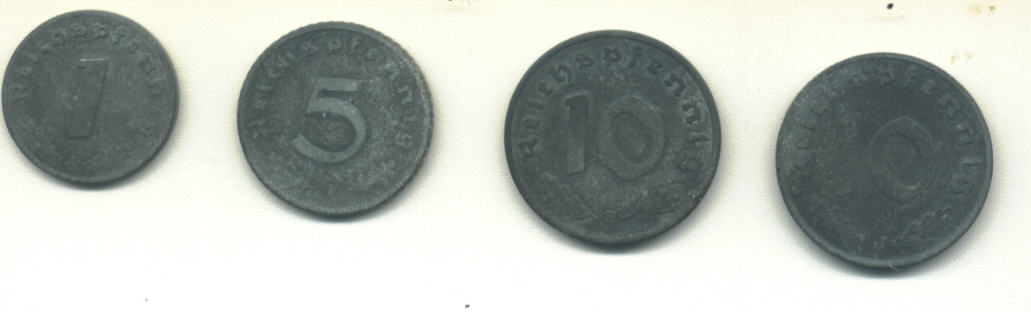
In my view, Nazi designs are nothing new. Low value coins (1,2, 5 and 10 Reichspfennig), stem from old Imperial designs: simple, big figures and stylized eagle with nazi symbol. Weimar Republic (The Government immediately before Third Reich), had the same basic design (without the eagle and the imperial memories). These general design will be kept in Federal Republic (again the eagle disappeared).
Silver coins with the Hindenburg bust may be related with Polish coins with Jozef Pilsudski bust. On the other hand, the coins with the Postdam garrison church are a mistery for me because I don´t know any coin with this kind of design before 30´s. I´m sure they must have a previous model because Nazis were not especially original.
Well, I could write more about these topics but I don´t want to bore the audience.
|
|
Valued Member
Australia
432 Posts |
Kreuzer: Netherlands are in the scope, yeah. not so much because the Third Reich ACTUALLY minted the coins, BUT because the coins were minted under Third Reich Occupation. I have a small few of the Netherlands occupation releases (Zinc ones of course, from memory at least 2x 20c and something else) amongst my slowly growing collection of coins from this era (France, Denmark, Norway, B&M, Poland as well)...
As for the Third Reich designs, yes, quite a few were descendants of the types of coin used in the Kaiserreich period. As you rightly point out tho, the Potsdam mit datum and the Potsdam ohne Datum are rather unique in European coinage of the time. BUT at the same time, they are very definately commemoratives of the 'Day of Potsdam' and the Garison Church is the most obvious image to use! Unless you wanted to use an image of Hitler shacking Hindenburg's hand! :)
|
|
Pillar of the Community
Germany
1238 Posts |
quote:
are we talking about 1,5, 10 and 25 cents zinc coins? I ask you this because I´m not sure these coins were minted by Third Reich.
These Dutch zinc coins were made in the Netherlands during the German occupation. And no, Nazi Germany's coins were of course not radically different from previous issues, just like the whole "nazification" was a process rather than a change from one day to the other. The early nazi pfennig coins had, by and large, the same diameters and alloys as the Weimar coins. And the swastika as a central, dominant symbol on coins did not appear until 1936. For German Reich circulation coins, the Garrison Church issues may have been novelties as far as the style is concerned. But the Goethe coin (1932, last Weimar Republic commem) is kind of similar: poet's bust only, with just the six letters of his last name below ... Christian |
|
Valued Member
Spain
58 Posts |
Oh, I see a debate. quote:
But the Goethe coin (1932, last Weimar Republic commem) is kind of similar: poet's bust only, with just the six letters of his last name below
Yes, the poet´s bust only and his name, but the style is different. Hindenburg´s head fills all the surface of the coin, and his features are very hard. And the main difference is that Hindenburg was a soldier, a warrior. Nazis want to legitimize their power, and they chose Hindenburg as a harmless symbol (Hindenburg died in 1934). Hindenburg´s bust had appeared in other coins in Weimar Republic, but then, he was the head of the Republic. Now he is the warrior. So, things was changing now. quote:
BUT at the same time, they are very definately commemoratives of the 'Day of Potsdam' and the Garison Church is the most obvious image to use!
Zaggy, you are right. But the things that "can" appear in a coin depend on the date we talk about. These days, even Lady di can appear in a coin, but in 1900´s the coins designs were much more homogeneous. For example, as far as I know, the first "not in a shield" animal that appeared in a coin was a bee, in Italian 10 Centesimi (1919). Now, animals in coins are very common. So, the really new in the Postdam church coin is the design, and the "idea" of a building in a coin. Well, as you can see, all these things are personal opinions, but the interesting thing is how in Europe the political situation has influence in coins. |
|
Pillar of the Community
Germany
1238 Posts |
Errm, how did Hindenburg get in here?  The Goethe pieces I mentioned because they are similar in style (OK, just vaguely, with regard to the design elements used) in style to the Garrison Church coins. Now the Hindenburg coins are much more traditional: big head in the middle, inscription that goes along the rim. Hindenburg being shown on some of Nazi Germany's coins made sense because he was the president of the Reich until he died: First he was the head of state in a republic that he was not really a convinced supporter of, then in Jan-1933 he appointed Hitler (who he did not like much) the new chancellor. Sure, the latter was basically not his idea, but we need to keep in mind that the nazi regime was not established as a result of a military coup and not of a democratic election either. So Hindenburg as the head of state was an important formal link between the Weimar Republic and the „Third Reich". Guess that was why his effigy appeared on the 5 RM coin (from Nazi Germany but without any swastikas) and then stayed on the 2 and 5 RM coins (with swastika) for several years, until they stopped minting them in 1939. The Garrison Church coins are quite appealing - especially the one without the 21 March date - for the reasons you mentioned. I like that side not because the church was understood and used as a symbol of Prussian militarism (until its ruins were torn down in the 1960s) but because of the detailed depiction of the tower as the sole object on that side ... Christian |
|
Valued Member
Australia
432 Posts |
Lets not forget that to the people of Germany, Hindenburg was very highly regarded; a Hero of the Great War and the conflicts of the late 1800's...
Yes Hitler didnt like him and Hindenburg didnt like Hitler, but Hitler and the NSDAP needed something to further legitimise their claim to power and what can be more legitimising to a party formed by WW1 Veterans than THE Military Hero and current Reichspräsident?
As for the Nazi rise to power, on the whole, they just manipulated the system, like many other politicians before and after. Sure at times they used force but one must put things into context; Germany was recovering from the Great Depression and what was essentially a civil war. The communist fundamentalists werent afraid of getting involved in the odd dust up. And if I remember right, the Weimar Governments backed the NSDAP in the late 1920's/early 1930's against their opponents!
And I have just erased another 40-50 lines, being that I dont want to turn this into a political debate! :)
But yeah, to a Party like the NSDAP, who wanted to appear as the legitimate, modern day, defenders of Germanic Culture, etc, tradition was a big thing! So it is rather logical and fairly easy to note that a lot of the coin designs drew heavily from the pre-WW1 'Kaiser-reichs' period. Prime example, the 1 Reichsmark!
|
|
New Member
United States
1 Posts |
There is this guy on ebay that sells pfennigs with eagle and swastikas for sometime now. Look up theleato on ebay |
|
Page 3 of 3
|
Replies: 35 / Views: 8,475 |
Page 3 of 3
|






 First Page
 Previous Page

 Posted 04/09/2008 11:15 pm