| Author |
 Replies: 17 / Views: 5,160 Replies: 17 / Views: 5,160 |
Page 2 of 2
|
|
|
|
Moderator
 United States
195742 Posts |
Very nice!  |
|
Pillar of the Community
United States
4507 Posts |
|
|
Bedrock of the Community
United States
12057 Posts |
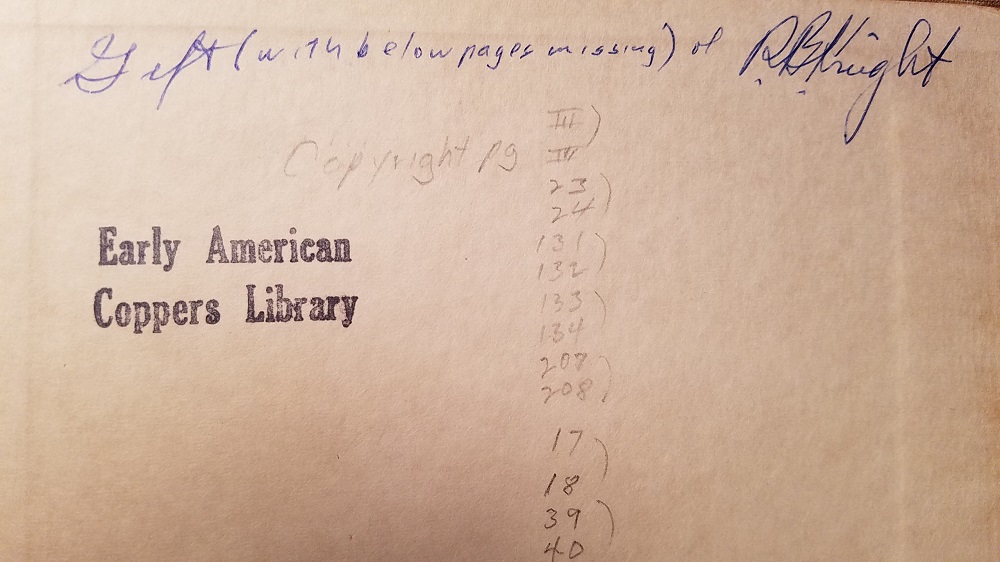
Richard B. Knight, yes, EAC member.
He was a contributor to Penny-Wise in the 70s. He authored at least one article I can find without pulling up PWRL:
"Early date U.S. large cents as investments," by R. B. Knight -- appeared in Volume VII, Issue #34 (1973.)
Member ANA - EAC - TNA - SSDC - CCT #890 "Most of the things worth doing in the world had been declared impossible before they were done." -- Louis D. Brandeis |
|
Bedrock of the Community
 United States
11966 Posts |
Thanks paralyse!
IN NECESSARIIS UNITAS - IN DUBIIS LIBERTAS - IN OMNIBUS CARITAS THE MAN IN THE ARENA, Theodore Roosevelt at the Sorbonne Paris on April 23, 1910: " It is not the critic who counts; not the man who points out how the strong man stumbles or where the doer of deeds could have done better. The credit belongs to the man who is actually in the arena, whose face is marred by dust and sweat and blood, who strives valiantly, who errs and comes up short again and again, because there is no effort without error or shortcoming, but who knows the great enthusiasms, the great devotions, who spends himself in a worthy cause; who, at the best, knows, in the end, the triumph of high achievement, and who, at the worst, if he fails, at least he fails while daring greatly, so that his place shall never be with those cold and timid souls who knew neither victory nor defeat." My coin website: https://fairfaxcoins.com |
|
Bedrock of the Community
United States
12057 Posts |
YW :)
Member ANA - EAC - TNA - SSDC - CCT #890 "Most of the things worth doing in the world had been declared impossible before they were done." -- Louis D. Brandeis |
|
Bedrock of the Community
United States
11966 Posts |
And thanks to all for your help and support.  IN NECESSARIIS UNITAS - IN DUBIIS LIBERTAS - IN OMNIBUS CARITAS THE MAN IN THE ARENA, Theodore Roosevelt at the Sorbonne Paris on April 23, 1910: " It is not the critic who counts; not the man who points out how the strong man stumbles or where the doer of deeds could have done better. The credit belongs to the man who is actually in the arena, whose face is marred by dust and sweat and blood, who strives valiantly, who errs and comes up short again and again, because there is no effort without error or shortcoming, but who knows the great enthusiasms, the great devotions, who spends himself in a worthy cause; who, at the best, knows, in the end, the triumph of high achievement, and who, at the worst, if he fails, at least he fails while daring greatly, so that his place shall never be with those cold and timid souls who knew neither victory nor defeat." My coin website: https://fairfaxcoins.com |
|
Bedrock of the Community
United States
11966 Posts |
IN NECESSARIIS UNITAS - IN DUBIIS LIBERTAS - IN OMNIBUS CARITAS THE MAN IN THE ARENA, Theodore Roosevelt at the Sorbonne Paris on April 23, 1910: " It is not the critic who counts; not the man who points out how the strong man stumbles or where the doer of deeds could have done better. The credit belongs to the man who is actually in the arena, whose face is marred by dust and sweat and blood, who strives valiantly, who errs and comes up short again and again, because there is no effort without error or shortcoming, but who knows the great enthusiasms, the great devotions, who spends himself in a worthy cause; who, at the best, knows, in the end, the triumph of high achievement, and who, at the worst, if he fails, at least he fails while daring greatly, so that his place shall never be with those cold and timid souls who knew neither victory nor defeat." My coin website: https://fairfaxcoins.comEdited by numismatic student
05/30/2017 9:56 pm
|
|
Bedrock of the Community
United States
20753 Posts |
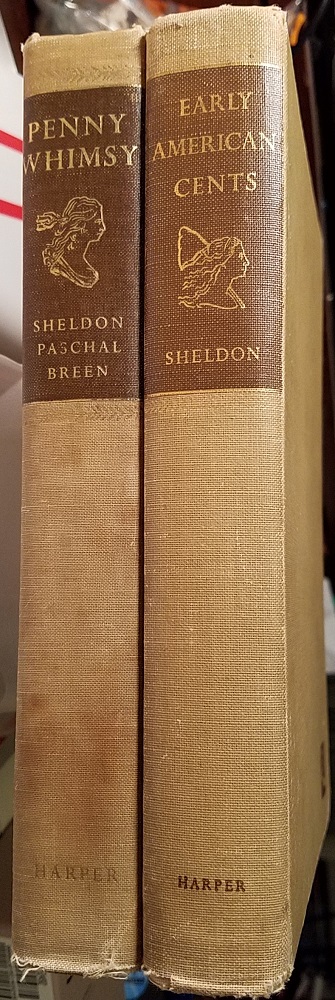
Really fantastic books. Wish I had those.
|
|
Bedrock of the Community
United States
12057 Posts |
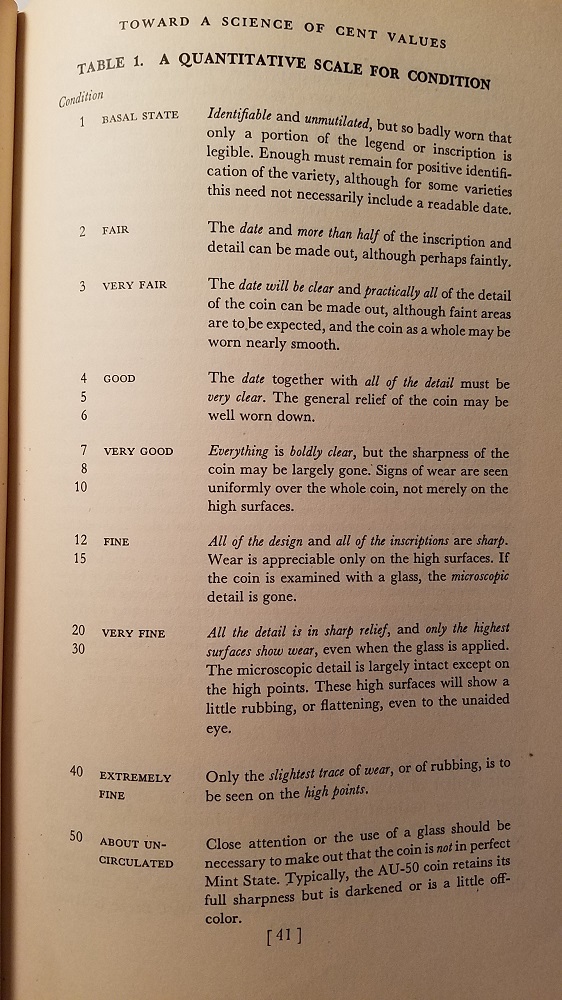
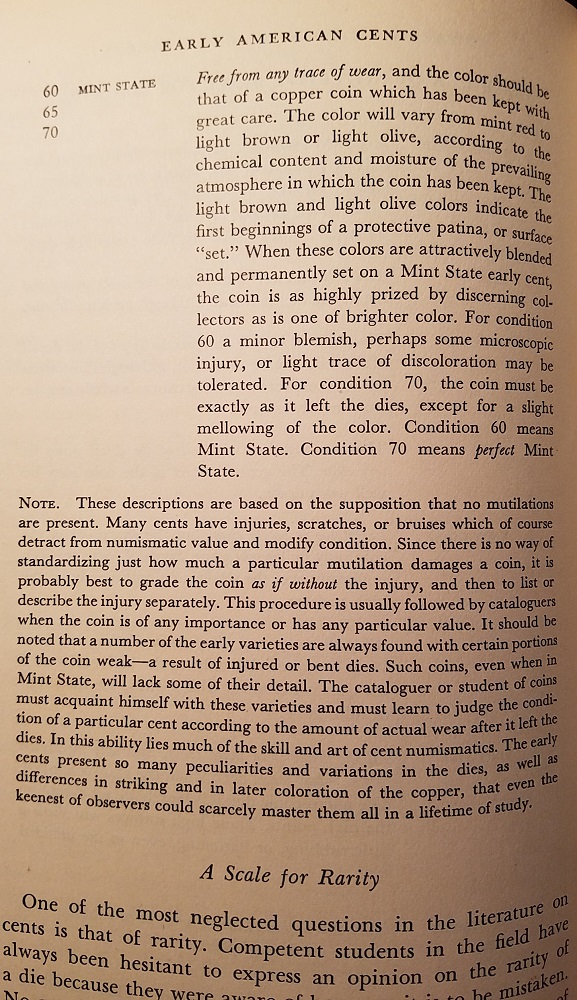
The scale's original concept - that a basal value of $1 could be assigned to a Poor grade for one of Sheldon's early date Large Cents, and that therefore, an Uncirculated was worth $60, $65 or even $70 - was outdated shortly after Sheldon conceived of the notion. Regardless, the fact that the grades were supposed to represent VALUES was soon lost, and the scale became simply numerical descriptors of written grade standards. Apart from Dr. Sheldon, I'm not sure anyone else minded this consequence in the least. To those who might think "gradeflation" is new to the hobby, or recently so, it is worth noting that Dr. Sheldon's condition descriptions for grades such as Fine and Very Fine had already been "gradeflated" by the time of Brown & Dunn's line-drawing grading book, which was the pre-ANA/Bressett standard for a number of years (and still is for some older collectors.) EAC grading falls more in line with Dr. Sheldon's system, although a bit more lenient and lacking the direct association with value, which explains why an EAC 45 large cent and a TPG XF45 large cent are often two VERY different looking coins. You might also note that Dr. Sheldon was of the school of thought that sharpness/wear grade should be the only grade assigned, and that defects, strike problems, die states, etc. should be listed in the description, allowing the collector the liberty of "mentally adjusting" a grade, and therefore a value, based on his or her opinion of any given coin. There was and is merit in this approach, since a buyer and seller who couldn't agree on anything else could usually agree on a sharpness grade, and then let the value be determined by the buyer's opinion of the other qualities of the coin. However, this was mutually incompatible with printed price guides. So net grading evolved to have a sharpness grade and a net grade, with the idea that the net grade would be used for prices/values. The ANA and some other early TPG's preferred split grading (obverse/reverse) instead of true net grading, and even that was dropped when the slab era dawned and the entire description had gone from the several sentences of Dr. Sheldon's book to the word "DETAILS" and a one or two word remark. Beautiful books, those, and I hope you keep them in your library for years to come. Member ANA - EAC - TNA - SSDC - CCT #890 "Most of the things worth doing in the world had been declared impossible before they were done." -- Louis D. Brandeis |
|
Pillar of the Community
United States
3479 Posts |
|
|
Bedrock of the Community
United States
11966 Posts |
Thanks for all the information and well wishes. I still can't believe that the auction for these books were at $30 or so, and I caught it with just a few minutes left on the bay. I guess you run into something cool every once in a while. Seller turned out to be a well known (I think - he comes up in google searches) EAC members who sold his extensive early copper collection in the mid 2000s at a major auction, and gave me some great advice to boot. IN NECESSARIIS UNITAS - IN DUBIIS LIBERTAS - IN OMNIBUS CARITAS THE MAN IN THE ARENA, Theodore Roosevelt at the Sorbonne Paris on April 23, 1910: " It is not the critic who counts; not the man who points out how the strong man stumbles or where the doer of deeds could have done better. The credit belongs to the man who is actually in the arena, whose face is marred by dust and sweat and blood, who strives valiantly, who errs and comes up short again and again, because there is no effort without error or shortcoming, but who knows the great enthusiasms, the great devotions, who spends himself in a worthy cause; who, at the best, knows, in the end, the triumph of high achievement, and who, at the worst, if he fails, at least he fails while daring greatly, so that his place shall never be with those cold and timid souls who knew neither victory nor defeat." My coin website: https://fairfaxcoins.com |
|
Pillar of the Community
 United States
2366 Posts |
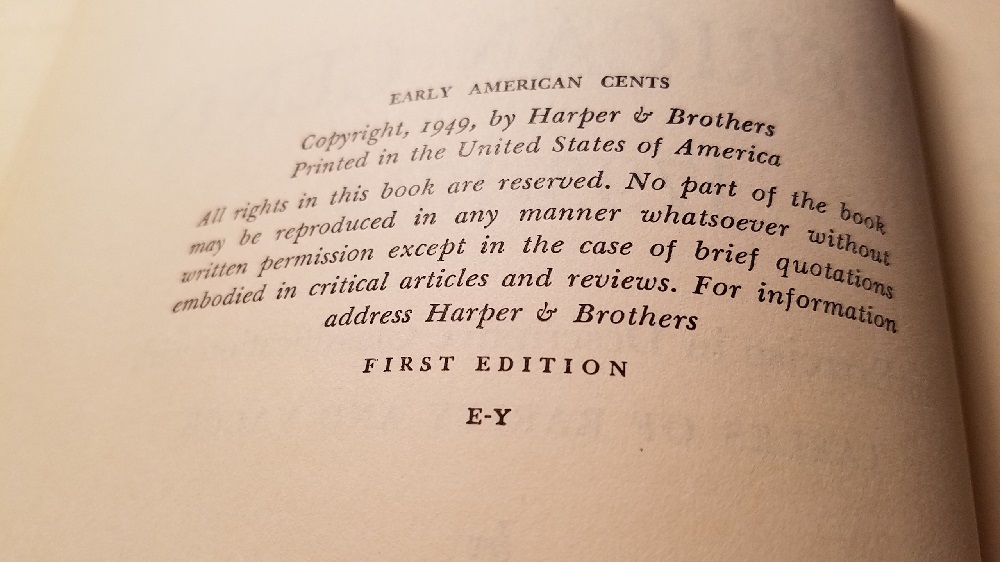
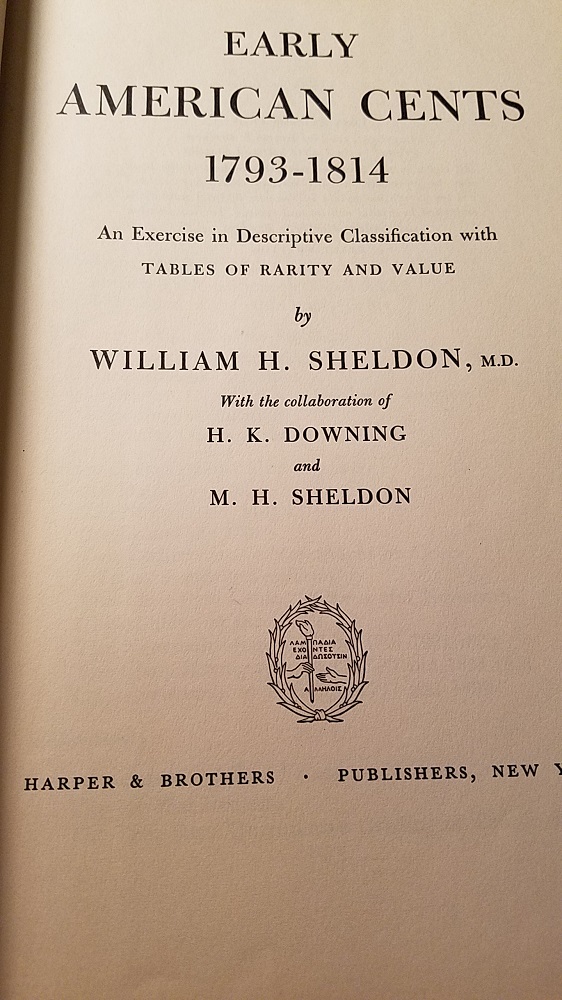
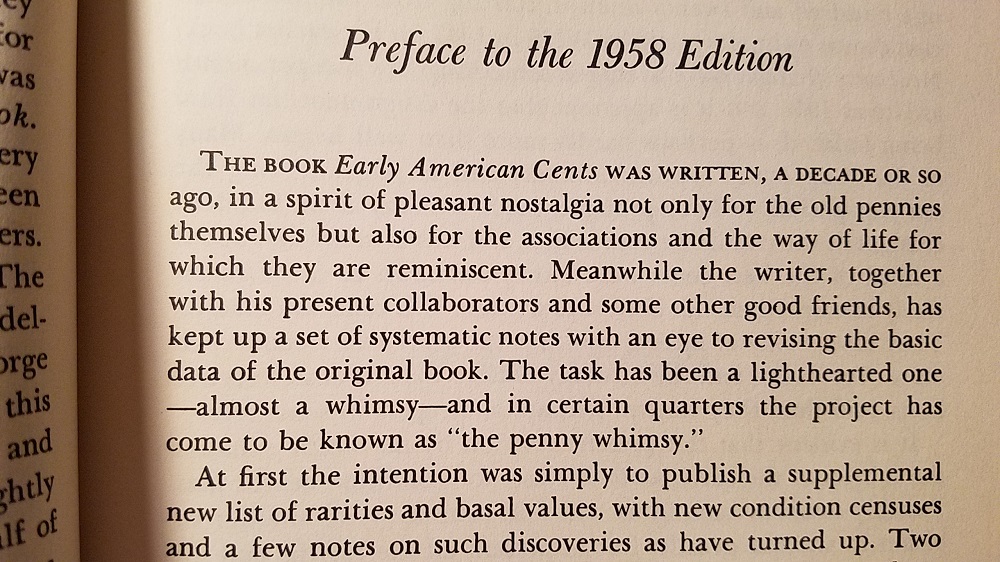
I bought a used copy of the 1958 edition a few years ago from a bookstore in Maine. Thanks for bringing up this topic as it reminded me to read and enjoy again the fascinating part 1 of this book. It's about 60 pages of introduction, background, and history of large cents. Great reading.
Member ANA and EAC "You got to lose to know how to win". Dream On by Aerosmith Edited by cipster
05/31/2017 12:05 pm
|
|
Moderator
United States
195742 Posts |
Quote:
Giddy to have received this today. Very nice, numismatic_student, and thank you for that post, paralyse. |
|
Bedrock of the Community
United States
17884 Posts |
Quote:
This work introduced to the world the Sheldon coin grading scale that we use every day today. Sheldon never introduced a grading scale, he introduced a pricing sysyem based on the grade. The grade descriptions shown were those alrady used in the collecting community at the time, they did not originate with Sheldon. The first step before you could apply Sheldon's numbers was to determine a strict, accurate grade for the coin. So you had the grade, and you had the price multiplier, or price scale, based on that grade. It is nothing like todays system. In todays system the number is simply an alternate name for the grade. |
|
Bedrock of the Community
United States
11966 Posts |
Quote:
Sheldon never introduced a grading scale, he introduced a pricing sysyem based on the grade. Wikipedia disagrees with you: https://en.wikipedia.org/wiki/Sheld...rading_scaleAnd so does William Sheldon. The author clearly states in the book that he came up with the 1-70 quantitative scale for condition (not value). He then posits that value would be easily derived from the numerical (grading) condition using the scale (which turned out to not be as simple as he believed). Sheldon thus introduced: 1. The 1-70 condition or grading scale, and 2. A system for pricing based on the quantitative scale. The scale was enormously successful and the de facto standard in use today with minor modifications and enhancements. The pricing system - not so much. Table 1: A Quantitative Scale for Condition 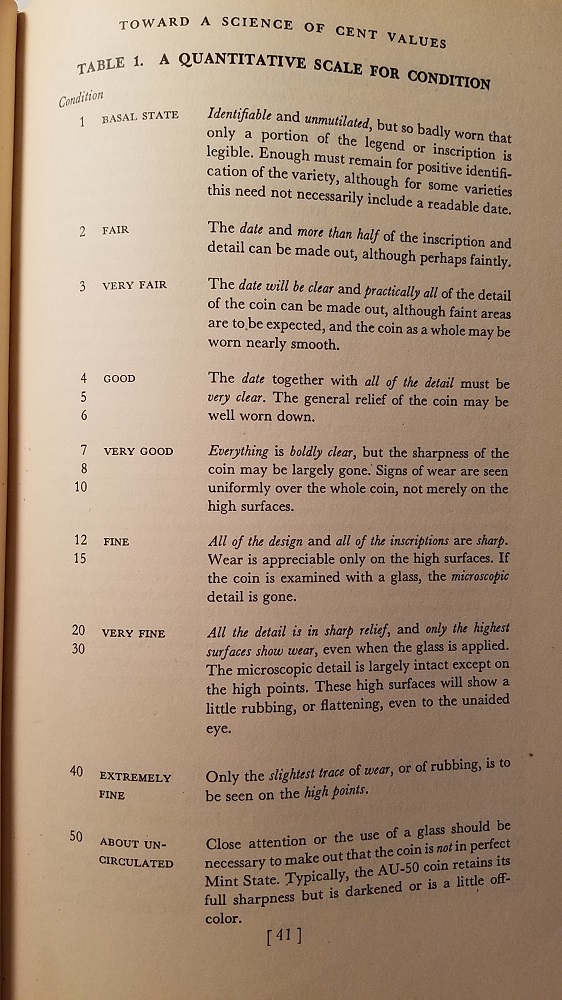 IN NECESSARIIS UNITAS - IN DUBIIS LIBERTAS - IN OMNIBUS CARITAS THE MAN IN THE ARENA, Theodore Roosevelt at the Sorbonne Paris on April 23, 1910: " It is not the critic who counts; not the man who points out how the strong man stumbles or where the doer of deeds could have done better. The credit belongs to the man who is actually in the arena, whose face is marred by dust and sweat and blood, who strives valiantly, who errs and comes up short again and again, because there is no effort without error or shortcoming, but who knows the great enthusiasms, the great devotions, who spends himself in a worthy cause; who, at the best, knows, in the end, the triumph of high achievement, and who, at the worst, if he fails, at least he fails while daring greatly, so that his place shall never be with those cold and timid souls who knew neither victory nor defeat." My coin website: https://fairfaxcoins.comEdited by numismatic student
06/01/2017 11:52 pm
|
|
Page 2 of 2
|
Replies: 17 / Views: 5,160 |
Page 2 of 2
|
To participate in the forum you must log in or register.
Disclaimer: While a tremendous amount of effort goes into ensuring the accuracy of the information contained in this site, Coin Community assumes no liability for errors. Copyright 2005 - 2026 Coin Community Family- all rights reserved worldwide. Use of any images or content on this website without prior written permission of Coin Community or the original lender is strictly prohibited.
Contact Us | Advertise Here | Privacy Policy / Terms of Use
|
| Coin Community Forum |
© 2005 - 2026 Coin Community Forums |
| It took 0.96 seconds to rattle this change. |
 |
|






 First Page


 Posted 05/26/2017 6:53 pm