| Author |
 Replies: 20 / Views: 6,898 Replies: 20 / Views: 6,898 |
Page 2 of 2
|
|
|
|
Pillar of the Community
 United States
3362 Posts |
I know that, at least for some metals, there is Lalpha1 line and Lbeta1 line which have escape depths more shallow than penetration depths. I hope someone can explain that to me!
|
|
Pillar of the Community
United States
3362 Posts |
Now that I think about it, any explanation which includes both L lines and K lines should be most helpful.
Edited by Pete2226
05/28/2018 06:15 am
|
|
Bedrock of the Community
Australia
21792 Posts |
Pete2226:
What is the typical penetration depth for hand held XRF scanners for:
1. copper?
2. copper nickel?
3. silver?
4. gold?
Thanks.
Edited by sel_69l
05/28/2018 08:30 am
|
|
Pillar of the Community
United States
3362 Posts |
Quote:
What is the typical penetration depth for hand held XRF scanners for:
1. copper?
2. copper nickel?
3. silver?
4. gold? I have not found the answer for all these elements yet. I do not understand K lines and L lines. I do not understand the nuances of the difference between penetration depth and "escape depth". Having said that, here is what I have found: "(The lighter elements (e.g. Na, Mg, Al, Si) have very low energy X-Rays, and thus will be difficult to detect even at relatively small depths within the sample. Heavier elements (e.g. Cu, Ag, and Au) have much more energetic X-Rays which will be able to pass through large distances within the sample." http://www.horiba.com/scientific/pr...tion-depths/Cu Emission Line: Kα1 Energy (keV) 8.01 Depth 580 microns (see the table below the first graph here): http://www.xrf.guru/styled-12/page40/index.html(Also I do not really understand what is being said about the SiO2 matrix?) Gold penetration @ 300 microns with 50keV, but practically speaking, only 10 microns to 18 microns. See this reference: (not allowing me to post this url, sorry |
|
Pillar of the Community
Canada
1747 Posts |
There are members on this forum that have Xrf machines and who are very willing to help people out testing their coins. you should PM SPP-Ottawa he uses one for work and will probably be able to answer all your questions.
Cheers.
|
|
Moderator
 Canada
10477 Posts |
Quote:
One of the strong limitations of XRF is that only the surface of the coin can be examined. This is incorrect, when you want to get into specifics. Penetration depth depends on many factors, but it all comes down to the power of the beam source (energy) and the matrix of the material being tested (density). The more powerful the beam source, the deeper the X-Rays penetrate. As each photon is emitted as a K or L shell line, the spectral peaks resulting from such fluorescence can be thought of as atom counts of sorts - though the quantity of photons is determined by both the voltage of the tube and the depth of penetration. The depth of penetration can be calculated by the following equation: I/I0 = e[-(μ/ρ)x] (1) where I is the quantity of photons returning from the sample, I0 is the quantity of photons entering the sample, μ/ρ represents the mass attenuation coefficient of a given element for a particular matrix, and x represents the density of the object. You can find mass attenuation coefficients at NIST: https://physics.nist.gov/PhysRefDat...ml/form.html For coins and other metallic alloys, you have to remember that while the penetration depth is one factor, note that electrons are dislodged from their orbital shells throughout the entire depth of analysis... so, in layman's terms, a gold-plated Cu-Ni coin will give results of gold, nickel and copper values. The thicker the electroplating, the more influence the surface material has on the analytical results. 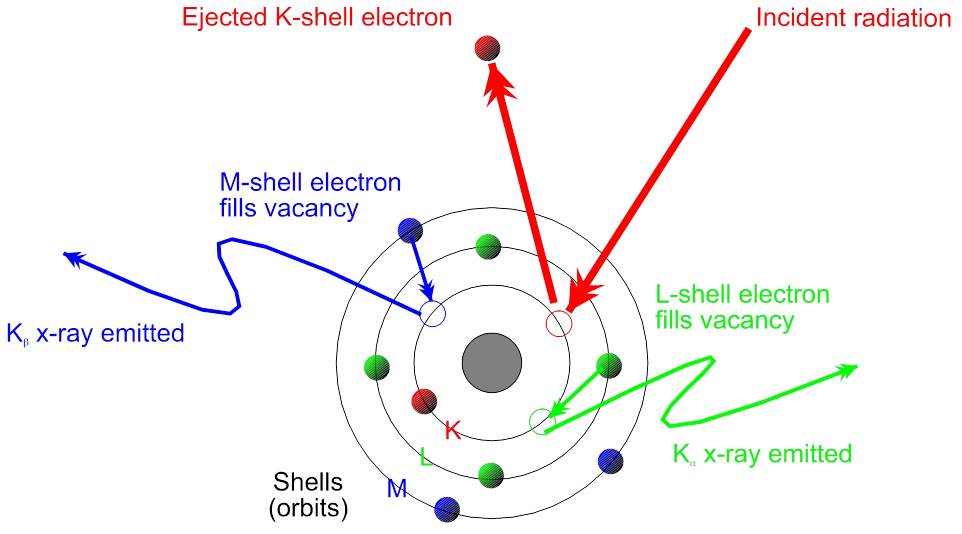 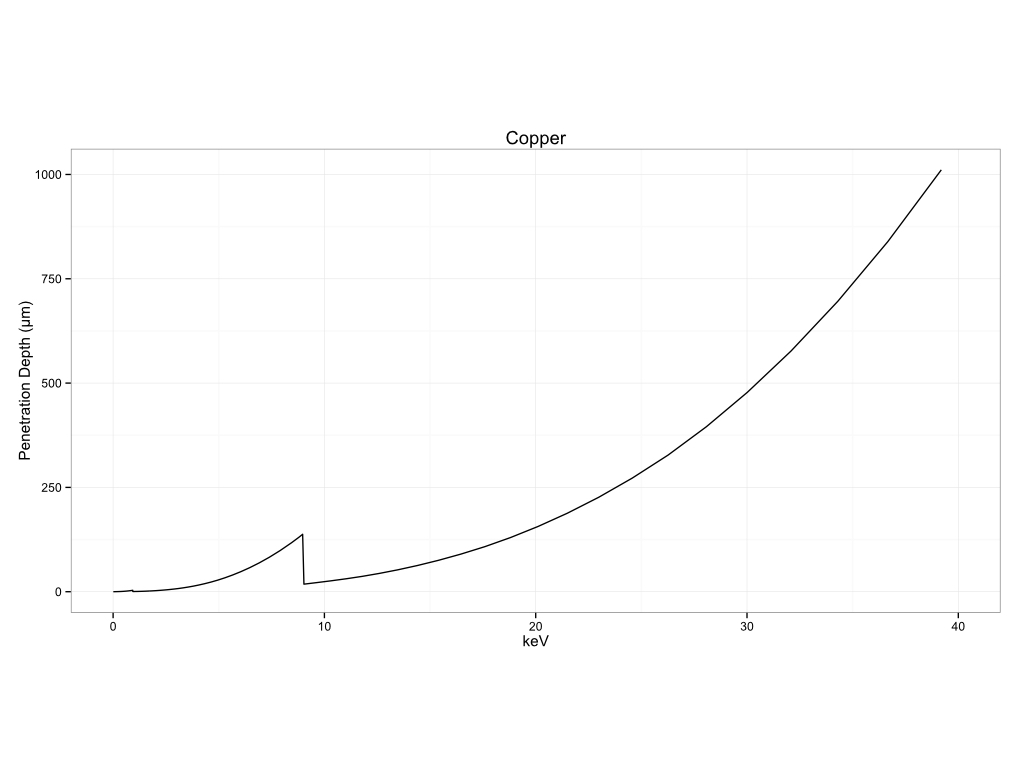 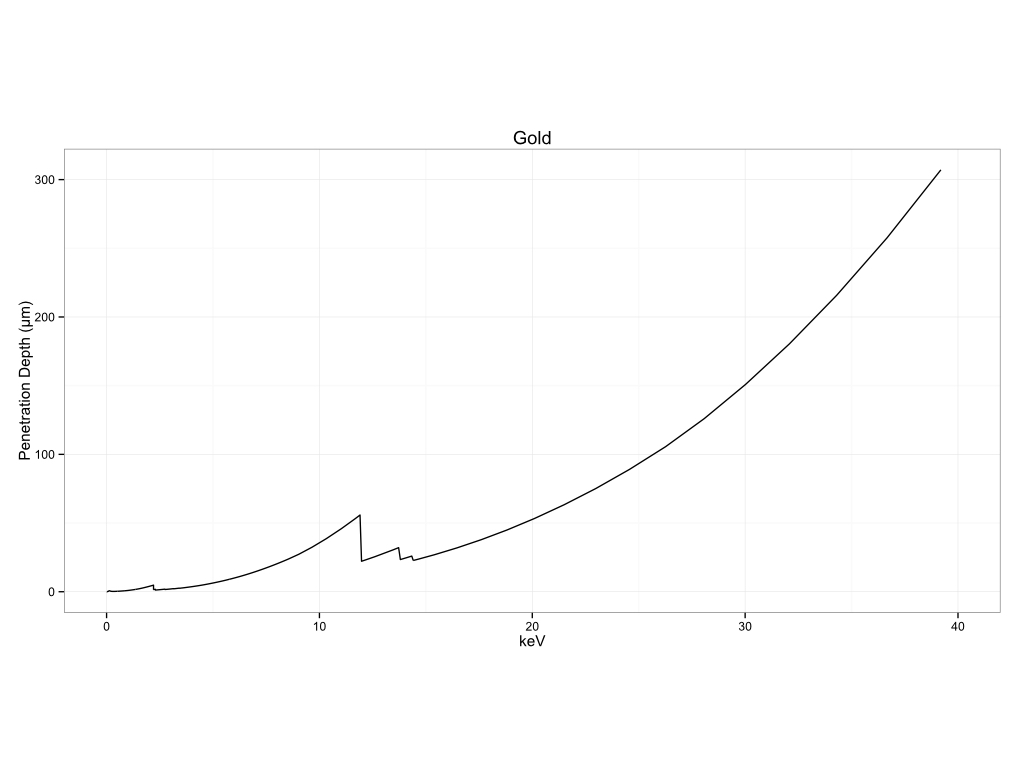 I test coins on the XRF in my lab, right inside the mylar 2x2s cardboard flips. Mylar barely attenuates the beam, as you can see by its penetration depth - hence why mylar film is used in handheld XRF instruments to protect the very sensitive detector from contamination and damage. 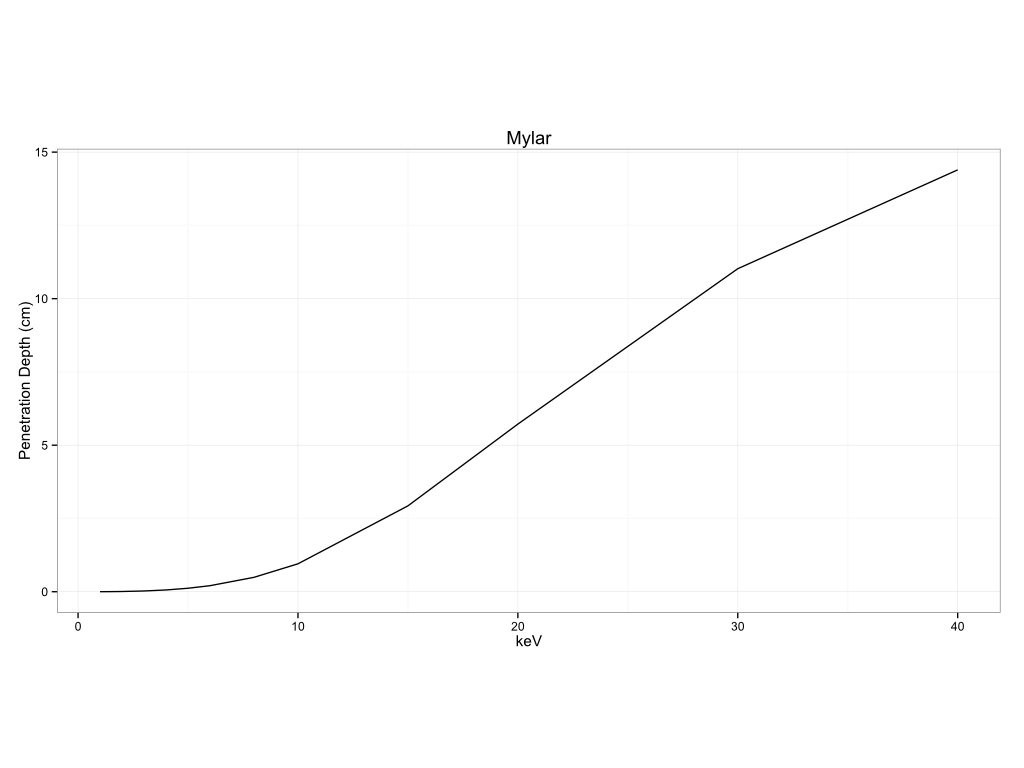 So yes - XRF can detected if a coin has been plated, because it picks up the other elements under the plating. The compositional values will be skewed to the plating. If the plating is too thick (cladding) then the energy beam cannot penetrate it to the underlying coin. But, if you know what you are doing, XRF is a powerful tool. In general, it is fair to assume that X-Rays will penetrate a few micrometers down to more than 100 microns of a coin's surface, depending on the sample matrix. Archeologists love using the XRF because it penetrates the oxide coatings (i.e., rust) of ancient tools without having to damage or clean them. "Discovery follows discovery, each both raising and answering questions, each ending a long search, and each providing the new instruments for a new search." -- J. Robert OppenheimerContent of this post is licensed under a Creative Commons Attribution-NonCommercial 3.0 Unported License. See: http://creativecommons.org/licenses...0/deed.en_USMy eBay store
|
|
Moderator
Canada
10477 Posts |
In short - to answer your question, yes, I have tested lots of plated coins... Dealers send me material sometimes because with off-metal error strikes, it can be tricky.
Clad coins no, as the cladding is too thick, but I was able to detect a silver-plated clad coin...
Gold bars and other bullion like ingots... it is not useful, as the cladding will be thick enough beyond the maximum penetration depth of the beam energy.
That said, a portable XRF is not black box technology. One must understand how the various elements behave when shell electrons are displaced and know their relationship in the Periodic Table when the detection software tries to interpret the energy peaks.
"Discovery follows discovery, each both raising and answering questions, each ending a long search, and each providing the new instruments for a new search." -- J. Robert OppenheimerContent of this post is licensed under a Creative Commons Attribution-NonCommercial 3.0 Unported License. See: http://creativecommons.org/licenses...0/deed.en_USMy eBay store
|
|
Pillar of the Community
United States
3362 Posts |
|
|
Pillar of the Community
United States
3362 Posts |
Would you be willing to allow for folks to send you coins for XRF analysis? If so, details on cost and where to send? (I don't mind if you send me a message instead of making it public.)
|
|
Pillar of the Community
United States
3362 Posts |
Another question: what is the expected penetration depth for Cupro Nickel (75% Cu and 25% Ni)?
|
|
Moderator
Canada
10477 Posts |
I do test coins for collectors, at no cost. Usually one or two coins, if all other avenues to determine composition (for example off-metal coins) have not ruled the coin as a garage job. You have to pay for the postage - the caveat is that if it is something interesting, I get to publish the results (either here at CCF or in research articles).
"Discovery follows discovery, each both raising and answering questions, each ending a long search, and each providing the new instruments for a new search." -- J. Robert OppenheimerContent of this post is licensed under a Creative Commons Attribution-NonCommercial 3.0 Unported License. See: http://creativecommons.org/licenses...0/deed.en_USMy eBay store
|
|
Moderator
Canada
10477 Posts |
Quote:
Another question: what is the expected penetration depth for Cupro Nickel (75% Cu and 25% Ni)? If the beam source is constant - it is a function of density... I showed two metals of differing densities in my previous post. A quick peek at the Periodic Table should be a good clue for you... try and figure it out!  "Discovery follows discovery, each both raising and answering questions, each ending a long search, and each providing the new instruments for a new search." -- J. Robert OppenheimerContent of this post is licensed under a Creative Commons Attribution-NonCommercial 3.0 Unported License. See: http://creativecommons.org/licenses...0/deed.en_USMy eBay store
|
|
Pillar of the Community
United States
3362 Posts |
Quote:
If the beam source is constant - it is a function of density... I showed two metals of differing densities in my previous post. A quick peek at the Periodic Table should be a good clue for you... try and figure it out! I am not sure how to do the math, but just trying to approximate, I offer penetration depths: 75%Cu 25%Ni = approx. 140 microns @ 20 keV 75%Cu 25%Ni = approx. 950 microns @ 35 keV Quarter clad layer of the composite strip out of which blanks are punched = 228.6 microns +/- 25.4 microns I would conclude that if a scan is at the higher levels of keV, the clad layer of a quarter should be able to be penetrated with room to spare. What am I missing? |
|
Moderator
Canada
10477 Posts |
My XRF has a 50 keV iridium beam source... maybe I should grab a clad US quarter and test your math... but I am skeptical...
Don't forget that is penetration depth only, there still has to be enough energy for the "escape depth", meaning that the energy penetrates but also has to escape back to the detector. Also, energy is attenuated all the way down to maximum penetration depth,
"Discovery follows discovery, each both raising and answering questions, each ending a long search, and each providing the new instruments for a new search." -- J. Robert OppenheimerContent of this post is licensed under a Creative Commons Attribution-NonCommercial 3.0 Unported License. See: http://creativecommons.org/licenses...0/deed.en_USMy eBay store
|
|
Pillar of the Community
United States
3362 Posts |
Quote:
My XRF has a 50 keV iridium beam source... maybe I should grab a clad US quarter and test your math... but I am skeptical... I don't know about my math either, but those are approximate values from comparing densities of the elements. I was surprised to see that Ni and Cu are only 0.06 different in density! I would be most interest in the results of such a scan. I am aware of the need for the ray to escape, but I have seen very little about calculating the depths for that! (Except that it will probably be from a more shallow depth). Edited by Pete2226
05/30/2018 2:35 pm
|
|
Page 2 of 2
|
Replies: 20 / Views: 6,898 |
Page 2 of 2
|





 First Page

 Posted 05/28/2018 06:15 am





