| Author |
 Replies: 17 / Views: 4,019 Replies: 17 / Views: 4,019 |
Page 2 of 2
|
|
|
|
Bedrock of the Community
United States
79348 Posts |
That's 100 percent Post Strike Damage (happened after it left the U.S. Mint). It was dipped in acid, causing the coin to reduce in size.
Errers and Varietys.
|
|
Bedrock of the Community
United States
12477 Posts |
 I don't even think being in the ground for decades would corrode it that much (conjecture). In Memory of Crazyb0 12-26-1951 to 7-27-2020
In Memory of Tootallious 3-31-1964 to 4-15-2020
In Memory of T-BOP 10-12-1949 to 1-19-2024
|
|
Valued Member
United States
420 Posts |
Quote:
I don't even think being in the ground for decades would corrode it that much (conjecture). You are quite correct, spruett001.. I have seriously dug thousands of pennies while metal detecting and have never seen a pre-'83 come out of the ground in anywhere close to that condition.. Ya can't include zincolns, because by the time they start to get thin they just fall apart.. Swamp |
|
Pillar of the Community
 United States
6514 Posts |
on both the acid damage assessment and that being burried would not cause it to dissolve like that. Check out my counterstamped Lincoln Cent collection: http://goccf.com/t/303507 |
|
Bedrock of the Community
Canada
24885 Posts |
Quote:
Spent time in an acid bath.  |
|
Pillar of the Community
United States
8715 Posts |
It has been damaged with acid. PMD. |
|
Bedrock of the Community
United States
17884 Posts |
Quote:
I don't even think being in the ground for decades would corrode it that much (conjecture) Peat bog or other formerly swampy area might do it, plenty of water and decomposing vegetation creates an acidic environment. Edited by Conder101
06/01/2018 11:52 am
|
|
Valued Member
United States
420 Posts |
Quote:
Peat bog or other formerly swampy area might do it, plenty of water and decomposing vegetation creates an acidic environment. True that, or so it would seem.. However, in the Abstract of: "The effect of soil conditions on the long-term corrosion of buried tin-bronzes and copper," R.F. Tylecote states: "The object of this work was to relate the corrosion of tin-bronzes to the chemical condition of the soil in which they have been buried, most of them since the Bronze Age. Naturally, it was not easy to obtain recent hoards with their related soils, and considerable reliance had to be placed on recorded finds by taking recent soil samples from sites on which hoards were found over a hundred years earlier. Even so, with the exception of peat, a reasonable relationship appears to exist between the pH of the soil and the state of the metal. Acid soils are aggressive to metals and alkaline soils are benign. In no cases were sulphate reducing bacteria active in promoting corrosion. In the main, peat and peaty soils were benign in spite of their acidity, probably due to the protective action of polyphenols." https://www.sciencedirect.com/scien...440379900189 Interesting.. Swamp EDIT: For those wishing to delve a bit deeper, check this out: "The Conservation of Early Post-Medieval Period Coins Found in Estonia" Authors: Viljus, A. & Viljus, M., (2013). The Conservation of Early Post-Medieval Period Coins Found in Estonia . Journal of Conservation and Museum Studies . 10 ( 2 ) , pp . 30-44 . DOI: http://doi.org/10.5334/jcms.1021204Abstract: This article deals with archaeological find material with a low silver content and the problems of conserving such material. The aim of the research was to find the most suitable method for the conservation of poorly preserved early post-medieval period coins with varying composition. For this, first, the composition of both the metal and the corrosion products of the archaeological coins were analysed, after which comparative experiments of different cleaning methods were carried out in order to find out the least harmful and most efficient method. A test was also performed to determine the necessity and efficiency of stabilizing the surface of the coins after cleaning. https://www.jcms-journal.com/articl...cms.1021204/-- Along with solid procedurals there are great photos of before / during / after.. Edited by da Swampster
06/01/2018 5:23 pm
|
|
Valued Member
 United States
292 Posts |
Ok So I can some what accept this acid theory. I can understand this causing the edge to deteriorate and the surface to be dissolved away. But can you explain why the coin is so thin? I would assume that acid would start dissolving the exposed surface all around the coin. so the whole rim is missing and I would assume if it took that much off the edge it would have dissolved that much from the obverse and reverse? leaving no raised areas. Instead we can still see the date and mint mark? I also added images of the side view. to show how thin the coin is. I can't believe that if you took off the details on both sides, the coin is only this thick? And we still have the details still showing. Is the amount of material between the front detail and the back detail, paper thin? I have it side by side with a dime. 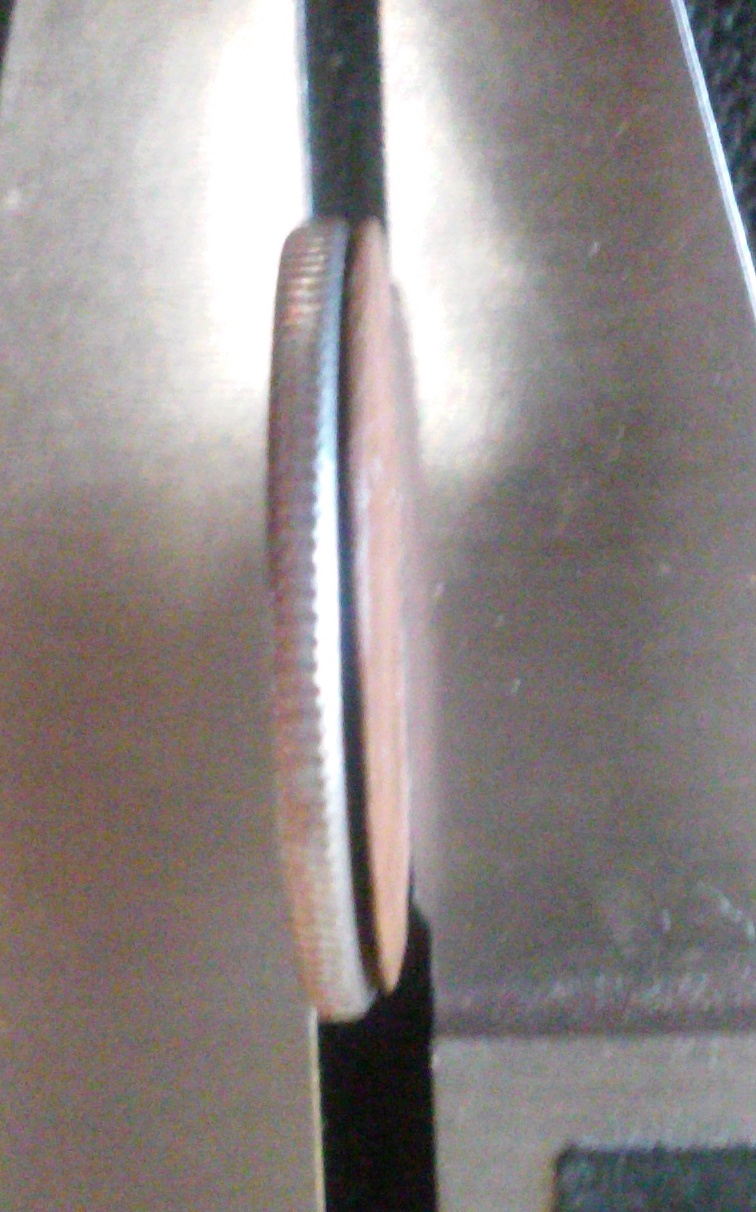 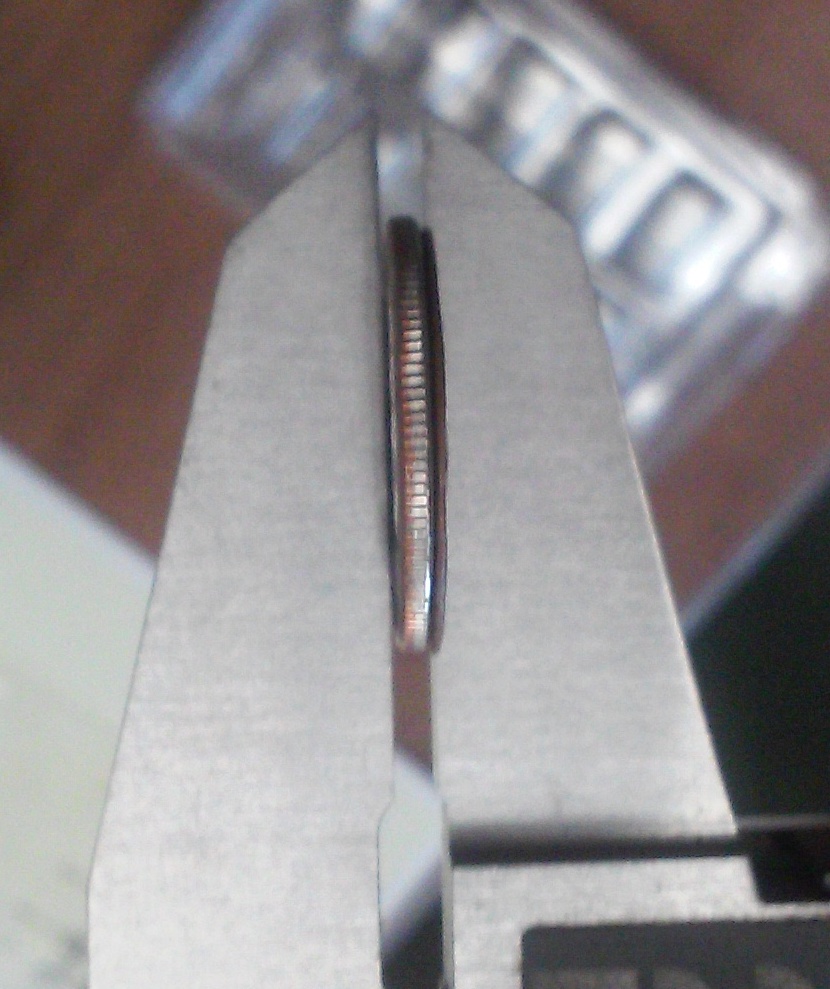 |
|
Pillar of the Community
7234 Posts |
Quote:
leaving no raised areas. Instead we can still see the date and mint mark? Leaving no raised areas would mean the acid would only eat away at the devices (raised areas) untill it reached the surface of the coin - No, it eats away everything equally down at the same time - leaving the details to still be seen! |
|
Valued Member
United States
292 Posts |
so if you stripped away or sanded off all the details on both sides what would the thickness be of the remaining stock? Also then why is the thickest part of the coin, the rim, completely gone? shouldn't there be dissolved through spots in the flat areas of the coin?
|
|
Valued Member
United States
97 Posts |
Whether dissolved by acid or electrolytic process, the highest rate of corrosion will occur at the rim, on the diametrical edges where both obverse and reverse surfaces intersect the rim. The corrosion is acting on both the rim, and on the obv/rev surfaces, so 2x the corrosion initially at those locations.
|
|
Bedrock of the Community
United States
12477 Posts |
The rim is being noticeably affected in two directions at once. In Memory of Crazyb0 12-26-1951 to 7-27-2020
In Memory of Tootallious 3-31-1964 to 4-15-2020
In Memory of T-BOP 10-12-1949 to 1-19-2024
|
|
Valued Member
United States
292 Posts |
SO I understand that the edge would be effected top, bottom and side. but the edge is also twice as thick. So wouldn't that effect the dissolve rate? Plus the the thinest parts of the coin, the field, why wouldn't it be dissolved through in spots compared to the say the center of the coin where it is thicker due to the raised face on front and the memorial on back.?
|
|
Bedrock of the Community
United States
62064 Posts |
Because some detail is there, it wasn't sanded. It was in acid or something acidic that reduced the size of the coin.
|
|
Page 2 of 2
|
Replies: 17 / Views: 4,019 |
Page 2 of 2
|








 First Page


 Posted 06/01/2018 12:35 am


