| Author |
 Replies: 35 / Views: 7,290 Replies: 35 / Views: 7,290 |
Page 3 of 3
|
|
|
|
Pillar of the Community
United States
3363 Posts |
I don't think it's metallic silver llewellin. More likely it's an oxide or sulfide of silver and/or copper which is near, or on, the surface. It might form the spots by detaching and "pilling" the way fabric does when it is rubbed. Tarnish balls. Update: I took the spotted 1807 quarter and an 1828 French 5F with even worse spotting, wrapped them in aluminum foil and boiled them in a baking soda solution. The sulfide is supposed to preferentially transfer from silver to aluminum. https://www.apartmenttherapy.com/ho...ilver-131048The treatment removed the black spots from both coins, and the heavy tarnish on the 5F was mostly removed. The next step is to put them back in the coin pouch and see if this desulfuring treatment eliminates the spotting. These are both cull coins. DO NOT do this to a numismatic coin."Two minutes ago I would have sold my chances for a tired dime." Fred Astaire
Edited by thq
04/07/2019 11:22 pm
|
|
Valued Member
United States
414 Posts |
Interesting thread folks. I don't know much about the chemical component of your discussion but I can certainly attest that porous coins without a doubt ring differently. I have several older thalers and European crowns that are not sea salvaged. Their planchet is porous (whether it was so when struck is unknown) and they ring completely differently when flipped than other silver coinage.
Also, I think Bob is spot on about saltwater coins containing micro-fissures and being "sponge like". I don't know necessarily if the salt water remains (also seems unlikely to me), but I don't think it is unreasonable for salt particles to be present. Secondly, if the coin is porous and contains micro-fissures, doesn't it by definition imply that tiny amounts of air get trapped inside the coin? Perhaps it is this air that raises the buoyancy of the coin and is responsible for the lower than expected SG measure. If you were to do an SG test and keep the coin submerged for a much longer period of time so as to allow the air particles to exit the coin (perhaps rotating the coin may be required), will the SG measure rise?
|
|
Pillar of the Community
United States
3363 Posts |
Specific gravity is a displacement test cableguy. The weight of the dry coin divided by the weight of the water it displaced. In Squire's case "24.62gr and suspended in water as 2.46gr" = 24.62/2.46
The water displaced is the volume of the coin. If the spongy coin sits in water long enough it will resaturate, but for the short duration of a specific gravity test it probably doesn't. It takes a while for the water to displace the air inside the micropores.
Air has a specific gravity of slightly more than zero (.0013). The air trapped inside the coin isn't enough to make it float, but it certainly lowers its specific gravity.
"Two minutes ago I would have sold my chances for a tired dime." Fred Astaire
Edited by thq
04/08/2019 4:45 pm
|
|
Valued Member
United States
414 Posts |
I told you I wasn't a chemist. Forgive my ignorance here but I'm not sure I understand how air inside a coin doesn't make it float? Hypothetically speaking, if the coin was hollow or had a hollow center filled with air, wouldn't it float, or at least be much more buoyant than a regular coin? If so, wouldn't that affect the SG of the coin as like you said, it would displace much less water?
Now that I'm thinking more about it, I guess I see the fallacy in my thought process. The hollow coin would also weigh much less outside the water. So theoretically speaking, would the SG of two identical coins, one hollow and one regular be identical?
|
|
Pillar of the Community
United States
3363 Posts |
In order for it to float the specific gravity of the hollow object has to be less than water. Think about a silver ping pong ball. If the silver shell is thin enough, the air volume at .0013 sg overcomes the silver at 10 sg to give an overall structure with sg less than 1 sg water, and it floats. In the case of the spongy coin, the air is at most 5-10% of the total coin volume, and way too little to make it float.
"Two minutes ago I would have sold my chances for a tired dime." Fred Astaire
|
|
Pillar of the Community
United States
5362 Posts |
This thread covers a lot of material that is found in undergraduate science classes and it can be very confusing for people who are not versed in those sciences.
Keep in mind that when we discuss coins we need to consider changes to the outside of the coin as well as changes to the internal structure of the metal alloy iteself. These are normally somewhat similar but simultaneously not at all the same.
When I was first taking courses in geology in High School, I was surprised to find that many rocks were not as solid as I initially thought they were. Rocks, it turns out, can be very low density like pumice which floats on water (S.G. under 1.00) or basalt which is quite dense (S.G. of 3 ). All rocks also have internal structures which are studied to establish two important characteristics associated with rocks and soils - porosity and permeability. Porosity is a measure the relative amount of open space between the individual granules in a rock or soil while permeability refers to the ability of a liquid or gas to pass through a rock or soil. A rock or soil can be porous without being permeable.
In practical terms this distinction is useful for rock climbers who want to avoid soft rocks that are permeable - in particular right AFTER a rainstorm. For that reason granite is preferred by climbers over sandstone because a granite surface dries quicker. Internal moisture in impermeable granite is often trapped for all intents and purposes while water moves easily in sandstone which is normally highly permeable.
Something similar can be thought of as applying to silver copper alloys that have been operated on by electrolysis, corrosion and abrasion as we see in sea water wrecks. Near the surface very large pores can form in the alloy from a combination of electrolysis, corrosion and mechanical actions. These large pores are sufficiently large to allow water to easily drain out or evaporate from the metal. This outer portion of the coin can be viewed as porous and very permeable. However, micro-pores which are the result of electrolysis along individual grain lines without any corrosion or mechanical action are rarely large enough to allow for any permeability of liquid water. This water would migrate out of the coin very slowly over time even more slowly than a low permeability rock.
When we measure SG using water - the water fills the outer pores but not the inner micro-pores. That is why using water actually works.
The volume of the salvaged coin decreases due to all of the surface effects of electrolysis, corrosion and abrasion. The SG is altered only when the composition of the alloy is changed by the removal of one element selectively. In the case discussed here Copper is the reactive element and it will be removed. The loss of copper faster than silver reduces the density of the remaining coin.
To make a coin float you would need to make the density drop below 1.
Someone mentioned a hollow coin. If you had two coins of the same size (volume) they would need to be the same total weight to get the same SG. So theoretically if you had a dense enough material you could make a hollow coin with the same density of a solid silver coin, but such a material is not known to exist. The densest element known is osmium at under 23 only about 2 times that of silver.
Now lets look at the silver copper alloy used in most coins (about 90% Ag 10% Cu). In the case of this alloy the speed of cooling results in a differentiation of the components of the alloy - the slower the cooling progresses the larger the grains become and the more the components tend to differentiate from each other. The larger the elemental grains the more susceptible to electrolysis the coin becomes.
Cast metal (silver) has a lower Specific Gravity (or density) than worked or struck silver. So you need to consider how a coin was fabricated to see what density it should have. This is also a reason a cast coin will not ring but a struck coin will. The small spaces between the grains are compressed by the strike.
The fillet ingots used in Spanish and Mexican mints were small in size so they could be worked on manually powered machines. This small size meant there would be fewer inclusions in the alloy as well as resulting in a rapid cooling of the metal which produced a nearly uniform alloy.
Inclusions seen in silver fillet ingots were primarily minute traces of fire scale (debris from working and re-melting) and tiny air or vapor pockets. These pockets might contain air or not. The normal vapor found in casting bubbles is usually metallic and condensation of the vapor into metal leaves a vacuum in the silver. The the metal condenses on the inside of the bubble. The fire scale is a solid material consisting of impurities or corrosion products (neither being metallic silver or copper). Too much of either kind of inclusions in the ingot can effect the density of the entire ingot and result in re-melting or even re-purification of the metal.
This was why the development of fillet ingots produced increased output, because it reduced the number of poor ingots.
Density as noted above is a relationship between weight and volume. Water is the standard against which other things are measured. So coined silver 900 fine is 10.31 times as heavy as an equal volume of water. Only things with a density under 1.00 will float.
The micro-structure of silver even when subjected to electrolysis is NOT permiable to water. If it was then water would pass through the coins readily. As an expiriment take a sea water recovered coin and place it on a flat level surface covered with tissue paper. Then take an eye dropper and apply water to the upper surface of the coin. How long is it before the tissue paper gets wet?
I agree that some water can be evolved from a sea salvaged coin by heating it to change the residual water into vapor. But how long it takes to completely dry a silver alloy must be far higher than stones. BTW a one inch thick slab of granite can take one week of heating to dry fully.
|
|
Pillar of the Community
 Australia
653 Posts |
Great feedback  Just out of interest, I have done Specific Gravity tests of the type conducted on my Rooswijk 8 Real coin on other 8 Real pieces in my collection For the mysterious 1766 / reverse 1765 piece of http://goccf.com/t/329523&SearchTerms=1766 the SG is 10.31. I believe this corresponds to 90% silver For the 1806 Class 2 English Contemporary Counterfeit 8 Real of http://goccf.com/t/102023&whichpage=2 this has a SG of 10.24. I believe this corresponds to 86 percent silver. If correct this would amount to a tidy profit for the English? Traders on the "China Run". I believe the Chinese Schroffs could not discriminate between 86% and 90% silver in the coinage using the methods of the times Squire |
|
Pillar of the Community
United States
3363 Posts |
English? They sound Scottish to me Squire....
The English steel we could disdain
Secure in valor's station
But English gold has been our bane
Such a parcel of rogues in a nation.
-Robert Burns
"Two minutes ago I would have sold my chances for a tired dime." Fred Astaire
|
|
Pillar of the Community
United States
1915 Posts |
I'll make another comment concerning dry and submerged coin weight:
I have seen and had to wait before recording a stable value because I see the measure very slowly change with time under water.
When wet and out of the water, I see the weight slowly decrease as the water evaporates.
Some porous coins can hang suspended under my lab balance quite a while before slowly returning to the dry weight.
If one used initial or stabilized values, the SG can be different.
|
|
Pillar of the Community
Australia
653 Posts |
Great response thq . Investigating the Robert Burns poem on the Internet led me to the Scottish (Caledonian) "Darien Scheme". A fascinating piece of history that I was not aware of. It also highlights the "economic skulduggery" that occurred during the 17th Century. This has a parallel to the nefarious activities of the "China Trade" and my 1806 Class 2 English Contemporary Counterfeit 8 Real Thanks for stimulating this research  Thanks also for your feedback Albert. Squire |
|
Pillar of the Community
United States
5362 Posts |
Squire Wilson I agree that shorting coin by as little as 4% would be worthwhile. The English actually used a standard of 850 fine to provide an extra 5% to pay for the manufacture and transport of these counterfeits to China. The 25% premium paid for the coins by inland farmers meant a very neat profit of almost 30% per coin. You are correct that the Chinese schroffs were not able to correctly distinguish an 850 fine silver coin from a 903 or 896 fine Mexican issue. It was the English who first introduced the schroff's to the principle of specific gravity for checking dollars in 1835. But the scales available were good enough to pick out coins under 800 fine not 850 fine. The English were not at all magnanimous in doing so. They did it as a means of self protection to avoid the even lower standard fakes being produced in China itself. There are records in diplomatic correspondence of 800 fine local counterfeits that were sent back to the London mint for testing. So SG testing was introduced so that the schroffs could reject these locally produced forgeries and in turn they would not be presented to the English for payment. Your coin at 860 fine is just over the English standard in place in 1835. When the US entered the same market about 50 years later they tended to produce coins at or near 900 fine (US standard for silver coin). This would avoid detection even with improved scales and it avoided making a distinct alloy. By the late 1870s silver was falling in price in relation to the newly adopted gold standard (1873). The 25% premium paid for silver coins bearing the Charles III and IV portraits was adequate to incentive to sell silver coming out of Nevada. The Trade dollar introduced for the same purpose was a failure and the US then turned to counterfeiting Mexican dollars to take advantage of the Chinese. It is believed by some writers that the manufacture of these Class 2 silver counterfeits was not limited to just the US and England. I have read papers that implicate the Netherlands, Spain and even Mexico itself in the production. It was very likely that anyone capable of making decent copies of a Mexican Portrait 8R could profit in the same way. It was viewed as a legitimate business opportunity in many circles.
|
|
Pillar of the Community
United States
3363 Posts |
Update to 4/7 post: After 5 days carrying in the coin pouch, neither the 1807 quarter nor the 1828 French 5F have formed any black spots. The baking soda boiling treatment of aluminum foil wrapped coins appears to remove the blackening sulfur from the coin surfaces.
"Two minutes ago I would have sold my chances for a tired dime." Fred Astaire
|
|
New Member
United States
15 Posts |
Hello, sorry to post on replies, but wasn't sure where to post this and this was the closest I found. I have a 1711 Peru 8 realest that I found at a garage sale for $4. I sent a pic to someone who deals with these quite a bit and he said it looked real to him. I was hoping someone here could give me your thoughts on it and what to do with it. 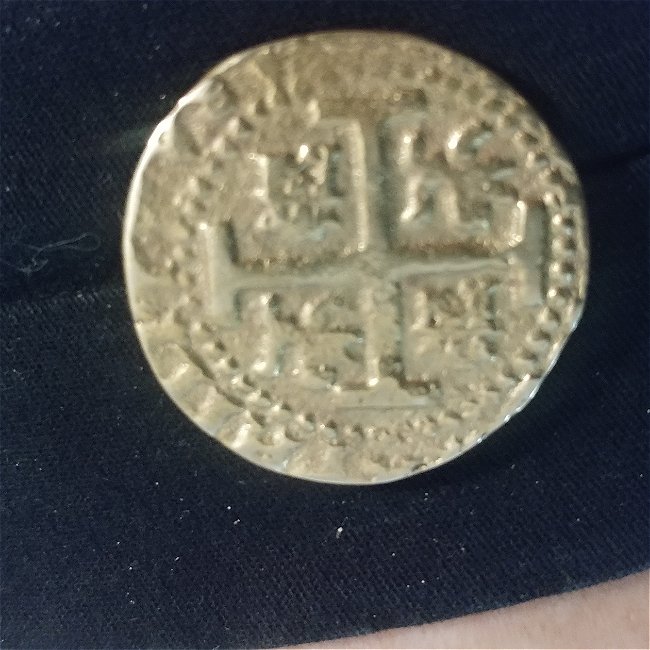 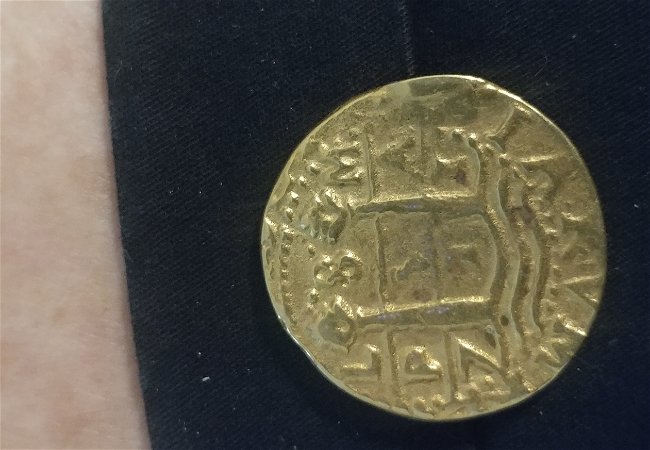 |
|
New Member
United States
6 Posts |
Quote:
Electrolysis of reactive metals in sea water is commonplace and a silver copper alloy can itself act like both the anode and cathode in the reaction . Exactly what I was thinking. Salt water is an electrolytic solution, so sunken coins are undergoing a slow electrolysis. Copper loss + resulting voids is a great explanation, and would be a very good physics homework problem. |
|
Pillar of the Community
United States
5362 Posts |
Hello Kimby0310  This is slightly out of my range of expertise but in my opinion the coin is most likely a tourist type replica of a cob coin. Based on the legend it purports to be a 1711 Lima (L-mint mark) assayer M - 8 escudos (gold) of the typical colonial Spanish type, so it should weigh about 27 grams. The surfaces appear intact so the density should be 17.45 roughly. The coin should be gold (91% gold) if genuine and would be worth over $5,000. The melt value alone would be 80% of spot. The problems as I see it are; 1. The lack of sharpness in the details and lettering. 2. The place of origin and cost - you never get a bargain like that. 3. The design of the Castles and Lion are wrong. The cross contains the crest of Castile and Lion of Spain. Sorry but there is virtually no chance the item is real - but I would still test the weight and density to be positive. As a Numismatic Forgery this is a $1 type item. Offer the person who says this is genuine to sell it for $100 and see if his tone changes. This would be a joke the item as a NF should not be sold at all without the word COPY stamped into the surface. Edited by swamperbob
09/07/2019 4:20 pm
|
|
Page 3 of 3
|
Replies: 35 / Views: 7,290 |
Page 3 of 3
|






 First Page
 Previous Page


 Posted 04/08/2019 11:52 am


