| Author |
 Replies: 18 / Views: 3,276 Replies: 18 / Views: 3,276 |
Page 2 of 2
|
|
|
|
Pillar of the Community
 United States
3363 Posts |
I have to laugh at the name Mike Diamond gives to this error:
"Frosting Slops Over the Edge of the Design Element"
|
|
Pillar of the Community
United States
1070 Posts |
|
|
Rest in Peace
United States
17900 Posts |
|
|
Bedrock of the Community
United States
17884 Posts |
In 1969 the proof coins were not deliberately "frosted" so it was not "applied" back then so the chance that it is a "frost slopped over" is pretty much zero. Cameo or deep cameo proofs are rather unusual back then and the command a premium. There are coin doctors out there that will artificially frost proof coins and the frost spilling over into areas where it doesn't belong is one way of spotting them. I would find this "error" questionable.
|
|
Pillar of the Community
United States
3363 Posts |
Quote:
In 1969 the proof coins were not deliberately "frosted" so it was not "applied" back then so the chance that it is a "frost slopped over" is pretty much zero. Cameo or deep cameo proofs are rather unusual back then and the command a premium. There are coin doctors out there that will artificially frost proof coins and the frost spilling over into areas where it doesn't belong is one way of spotting them. I would find this "error" questionable. Thank you Conder101! Your comments sent me scrambling for more information. I found this article by Charles Morgan (editor of Coin Week) about the 1969 Proof set.I would appreciate hearing your thoughts about it: Quote:Again, its key to remember that the techniques employed by the United States Mint to strike Proofs in 1969 produced coins that more consistently exhibited frosted devices, but the quality of these cameos varies dramatically and it's not unusual to find sets that are comprised of coins that are brilliant, cameo'ed, or borderline. https://coinweek.com/modern-coins/w...f-set-worth/ |
|
Bedrock of the Community
United States
94367 Posts |
Thanks for clearing that up, Conder.
|
|
Pillar of the Community
United States
3363 Posts |
I also found the following reference. It sounds like frosting was around before 1971. Interested in additional information anyone can provide. Quote:The cameo affect on a proof coin is produced by the field having a mirror-like surface and the coin's devices having a frosted surface. Proof coins minted before 1971 were made using a technique so that only the first hundred coins had a cameo contrast effect. If there is a dramatic contrast between the field and the devices, this is referred to as deep cameo. https://www.thesprucecrafts.com/cam...ition-768528 |
|
Bedrock of the Community
United States
17884 Posts |
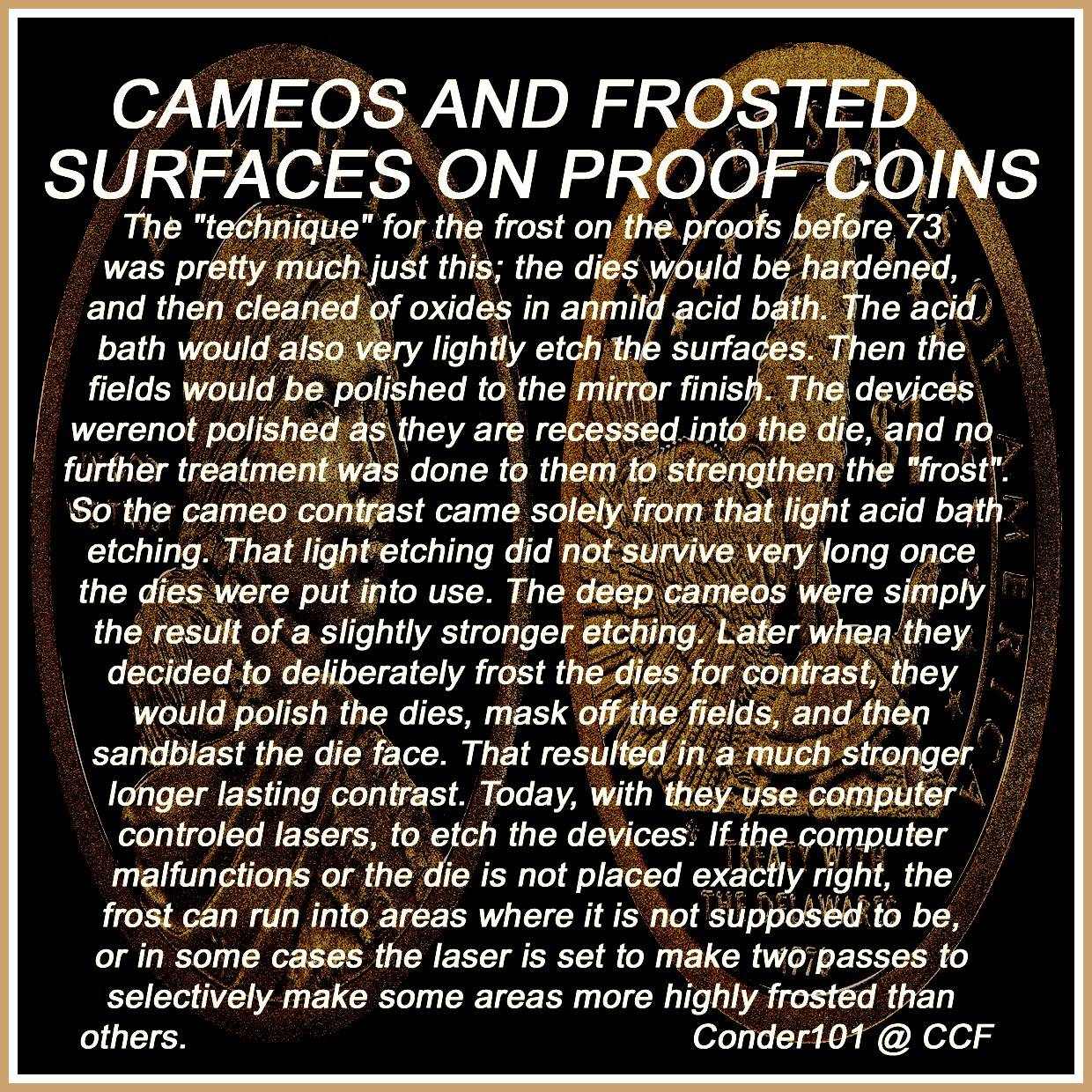
The "technique" for the frost on the proofs before 73 was pretty much just this, the dies would be hardened and then cleaned of oxides in an mild acid bath, The acid bath would also very lightly etch the surfaces. Then the fields would be polished to the mirror finish. The devices were not polished and no further treatment was don to them to strengthen the "frost". So the cameo contrast came solely from that light acid bath etching.(hence the reason wy the 1969 proof quarter would not show frost "slopping over") That light etching did not survive long once the dies were put into use. The deep cameos were simply the result of a slightly stronger etching.
Later when they decided to deliberately frost the dies for contrast they would polish the dies. mask off the fields and then sandblast the die face. That resulted in a much stronger longer lasting contrast. Today the use computer controled lasers to etch the devices. If the computer malfunctions or the die is not placed exactly right the frost can run into areas where it is not supposed to be, or in some cases the laser is set to make two passes to selectively make some areas more highly frosted than others.
Edited by Conder101
08/20/2019 2:34 pm
|
|
Pillar of the Community
United States
3363 Posts |
Thank you Conder 101.
So I think you are saying that the polishing of the fields of the die after an acid bath is unlikely, if not impossible, to leave a smear such as is on this coin.
Therefore, this coin most likely had the frost artificially applied after minting and in the process some of the frost spilled over into the area I have circled on this coin, thus providing a helpful diagnostic in identifying a doctored coin.
Now I understand!
THANK YOU!
|
|
Bedrock of the Community
United States
62064 Posts |
|
|
Pillar of the Community
United States
3363 Posts |
After checking values, I am thinking the Coin Doctors would be trying to produce very high grade Deep Cameo coins (PR 69DCAM) which would command a substantial premium.
|
|
Pillar of the Community
United States
3363 Posts |
|
|
Bedrock of the Community
United States
17884 Posts |
Quote:
So I think you are saying that the polishing of the fields of the die after an acid bath is unlikely, if not impossible, to leave a smear such as is on this coin. That is what I believe. Quote:
After checking values, I am thinking the Coin Doctors would be trying to produce very high grade Deep Cameo coins (PR 69DCAM) which would command a substantial premium. Quite possibly. Back in the early 70' there was a rash of fake DMPL Morgans coming onto the market. The coins were real but they had been polished and then the devices artificially frosted. They were impressive looking but the hailines in the fields and the frost spilling over into confined field areas where it shouldn't have been gave them away. They were known as "California Prooflikes". I have one but it has been a long time since I have seen any. The last one I saw believeit or not was a Deace dollar! Imagine a Peace dolar with deep mirror fields and frosted white devices. I knew what it was and so did the dealer, would have loved to have it but couldn't get the dealer to part with it. Several years later there was another round of artificially cameoed Morgans but this time they didn't bother to polish them so they were just Deep Cameos and not DMPL. Same identifying feature, cameo running off into the field in places. |
|
Pillar of the Community
United States
3363 Posts |
Conder101 - would you happen to remember a reference where I could go to read about the pre- 1970 Proof Minting and Frosting Process? My Coin World Almanac does not contain that information (6th Edition). {I did finally find one decent online summary of frosting history, but I am still searching for more detail}. Edited by Pete2226
08/21/2019 3:02 pm
|
|
Pillar of the Community
United States
3363 Posts |
HERE IS AN UPDATE:
I sent the Quarter to Mike Diamond. Here are his comments:
Prior to me sending the coin to him and commenting on the photos only, he said: "It's unlikely to be a case of frosting slopover because, as far as I'm aware, intentional frosting of proof coins wasn't introduced until 1971. Before then, all "frosting" was the result of an early strike (the real cameo appearance)."
After examining the coin, he said: "The patch of frosting below Washington's queue represents an area of the die face that was missed during polishing. As I mentioned before, the frosting is not enhanced during this time period to make every proof a cameo. I abhor the introduction of that step in 1971, as it eradicates the fine details of the design. The much finer frosting seen on your coin is the result of an acid bath (actually, a nitric acid/alcohol solution) that the dies were submerged in prior to polishing."
|
|
Page 2 of 2
|
Replies: 18 / Views: 3,276 |
Page 2 of 2
|




 First Page

 Posted 08/19/2019 5:26 pm