| Author |
 Replies: 28 / Views: 5,484 Replies: 28 / Views: 5,484 |
Page 2 of 2
|
|
|
|
Pillar of the Community
United States
3497 Posts |
Constantius Gallus Centenionalis Antioch Nothing special really But it is unusually thick for the type 6.11 grams 19-20mm 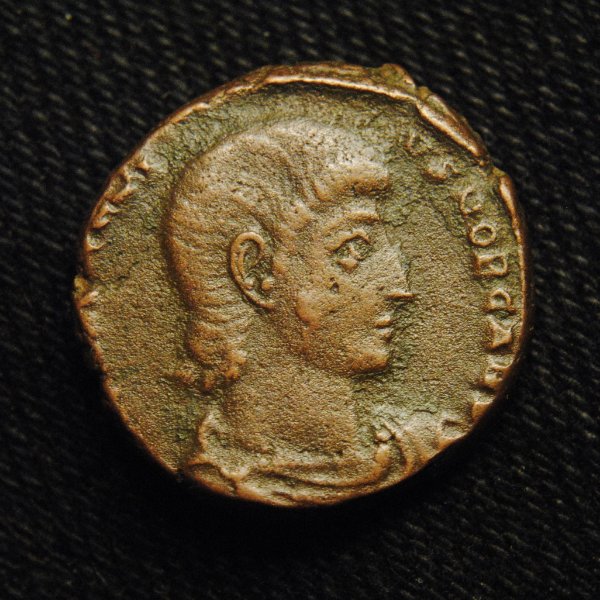 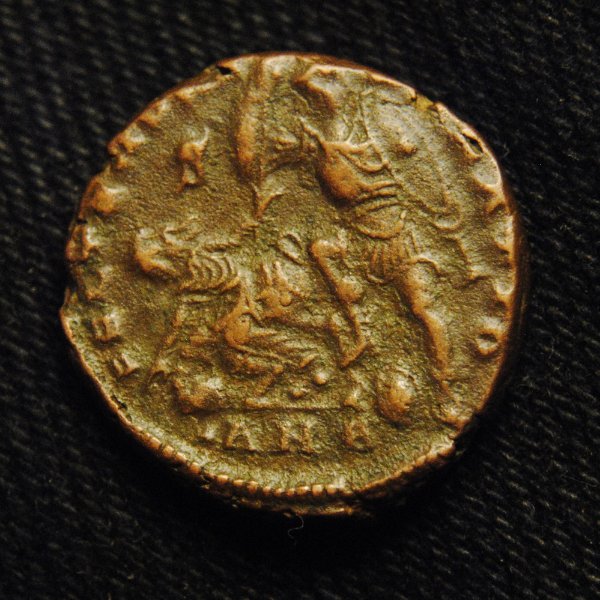 |
|
Pillar of the Community
 United States
993 Posts |
Over the years, I've had a few examples of the horseman sitting on the ground. The last two examples below were minted under the authority of Vetranio. 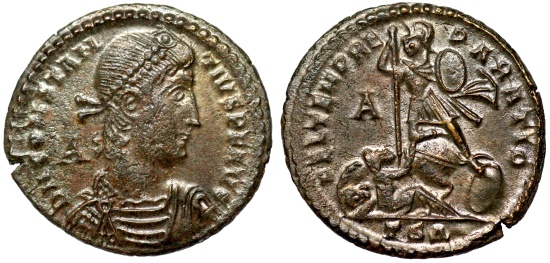 Thessalonica 123 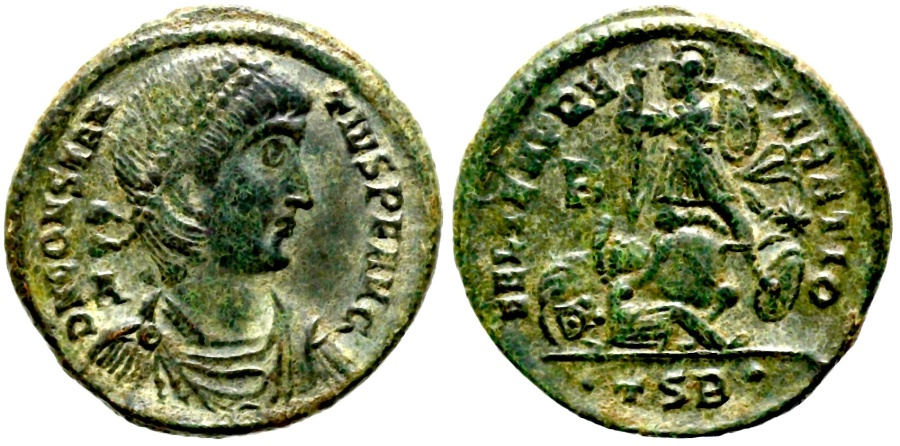 RIC VIII Thessalonica 134 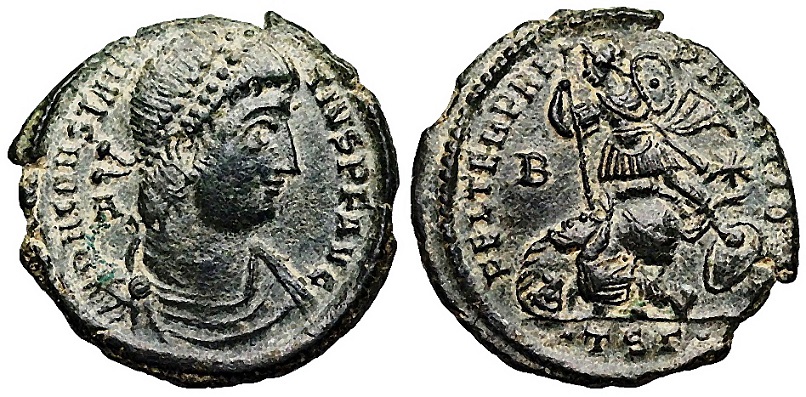 RIC VIII Thessalonica 134 |
|
Pillar of the Community
United States
3497 Posts |
I am tempted to think that we might have a reverse die match here
Mine is definitely from a worn die as the silvering is intact
When I purchased it I had high hopes that once the green was gone I would have crisp details !
Alas it was not to be
|
|
Pillar of the Community
United States
1554 Posts |
One aspect of this series that I find particularly interesting is that the fallen horseman is sometimes clearly Persian (top) with the characteristic pointed cap and other times a stereotypical German barbarian (bottom) with long plaited hair and a bushy beard. Images courtesy CNG.  |
|
Pillar of the Community
United Kingdom
2121 Posts |
I have a few (in fact far too many!). Here is a small selection:- Constantius II - Antioch - Horseman reaching type  Constantius II - Antioch - Horseman clutching type  Constantius Gallus - Antioch - Horseman reaching type (uneven strike otherwise quite attractive for type)  Here is one similar to the opening coin (different officinal). This one is still nearly fully silvered.  Similar but now the reaching type.  Amiens can be harder to find.  Good imitatives exist too  Alexandria  Cyzicus  Constans - Kneeling horseman  Seated horseman  Bored yet? |
|
Valued Member
 United Kingdom
106 Posts |
@maridvnvm, love the variety you have
|
|
Pillar of the Community
United States
3497 Posts |
"Bored yet ?"
I am reminded of my school days sitting in Latin class
Learning all the great variety of terms used by the poet Vergil
For killing people !
Our professor compared it to the Inuit having 100 different words for snow
Ah those were the good ole days .......
Sitting in Latin I mean
Not getting disemboweled by the border patrol !
|
|
Valued Member
United Kingdom
106 Posts |
How many variations are there? I lost count after about 98 on wildwinds earlier
|
|
Pillar of the Community
United Kingdom
2121 Posts |
Where do you want to draw the line with variations? Dane Kueth (Helvetica) has created a spreadsheet identifying the ones known to he from RIC and other sources separated by each emperor, each bust type, each mint, each identified issue (let's say RIC breakdown), each officina per mint, each reverse legend break noted in RIC, each horseman headgear etc. This gives about 2400 variations.
|
|
Valued Member
United Kingdom
106 Posts |
Goodness me!! That's incredible
|
|
Pillar of the Community
United Kingdom
2121 Posts |
I have over 140 different variations in my own collection, which has been put together as a sideline collection in the last 4 years.
You can then expand this out into the other FEL TEMP REPARATIO types (hut, captives, phoenix etc.) and the number goes through the roof.
I also have spent some time on the wider FEL TEMP series but won't kill this thread by adding loads of those too.
|
|
Valued Member
United Kingdom
106 Posts |
Does FEL TEMP REPARATIO refer specifically to 348 AD ?
|
|
Pillar of the Community
United States
993 Posts |
Quote:
Does FEL TEMP REPARATIO refer specifically to 348 AD ? the short answer is "maybe" A.D. 348 marked the eleven hundredth anniversary of the founding of Rome (Philip the Arab celebrated the 1000 anniversary in A.D. 248) and the "Felix Temporum Reparatio" (Fel Temp) coins may have been struck in anticipation of this event. The reverse on this coin translates as "good times restored" or "happy times are here again" The Fel Temp slogan was used with 7 different reverse types in bronze - Fallen horsemen, Phoenix on a pyre/globe, Emperor leading a barbarian from a hut, Emperor on a galley steered by Victory (maybe a nod to Constantinople), Emperor with two captives/one captive and Emperor on horseback spearing enemy and the incredibly rare and curious reverse type with an M (pictured below)  An article by Konrad Kraft ("Die Taten der Kaiser Constans und Constantius II"), argues that the FTR type should be assigned an earlier year of issue, maybe as early as A.D. 344 and should not be associated with the anniversary of A.D. 348. Kraft said that the two captives FTR was issued to celebrate the victory of the Roman Army under the command of Constantius II at the Battle of Singara, which occurred in A.D. 344. The Roman Empire claimed to have defeated the Sassanid Army led by Shapur II, but in reality the Persians left the battle, as Shapur II realized he was spread too thin.  Kraft also argued that the Hut FTR coins were issued to commemorate the A.D. 342 resettlement of the Frankish people within the Roman Empire, on the left bank of the Rhine River, mainly in Toxandria.  RIC VIII even says that the FTR Galley types seems to be a reference to a visit Constans made to Britain in A.D. 343, and it seems he was celebrating some sort of a victory on these coins.  Of course, just because these coins may have been issued earlier than RIC VIII has listed, does not mean that these coin types, with messages of victories over enemies, could not have also been issued as part of an anticipatory celebration for the eleven hundredth anniversary. The phoenix type also seems to suggest an anniversary or renewal in accordance with the Roman saeculum. This symbolized a rebirth, as nobody that was alive at the start of the saeculum would be alive at the end.  So, there is a bit of debate about why the FTR types were issued; but none of the FEL TEMP types has a reverse that can be explicitly linked to an anniversary celebration and they may have just been Roman propaganda that was coincidentally struck around the time of the anniversary. Edited by Victor
08/22/2019 12:02 pm
|
|
Valued Member
United Kingdom
106 Posts |
Thanks for that, a lot of information for me to go through and learn.
Everyone on here is always so helpful and it make it so much easier to learn and understand the huge variety of Roman coins and meanings behind them all
|
|
Pillar of the Community
United Kingdom
2121 Posts |
If you start to get interested in any of the other types of FTR coins then be prepared for as much minutiae in collecting focus as you desire. Multiple mints, multiple officina, spears pointing up/down, different trees, emperor with or without cloak, different poses with captives.... Here is a website by Bill Welch who covers an analysis on the hut types:- https://www.forumancientcoins.com/m...nalysis.htmlA couple just to illustrate the differences:- Alexandria, spear points down, emperor cuirassed  Antioch, spear points down, emperor draped  The huts, trees and captives can all be quite different between mints with some variation within a mint too Barbarous imitations also exist. This one imitating Trier  There are also things that turn up that don't fit with what we know today:- Constans - AE2 Obv:- D N CONSTANS P F AVG, Pearl diademed, draped & cuirassed bust right; N behind bust Rev:- FEL TEMP-REPARATIO, Helmeted soldier, spear in left hand, advancing right, head left; with his right hand he leads a small bare-headed figure from a hut beneath a tree. The spear points downwards to the left Minted in Trier; (_ | N//TR), Second Series Reference:- RIC VIII Trier - A puzzling coin. The style is consistent with Trier. The trre detail, hut, soldier and captive are all consistent with Trier. Hut coins are not ateested for the second series at Trier and the value mark "N" is not attested for at Trier. The lack of officina is also puzzling. 20.87 mm. 4.39 gms. 180 degrees  |
|
Page 2 of 2
|
Replies: 28 / Views: 5,484 |
Page 2 of 2
|








 First Page

 Posted 08/21/2019 11:03 pm


