| Author |
 Replies: 25 / Views: 90,854 Replies: 25 / Views: 90,854 |
Page 2 of 2
|
|
|
|
Pillar of the Community
United States
645 Posts |
This coin was struck from 1890-1895 with a nominal weight of 8 fen - over 2.8 grams and from 1895-1899 with a nominal weight of 7 fen - under 2.8 grams.
|
|
Valued Member
 Canada
122 Posts |
Hmmm mine looks a lot less worn, so it's likely faked then? Is there a way to determine if it's legit other than go to a profesional? Thanks!
|
|
Moderator
 Australia
17005 Posts |
Quote:
Hmmm mine looks a lot less worn, so it's likely faked then? I wouldn't conclude that. If it's less worn, it's simply been well-preserved. You can readily find examples of this coin in mint-fresh uncirculated state. Quote:
Is there a way to determine if it's legit other than go to a profesional? Thanks! Honestly, I wouldn't worry about it. A professional authenticator like a TPG would charge $40 or so to give an opinion on a coin worth less than a dollar. Your coin shows all the signs of being genuine, and for these coins there really would be no difference in price between a well-made fake and a genuine item - not that I've ever heard of anyone going to the trouble of making "well-made fakes" of these. Here's my example of KM/Y# 190. It came from a bulk lot of "3 for $1" coins I bought some 10 years ago. For this particular coin, 33¢ was a bit of a ripoff - the CV at he time was 10¢ or so. 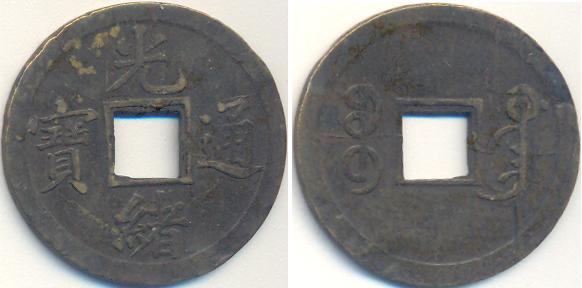 The coin is a little bent, just like most examples of this coin I've seen (including yours) are. The metal is so thin, the machine they used to punch out the square holes was apparently prone to causing the coins to warp and bend. There's also some kind of lamination or planchet flaw on the lower right side of the reverse; I can see a similar kind of flaw on your coin, on the upper left side of the obverse. As I said, quality control simply wasn't worth them paying much attention to. Don't say "infinitely" when you mean "very"; otherwise, you'll have no word left when you want to talk about something really infinite. - C. S. Lewis
|
|
Valued Member
Canada
122 Posts |
Okay, thanks!
I also picked mine up cheap - in a 4 or 5 for a dollar bucket - so no worries if it is fake, and if it isn't, it's still in good condition.
|
|
Valued Member
67 Posts |
This type of copper coin is very cheap in China. Kwangtung (Guangdong) Mint was one of the most prolific issuers of Chinese coins. Below is an abstract on the Kwangtung Mint:
A NUMISMATIC HISTORY OF THE BIRMINGHAM MINT, 1981
Chapter X Minting Equipment
by James O. Sweeny,
" In April 1887 Heatons received an order for a complete mint to be erected at Canton. The size of the mint was enormous. It had a capacity of 2.6 million cash coins per day, simultaneous with 100,000 silver coins per day. It required 90 coining presses to achieve this output, plus thousands of tons of peripheral equipment. It was unquestionably the largest mint - government or private - in the world, both then and for a long time to come. Heatons' contract was for the entire project, including buildings, equipment, start-up, and training. The buildings were designed by Mr. Edwin C. Middleton of Birmingham, and had an overall size of 657 feet by 424 feet. Completion of the plant was required in 18 months, and, in spite of some delays in the construction of the buildings, actual minting operations began in early 1889. some 60 million cash coins were produced in that year.
Follow-on orders continued for many years afterwards. Another 12 coining presses were ordered in 1904, along with a new rolling mill. There were even orders for such diverse items as lawn mowers and a two-wheel hand-drawn fire engine. The original order was probably the largest single order ever placed on a manufacturer of minting equipment; it was certainly Heatons' largest undertaking."
|
|
Pillar of the Community
Australia
3841 Posts |
Funny how I happen to have this in my collection and I never bothered to research about it: 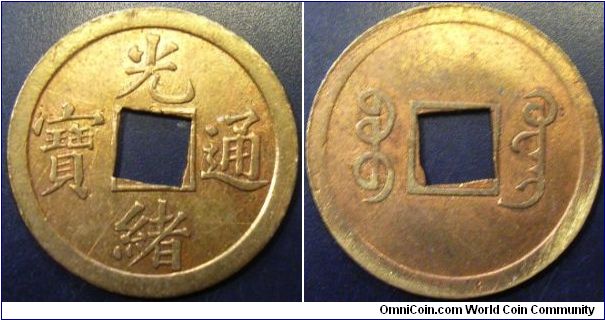 Quite nice grade in my opinion. The square hole is off centered. My partial coin collection http://www.omnicoin.com/collection/gxseriesMy numismatics articles and collection: http://www.gxseries.com/numis/numis_index.htmRegularly updated at least once a month. |
|
Pillar of the Community
Spain
1361 Posts |
It is a copy. A lot of these coins are used for house decor like windchimes, sword made from coins attached together with a red thread, etc.
Chinese coins are essential ingredients in the practice of Feng Shui. It is the most potent symbol of wealth, especially when tied with red thread. They are rounded shape with a square hole in the center. The circle represents heaven while the square represents earth. When used by humans, they represent the cosmic trinity of luck of "Heaven-Earth-Man". There is the Yang side (with four chinese characters according to reign of emperor) and the Yin side (2 characters) on every chinese coins. The Yang side should always be used facing up. Feng Shui masters often focus only on Ching Dynasty coins compared to other dynasties because Ching was the most powerful dynasty in China, while other dynasties usually collapsed in less than a century. The Chinese coins, particularly of those of the Kang Hsi or Chien Long Emperors' reign are deemed most auspicious. Chinese coins are creation of old advisors of emperors (who are Grand Feng Shui wizards) and that is why chinese coins are powerful emblems of wealth, endless fortune and prosperity.
|
|
Valued Member
Singapore
104 Posts |
|
|
Pillar of the Community
Spain
1361 Posts |
haidee its a copy in brass
|
|
Moderator
Australia
17005 Posts |
All of the coins posted in this thread so far appear genuine to me.
Don't say "infinitely" when you mean "very"; otherwise, you'll have no word left when you want to talk about something really infinite. - C. S. Lewis
|
|
Pillar of the Community
Spain
1361 Posts |
The method in doing the fake coins is the same as in doing the real coins. Casting. You have to have an eye for chinese coins to know the real mccoy.
|
|
Valued Member
Singapore
104 Posts |
^i actually asked a chinese guy (colleague) about it... showed him the coin... and he said it's real.
then again, maybe there's a standard weight for these, too? anybody who can share this info, so we can check
|
|
Moderator
Australia
17005 Posts |
Quote:
maybe there's a standard weight for these, too? Unfortunately, no. The cast ones like yours vary in weight considerably, and the size or diameter varies as well, particularly over such a long reign as that of Qian Long. Quote:
The method in doing the fake coins is the same as in doing the real coins. Casting. All of the most blatantly fake cash I've seen have been the ones that were made using modern coinage machinery, with little dimples carved into the dies in the background fields in a crude attempt to simulate the "sandy" background fields of genuinely cast coins. Don't say "infinitely" when you mean "very"; otherwise, you'll have no word left when you want to talk about something really infinite. - C. S. Lewis
|
|
Pillar of the Community
United States
645 Posts |
All of the machine struck cash look good to me.
Haidee's Qian Long, I'm not sure about. It's probably genuine as Hartill lists an undersized piece(23-24mm,1754-1760) with the note "often coarse workmanship". If this is a full size coin(25mm+,1736-1753) then it is most likely a contemporary counterfeit. I see nothing to make me suspect a modern fake.
|
|
Pillar of the Community
United States
3098 Posts |
They all look good. to me. And haidee, yours looks just like one of mine I found in the field in my old ancestral home in China. Fake ones usually have something else written on it. Plus, the background is textured (like small little boils) and the coin just looks very new and... well, recently made. Also, as not a deterrent, there are steel cash coins. Well, iron cash coins. They we making those up to the 1800s.   Well, I think these are what they're *supposed* to look like. Anyways, the left one is Daoguang (1820-1850); the middle is Kangxi (1661-1722) and the last one is iron... Edited by wd1040
11/24/2008 11:41 pm
|
|
Page 2 of 2
|
Replies: 25 / Views: 90,854 |
Page 2 of 2
|







 First Page
 Posted 10/11/2008 9:47 pm





 Image000.jpg
 Image001.jpg


