| Author |
 Replies: 18 / Views: 2,121 Replies: 18 / Views: 2,121 |
Page 2 of 2
|
|
|
|
Pillar of the Community
United States
4233 Posts |
VF-20, slightly less common Reverse 2 (thin ribbon).
|
|
New Member
United States
7 Posts |
|
|
Bedrock of the Community
 United States
36940 Posts |
Thanks kbbpll, I totally missed that. I believe this is reverse 1, thin ribbon which is 1900 and before. The thick ribbon, reverse 2 is 1901 and later. 1901 used both reverses. True? Reverse 1 1892-1901  Reverse 2 1901-1916  Edited by IndianGoldEagle
07/28/2021 12:38 pm
|
|
Pillar of the Community
United States
4233 Posts |
Actually, yours is Reverse 2. I discovered, or at least documented, a third reverse 1900-1901, published in BCCS journal a couple years ago. It maintained the thin ribbon, but the leaf veins and corn changed. Then the thick ribbon (now Reverse 3) was introduced around April 1901, with both 2 & 3 used at all three mints. There are 11 transition varieties from 1899-1905, mostly SF. I posted a thread in the varieties main section a while back with a link to a slideshow I put together on these, which you can find by searching (it didn't get much attention here). It's obscure but they're fun to look for. So: 1892-1899 Reverse 1 1900-1901 Reverse 2 1901-1916 Reverse 3 I estimate your 1901 Rev2 was about 20% of the mintage in Philadelphia. Here's a quick look at the Rev1 -> Rev2 changes. 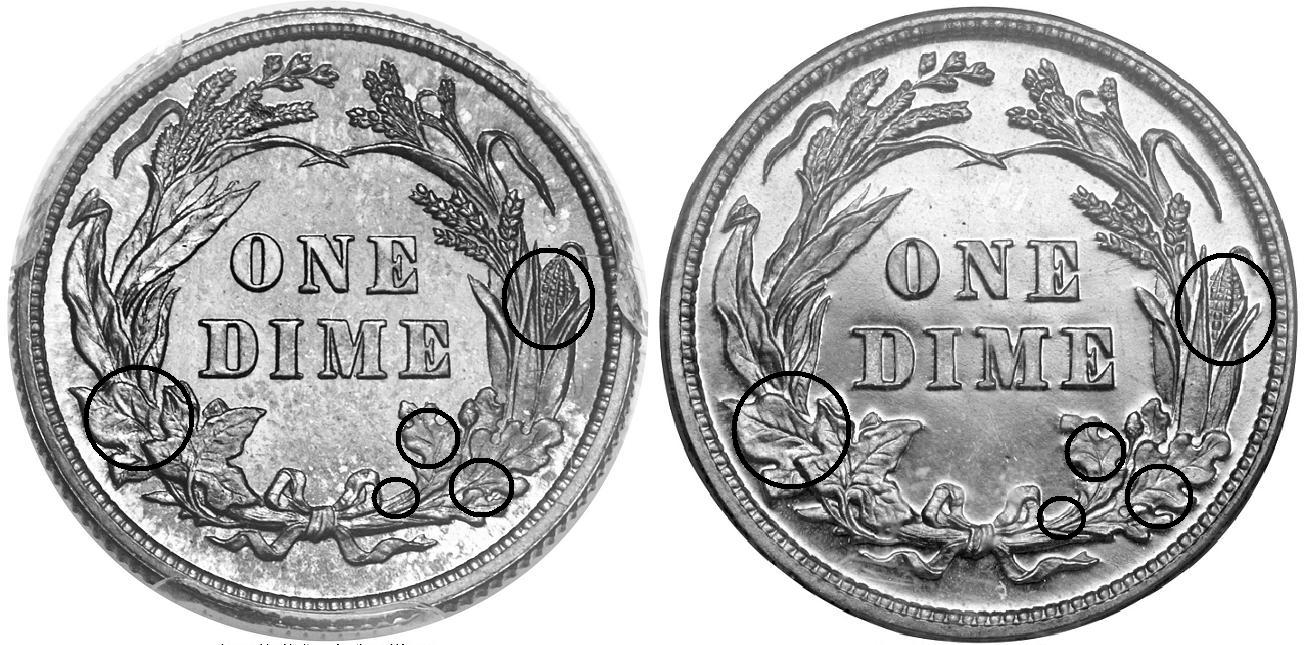 Edited by kbbpll
07/28/2021 2:09 pm
|
|
Bedrock of the Community
United States
36940 Posts |
kbbpll, great info, thank you. NGC only shows two reverses which is what I used. You taught me something today, made getting up worth while.
Edited by IndianGoldEagle
07/28/2021 2:54 pm
|
|
Pillar of the Community
United States
4233 Posts |
Even the previously known info is often incomplete/inaccurate on these. NGC for example for 1901-S says "All 1901-S dimes were coined with reverse dies taken from the old hub on which the lower right ribbon is slender" and yet their image is of the "new" thick ribbon hub. Etc. None of the TPGs, as far as I know, designate the previously known varieties. Some of the SF transitions weren't really published (in BCCS) until 2017. I contacted a few publishers about the third reverse type (and three new transition varieties) and got zero interest, so I gave up. I mention them on forums when something like this pops up.
|
|
Pillar of the Community
United States
4680 Posts |
Great info on this thread  thank you for sharing!! As far as grade, I'm also at VF20 |
|
Rest in Peace
United States
10625 Posts |
VF20 as well. I had no idea there was a design change to the reverse either.. and it's about the same time as the Morgan dollar C3 to C4 reverse design change. |
|
Pillar of the Community
United States
4233 Posts |
Thanks @dave700x, I didn't know about the Morgan C3/C4 changes. This looks like a good description http://vamworld.com/wiki/Reverses,_..._C4C3_and_C3It's great to have that additional context. There were also changes to both sides of the quarters and halves in 1900 & 1901, and the reverse of the V nickel, just as subtle. Barber was a busy guy. Edited by kbbpll
07/29/2021 11:59 am
|
|
Rest in Peace
United States
10625 Posts |
Yes it appears the Barber shop was busy in that time period. I would love to find out why these minor changes came about.
|
|
Pillar of the Community
United States
1173 Posts |
I'll go with a grade of VF-20.
|
|
Bedrock of the Community
 United States
18880 Posts |
VF25 for me the ear and leaves have better detail than a VF20
|
|
Pillar of the Community
United States
4233 Posts |
Quote:
I would love to find out why these minor changes came about. For the dimes, Bowers states in his Barber Silver Coins guide that the 1901 obverse changes lowered the relief, and that Liberty subsequently did not wear away as quickly. The relief for the 1900 Reverse 2 change also seems flatter to me. Other speculation regards die life - there are several letters back and forth between the branch mints and Barber around 1900 regarding die life. Coin stacking differences are noted as a reason for changes to the quarter in 1892 and possibly again in 1900, and Bowers also mentions lowering of the relief for quarters resulting in Liberty not wearing as quickly. I've been mulling over the reason for the addition of the "thick ribbon" in 1901, as it appears to be the only change to the reverse design, and the 1900 design only lasted a little over a year. I have noted that many 1900-1901 Reverse 2 coins across all mints have a die gouge below the right ribbon, exactly where the thick ribbon later appears. Barber may have been picky and wanted to cover this up on a master die, or perhaps he intended the 1900 change to have the thick ribbon, started to engrave it, and didn't finish? Otherwise, the 1901 obverse changes, and the addition of the thick ribbon, more closely resemble features on the 1891 pattern coin. Perhaps Barber simply thought "I really wanted it to look more like this" and finally got around to it? Idle speculation on my part. |
|
Bedrock of the Community
United States
36940 Posts |
I never expected this thread to turn into such an education. Thank's kbbpll, I learned a lot from this.
|
|
Rest in Peace
United States
10625 Posts |
Yeah, my initial thought was it may have been to improve the die life. I don't recall any known reason or even speculation in Bower's book on Morgan dollars for the C3 to C4 hub change. I'll have to dust it off and look now.. edit to add - no explanation or speculation as to why the C3 to C4 hub change in the Morgan RedBook.... Edited by dave700x
07/29/2021 5:02 pm
|
|
Page 2 of 2
|
Replies: 18 / Views: 2,121 |
Page 2 of 2
|







 First Page

 Posted 07/28/2021 12:26 pm





