|
This page may contain links that result in small commissions to keep this free site up and running.

Welcome Guest! Registering and/or logging in will remove the anchor (bottom) ads and the security checks. It's Free!
To participate in the forum you must log in or register.| Author |
 Replies: 41 / Views: 5,250 Replies: 41 / Views: 5,250 |
Page 3 of 3
|
|
|
|
Pillar of the Community
 Spain
2752 Posts |
This is an excellent thread!  ... Thoroughly enjoying the ride and have learnt a great deal so far! ..Thanks...Looking forward to more of these interesting posts....Some wonderful coins have been represented so far! The Constantine era is not an area of collecting I've ventured into yet but I can contribute at this point with a Helena having the same reverse but from a different mint than the 2 examples already shown...It depicts an alternate hairstyle and also shows the folds of her drapery running vertically as far as I know a unique detail associated with Siscia? Helena AE3 (19mm, 3.30g). Struck 326-327 AD Obv- FL HELENA AVGVSTA, Diademed and draped bust right. Rev- SECVRITAS REI PVBLICE, Securitas standing left, holding olive branch in extended right hand.raising hem of robe with left hand. Mintmark dot ΓSIS dot. RIC VII Siscia 204; Sear 16609. 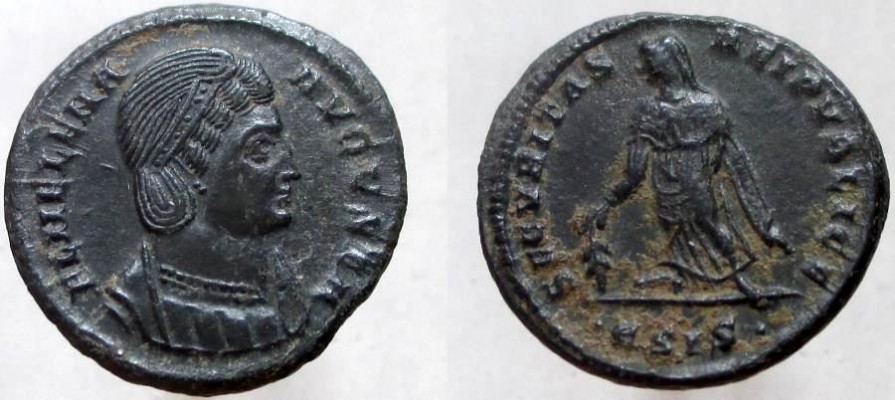 |
|
Pillar of the Community
 Sweden
2124 Posts |
Thank you @Palouche, glad you enjoy the thread! And thank you and @Novicius for the Helenas, they are both real nice examples. It is interesting that her hair style seems to vary a bit between mints - I wonder what they had to base the portrait on? Another relative now: Coin #12: 323 AD, Lugdunum (1st officina). 3.2 g, 19 mm. RIC 216.Obv: Crispus, Constantine's first son, laureate, draped, cuirassed. FL IVL CRISPVS NOB CAES Rev: Laurel wreath, VOT X. CAESARVM NOSTRORVM | VOT X (Our Emperors' Vows for the 10th) 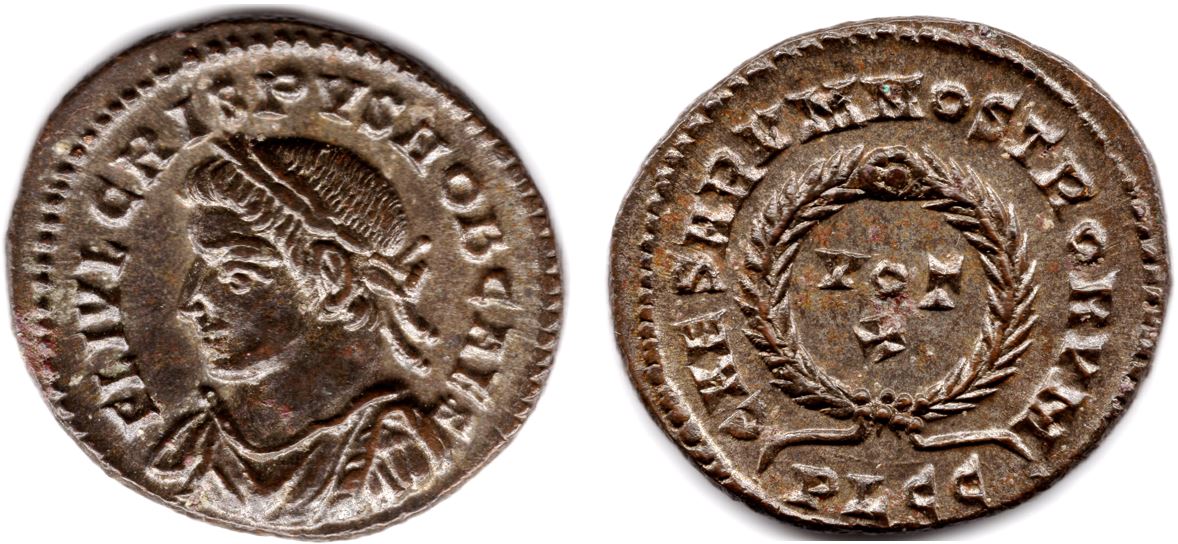 Crispus was Constantine's first son and was made caesar in 317 at the same time as his brother Constantine II and Licinius's son Licinius II. About five years into their reign it was time for their 10 year vows and VOTA coins were minted for all three caesars. 326 AD, the year the vows were to be fulfilled, was however an unfortunate year for Crispus. Following allegations of misconduct with his stepmother Fausta, Constantine had his own son Crispus executed. Fausta was to meet the same fate, but more about that in my next post. |
|
Pillar of the Community
United Kingdom
2121 Posts |
Dragging the thread back to coin #6. Whilst the type is most commonly found from Trier the type is attested to have been struck in Trier, Ticinum, Aquileia, and London (see Num. Chron. 152, 1992, 157-60).
|
|
Pillar of the Community
Sweden
2124 Posts |
Ok, thanks @maridvnvm, that is good information. The paper seems to deal mostly with Sol coins; for unsigned Mars coins like RIC 885 it shows strong evidence for minting also in Aquileia (die match with a signed coin), for the other mints I think it is more open-ended. Coin #13: 326 AD, Treveri (2nd officina). 3.5 g, 18 mm. RIC 483.Obv: Fausta, Constantine's second wife. FLAV MAX FAVSTA AVG Rev: Salus (or Fausta?), standing holding two children. SALVS REIPVBLICAE (Welfare of the State) 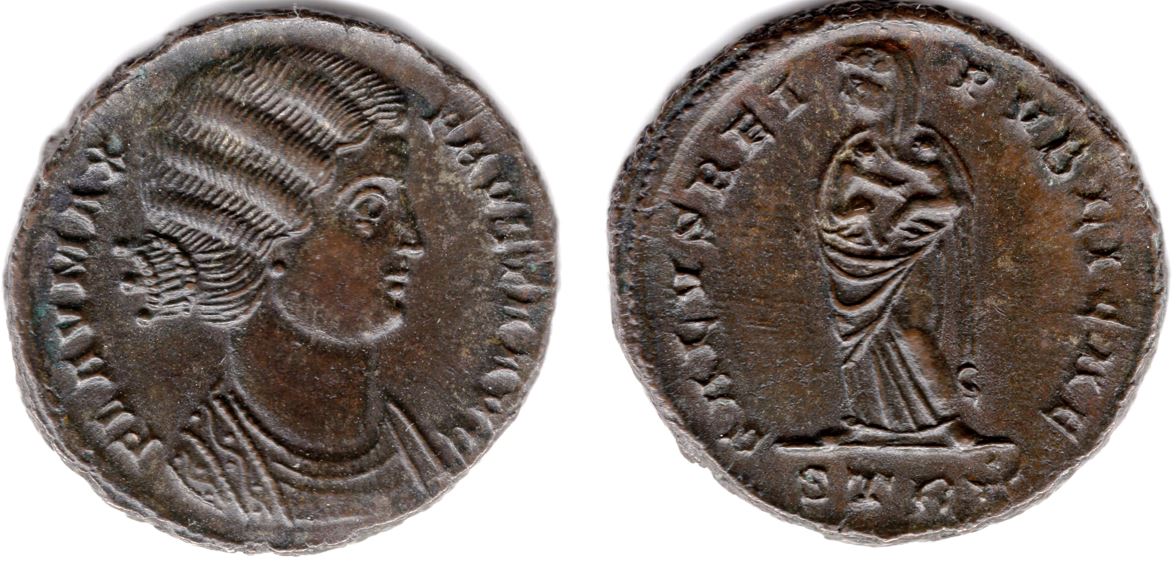 Constantine married emperor Maximian's daughter Fausta in 307 to seal the bonds of power within the tetrarchy. For this he had to divorce his first wife, Minervina, with whom he had his first son, Crispus. In 324, shortly after the downfall of Licinius and Constantine becoming sole emperor, Fausta was made augusta. As for Constantine's mother Helena, who was also made augusta soon after, coins were minted for Fausta. On her coins, she was associated with Salus (goddess of welfare, health and prosperity) or Spes (goddess of hope). On the coins, Salus/Spes is depicted holding two children, and it can be interpreted as showing Fausta as a living personification of the goddesses, holding two of her children with Constantine (which ones of the five they had is unclear). In any event, she represented the future of the Constantinian dynasty and thus the (bright) future of Rome. Her own future was not too bright, however. Exactly what happened in 326 is not clear and is poorly documented. According to some accounts Fausta accused Crispus, Constantine's son with his first wife, of having approached her inappropriately. Constantine, holding Fausta in very high esteem, then had Crispus executed. When the allegations were found to be false - speculations are that Fausta wanted Crispus out of the way in favor of her own sons - he had Fausta executed too. |
|
Pillar of the Community
United Kingdom
2121 Posts |
Here is the image of a coin that was shared on another forum some tears ago that can be seen from the style is not Trier and is in fact Ticinum. 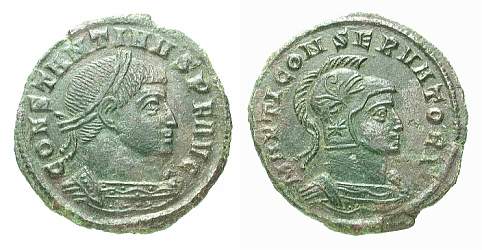 |
|
Pillar of the Community
Sweden
2124 Posts |
Ok - and thanks for sharing the coin! |
|
Pillar of the Community
Sweden
2124 Posts |
Now back to Constantine himself. Coin #14: 327 AD, Treveri (2nd officina). 3.2 g, 19 mm. RIC 504.Obv: Constantine I, laureate. CONSTANTINVS AVG Rev: Military camp gate with two turrets, beneath a star. PROVIDENTIAE AVGG (To the Foresight of the Augustii) 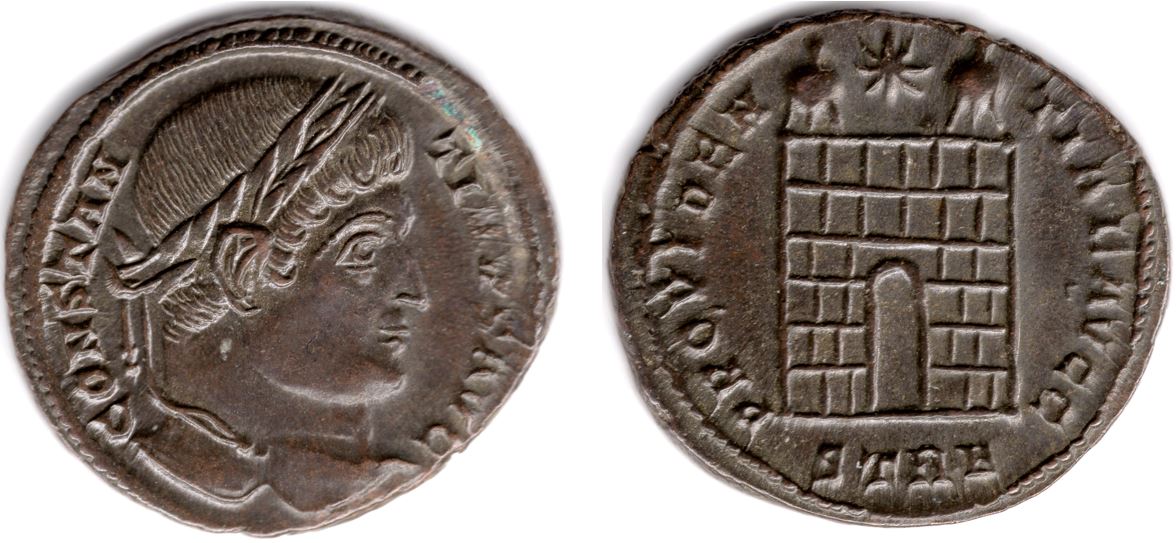 A type minted from 317 and for more than a decade (although the camp gate design had been used before, with other inscriptions). The military camp gate and the reverse inscription refer to the emperors' ability to plan for the defense of the empire and protect its security. Versions referring to the augustii (AVGG; that is augusts? augustuses?) respectively to the caesares (CAESS) were minted, to make clear that all worked united towards the same goal. The first issue came in 317, after Constantine and Licinius came to an agreement and division of power after their civil war. It was minted for both Constantine and Licinius. From 324, after Constantine had taken all power for himself, the design was complemented with a star above the gate, the symbol used by Constantine. Interestingly, the inscription keeps referring to the plural form augustii, although Constantine is now alone in that position. I take it that it refers to the institution of augustus rather than to Constantine personally. |
|
Pillar of the Community
United Kingdom
2121 Posts |
Sorry for my late responses but.... I might take a while catching up with the thread. Hairstyle can vary within a mint too. Here is a different hairstyle to the Trier examples above  I must admit that I like the Alexandrian style  |
|
Pillar of the Community
United Kingdom
1168 Posts |
Here is a Constintine CONSTANTINVS AVG/PROVIDENTIAE AVGG camp gate from my collection. It is nowhere near as nice as the one you posted, @erafjel. I believe that the turrets represented signal fires, but can anyone tell me what the different levels on camp gate coins represented? Did the higher number of layers represent a higher degree of importance? 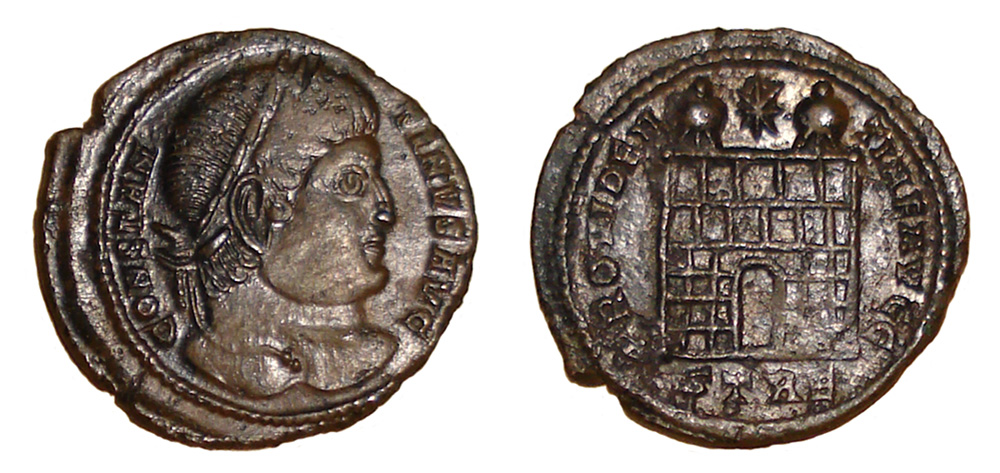 |
|
Pillar of the Community
Sweden
2124 Posts |
@maridvnvm: Thanks for the nice Helenas - yes, I have noticed that hair style largely seems to be a function of mint. Trier favored the one on my coin, but that style doesn't seem to have been used elsewhere that much. (And there's no hurry posting, the thread will stay open.  ) @Novicius: Still a nice coin! What are the turrets? Signal beacons is one idea. I recently read a paper that discusses various possibilities (without stating it is one or the other; available online in a couple of places): Lorinc Timár: City gate or watchtower? Turret or signal beacon? An obscure detail on some Late Roman coins, Numismatica Pannonica II, Hungarian Numismatic Society, Budapest 2020. Whether the layers have any significance, I don't know. Another campgate today: Coin #15: 329 AD, Arelate (1st officina). 3.0 g, 20 mm. RIC 337.Obv: Constantine I, diademed. CONSTANTINVS AVG Rev: Military camp gate with four turrets, beneath a star. VIRTVS AVG[G] (last G left out) (To the Virtue/Strength of the Augustii) 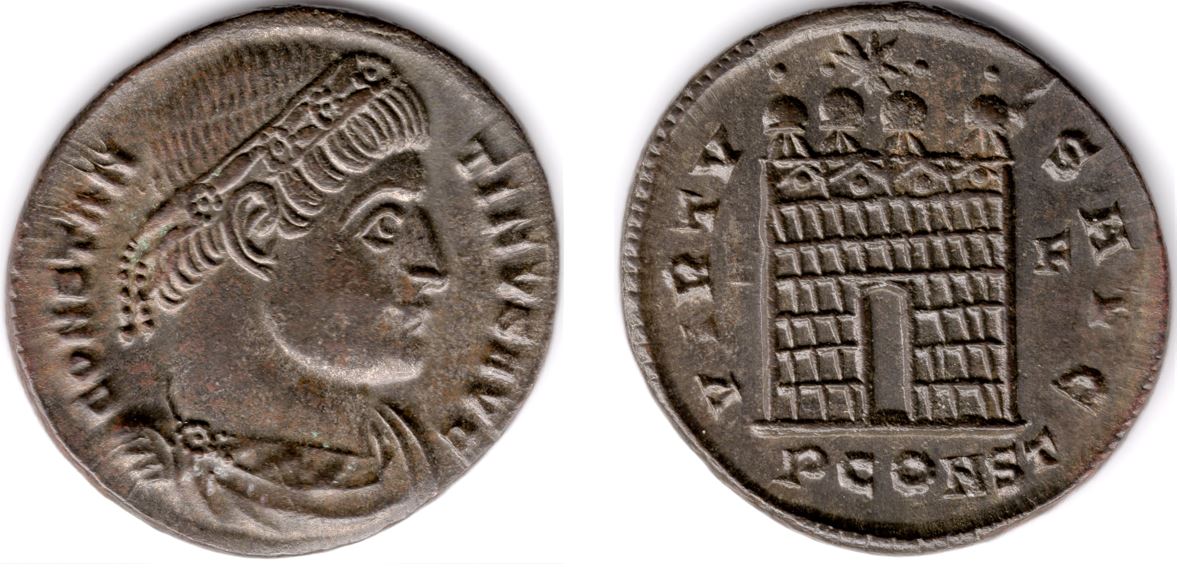 A type with similarities to the PROVIDENTIAE AVGG. Here it is the strength and/or virtue of the emperors that is celebrated (as discussed in a previous post, virtus is a wide concept covering several desirable qualities). First issued in 318, for both Constantine and Licinius (and caesares). From 325 issued for Constantine (and his sons) and with a star above. It is also around 324-25 that Constantine begins wearing a diadem instead of a laurel wreath on his coins (although the laurel wreath continues to be used as well). The diadem was worn by Alexander the Great and the Hellenistic kings as a sign of their position. Constantine, now having united Rome under one ruler and moving the center of the empire to the East, with Constantinople as its new capital, may have wanted to associate himself with the former rulers of the wide Hellenistic world, also with its center in the East. Perhaps it was also a step away from association with the Roman gods, the laurel wreath being an important attribute of Apollo. The conclusion of the Council of Nicaea in 325, called upon by Constantine to unite the different views that had developed in different parts of Christianity, may also have played a role in Constantine's view of himself as creating a world wide unified Christianity (and stepping away from the old gods). Note:Arles/Arelate was named Constantina 328-40, after Constantine's son Constantine (II) who was born in the city in 316 (thus the mintmark PCONST on this coin). At the age of 10 he was made commander of Gaul where he probably defeated German tribes, possibly in 328. Edited by erafjel
01/12/2022 1:08 pm
|
|
Pillar of the Community
United Kingdom
2121 Posts |
|
|
Valued Member
United States
253 Posts |
Rare Denominationally Marked Adding to this topic: This coin was minted at Rome about 311-312 and has been called a half follis because of the date and size. I posted pics of it back in 2017. 18mm and 1.8 grams. This is one of the very few Roman coins of the period that actually showed the denomination of the actual value of the coin in "denarii communes". VII. This was just before the huge inflation of Roman coinage started that ultimately resulted in their monetary collapse. Bronze coins of the Constantine era were used very similarly to our paper money is used today. Obverse: FL VAL CONSTANTINVS AVG; Laureate, cuirassed, right facing bust of Constantine. Reverse: PACI P-ERPET; Pax standing facing, head left, right hand holding branch, left holding standard; RS in exergue, XII in left field. You can find it in RIC VI on page 391. 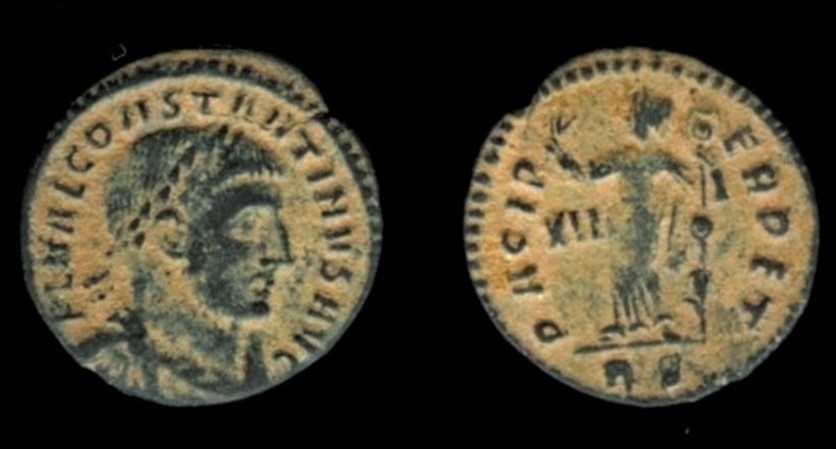 |
|
Pillar of the Community
Sweden
2124 Posts |
Nice collection @maridvnvm! That is one of the more unusual coins, @pendrak. Thanks for sharing! Coin #16: 330 AD, Arelate (1st officina). 2.2 g, 18 mm. RIC 364.Obv: Constantine I, diademed. CONSTANTINVS MAX AVG Rev: Two soldiers facing each other and two standards. GLORIA EXERCITVS (Glory of the Army) 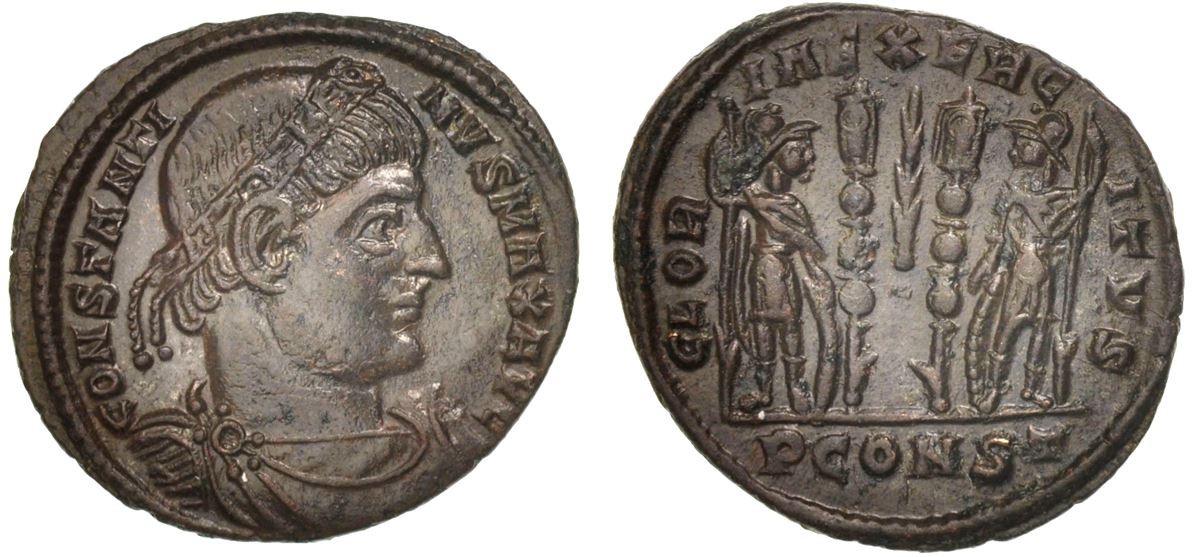 A tribute to the army, without which Constantine would of course not have the position he now has as undisputed leader of the Roman Empire. The army also has to be kept in a good mood to keep fighting the persistent barbarian incursions along the borders. The type was minted 330-40 by Constantine and his caesars. Coins have now become rather small. You may have noticed a continual shrinking of coin size as we progress in time. My coin #2 from 307 AD weighed 7.7 g and was minted to a standard of 1/40 of a Roman pound. That was already a reduction from the original 1/32 of a pound used under Diocletian. A number of reductions were performed 307-330 and the coin shown above is minted at 1/132 of a pound. There would be yet another reduction, to 1/192, in 335. After that, the GLORIA EXERCITVS coins, then smaller in diameter as well, were modified to show only one standard between the soldiers. |
|
Pillar of the Community
Sweden
2124 Posts |
Coin #17: 335-36 AD, Arelate (2nd officina). 1.9 g, 16 mm. RIC 401.Obv: Constantinopolis, laureate, helmeted. CONSTANTINOPOLIS Rev: Victory on prow, holding scepter or spear. 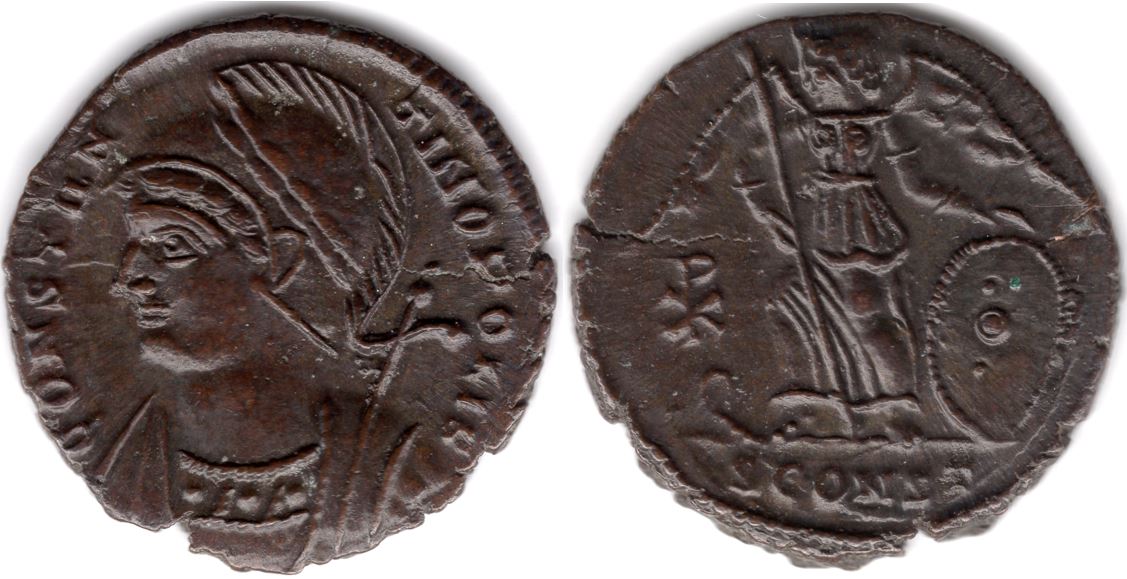 In 330 AD the new capital of the Roman Empire, Constantinople, was consecrated. It had been built over six years, on the initiative of Constantine who felt that Rome was located too far from where the action was: The frontiers, the army, the wealth and sophistication of the East and Asia. Also, the strategic position at the Bosphorus, guarding the port to Asia and the strait between the Mediterranean Sea and the Black Sea, was unsurpassed. So that was where the imperial court should reside. Moving the capital from Rome, having had that role for more than a thousand years, was no small thing of course. Naturally coins were minted to commemorate the event: One for Constantinople and one for old Rome, which was still an important city (I will show that coin next). All mints emitted the coins, beginning in 330 and continuing into the 340s. The Constantinople coins show the personification of the city, Constantinopolis, dressed in military attire. The reverse shows the goddess Victory standing on the prow of a ship, holding a scepter (or is it a spear?) and a shield. A common interpretation is that this symbolizes the naval victory at the Hellespont in 324 which was pivotal in Constantine's final military campaign against Licinius. This also happens to be one of few coins by Constantine that has a Christian symbol on it: The XP (Chi-Rho) in front of Victory. XP is a short form of the Greek name for Christ, ΧΡΙΣΤΟΣ. Its appearance here is not a statement by Constantine though, it is merely a mintmark, possibly put there by a Christian mint master or celator. Constantine was cautious about using overtly Christian symbols, as he did not want to repel any important groups (like for instance the mostly pagan army). |
|
Pillar of the Community
Sweden
2124 Posts |
Now it is time for my last coin in this thread. Hope you enjoyed it all! And keep posting your Constantines! Coin #18: 330-31 AD, Lugdunum (1st officina). 2.3 g, 16 mm. RIC 247.Obv: Roma, helmeted. VRBS ROMA Rev: She-wolf and suckling twins, stars above. 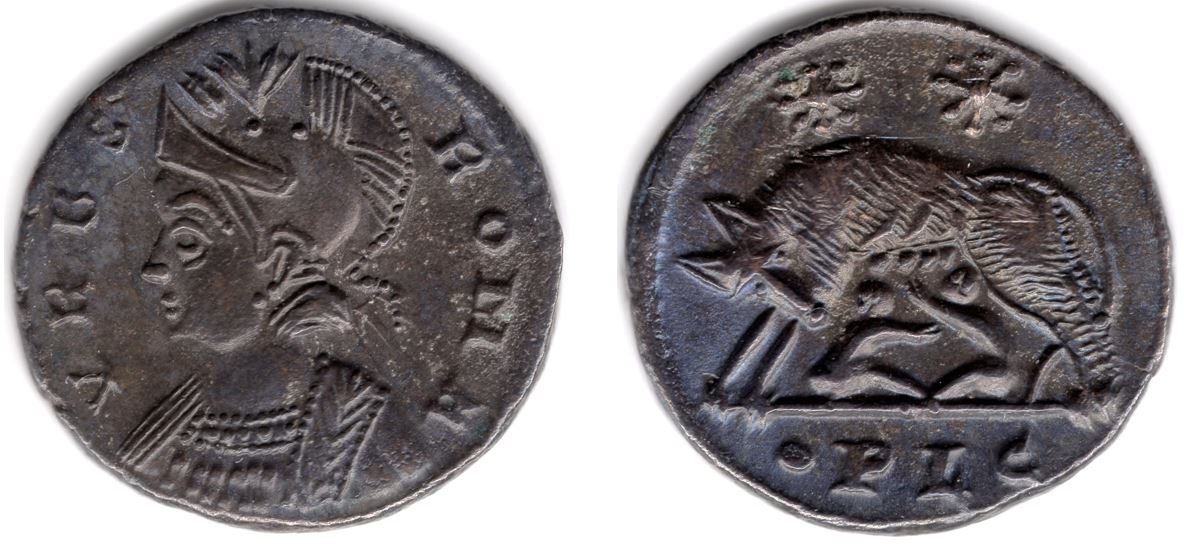 Though the capital of the Roman Empire had been moved to Constantinople in 330 AD, Rome was still a city of great importance. The Roman Senate remained in Rome (there was a Senate in Constantinople too, but only with provincial power) and of course its more than thousand years of traditions gave the city a special position in the empire. Thus the commemorative coins for the move also reminded about the importance of the old capital. The obverse shows Roma, the city's divine personification, like Constantinopolis on her coins in military attire. The reverse shows the perhaps strongest symbol for the city of Rome of them all: The twins Romulus and Remus, suckling their she-wolf stepmother, Romulus according to mythology becoming the founder of Rome and its first king. The two stars above are generally considered to be Castor and Pollux, the two brightest stars in the constellation Gemini (The twins), which in Roman mythology are associated with the two founding brothers. |
|
Page 3 of 3
|
Replies: 41 / Views: 5,250 |
Page 3 of 3
|
To participate in the forum you must log in or register.
Disclaimer: While a tremendous amount of effort goes into ensuring the accuracy of the information contained in this site, Coin Community assumes no liability for errors. Copyright 2005 - 2026 Coin Community Family- all rights reserved worldwide. Use of any images or content on this website without prior written permission of Coin Community or the original lender is strictly prohibited.
Contact Us | Advertise Here | Privacy Policy / Terms of Use
|
| Coin Community Forum |
© 2005 - 2026 Coin Community Forums |
| It took 0.43 seconds to rattle this change. |
 |
|
| |
| |




 First Page
 Previous Page


 Posted 01/09/2022 11:59 am


