|
This page may contain links that result in small commissions to keep this free site up and running.

Welcome Guest! Registering and/or logging in will remove the anchor (bottom) ads and the security checks. It's Free!
To participate in the forum you must log in or register. | Author |
 Replies: 41 / Views: 5,257 Replies: 41 / Views: 5,257 |
|
|
|
Pillar of the Community
  Sweden
2124 Posts |
Nice coins, @travelcoin.  That campgate imitation is really interesting, well made. Coin #6: 313-16? AD, Treveri. 3.6 g, 20 mm. (RIC 885 - see Note.)Obv: Constantine I, laureate, draped, cuirassed. CONSTANTINVS P F AVG Rev: Mars, helmeted, cuirassed. MARTI CONSERVATORI (To Mars, the Protector) 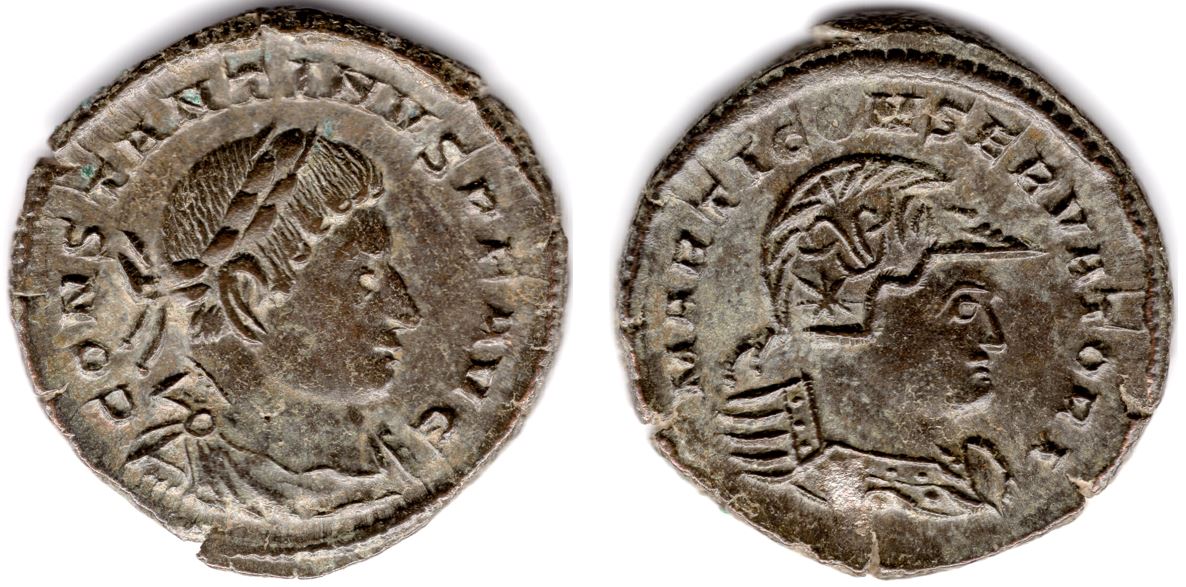 Another Mars coin. This type was minted in Trier only, from 310 (see Note). Even with Sol as his new "partner," Constantine didn't cut the bonds with Mars. He relied heavily on his armies for his continued success: Fighting off his former ally Maximian in 310, Maxentius in 312 (culminating with the victory at the Milvian bridge) and then Licinius from 316 and on. In between fighting the other emperors, he had to use his army to protect the borders of the empire. So demonstrating a good relation with the war god Mars, who was of course the patron god for the soldiers, was of great importance. An interesting detail on the coin is the eight-pointed star on Mars's helmet, which Constantine at least later used as a symbol (for Sol?). A coincidence perhaps, maybe it is just an arbitrary decorative element. Note: This coin is from the Chitry hoard, nr 949. It is classified as struck to a weight of 1/96 of a Roman pound, not 1/72 as the 310-13 AD RIC 885. I have marked the time span for its minting as uncertain, as there is discussion about when exactly minting of such coins was performed in Trier. |
|
Pillar of the Community
United States
1122 Posts |
erafjel WOW that is some coin!  I've learned a lot from this thread. |
|
Pillar of the Community
Sweden
2124 Posts |
My companion to one of your coins, @travelcoin: Coin #7: 319 AD, Treveri (2nd officina). 3.5 g, 18 mm. RIC 221.Obv: Constantine I, laureate, helmeted, cuirassed. IMP CONSTANTINVS MAX AVG Rev: Two Victories holding a shield inscribed VOT PR. VICTORIAE LAETAE PRINC PERP | VOT PR (Joyous victory to/of the eternal Prince | Vows of the Roman people) 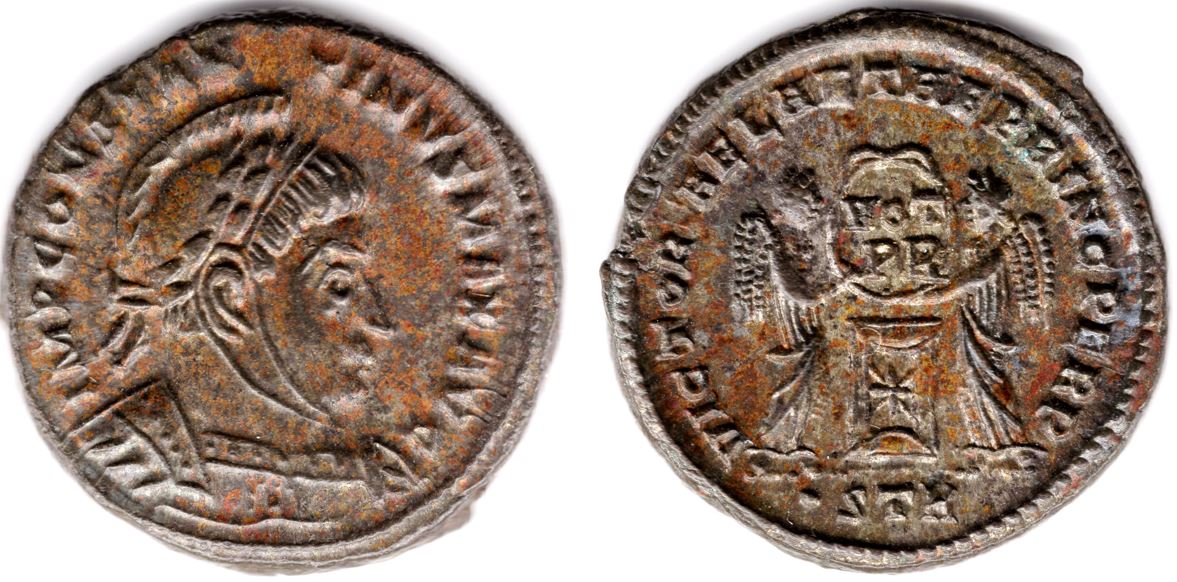 The eternal prince (that is, leader in the Roman meaning of the word) is of course Constantine. Here he wears armor and helmet with a laurel, clearly to show him in his role as a great and victorious military leader. Possibly the coin is a celebration of Constantine's victory over Licinius at Mardia in 317, after a campaign where Constantine's army had chased Licinius far into his Eastern part of the Roman Empire. The victory gave Constantine control over the provinces Pannonia and Macedonia, which was about half of Licinius's possessions. He now controlled more than half of the Roman Empire and surely was convinced (I believe) that his fate is to lead all of it. The VOTA P[opuli] R[omani] inscription should perhaps be interpreted as the Roman people's prayers for further Constantinian victories? Or at least Constantine's expectation that that was the case? The altar between the Victories has an eight-pointed star, which by this time is a symbol (possibly for Sol) that appears on many of Constantine's coins. It is used on many, but not all, coins of this type - other ornamentations are also used. My guess is the significance of the star is known at the mint, but its inclusion is up to the mint master or celator. Note:PRINC PERP can be read either as Principis Perpetui - the Eternal Prince - or Principum Perpetuorum - the Eternal Prince s - in which case also Constantine's newly appointed caesars, his sons Crispus and Constantine II, would be included. |
|
Pillar of the Community
 United States
994 Posts |
Quote:
PRINC PERP can be read either as Principis Perpetui - the Eternal Prince - or Principum Perpetuorum - the Eternal Princes - in which case also Constantine's newly appointed caesars, his sons Crispus and Constantine II, would be included. I think this legend is only referring to Constantine. In A.D. 306, Constantine was awarded the title "Prince of Youth" by the Senate. There was even a large series of coinage with several reverses issued over the years with the reverse legend of PRINCIPI IVVENTVTIS (Prince of Youth). So the VLPP coinage is a reference to Constantine's title as "Prince of Youth" even though he is about 45 years old at the time. This is further evidenced by Licinius I appearing on this type and he was never a "Prince of Youth" |
|
Pillar of the Community
Sweden
2124 Posts |
Thank you @Victor. That makes sense. Coin #8: 320 AD, Treveri (1st officina). 3.2 g, 18 mm. RIC 266.Obv: Constantine I, helmeted, cuirassed. CONSTANTINVS AVG Rev: Standard and two captives, VOT XX on the standard. VIRTVS EXERCIT | VOT XX (Virtue/Strength of the Army | Vows for the 20th) 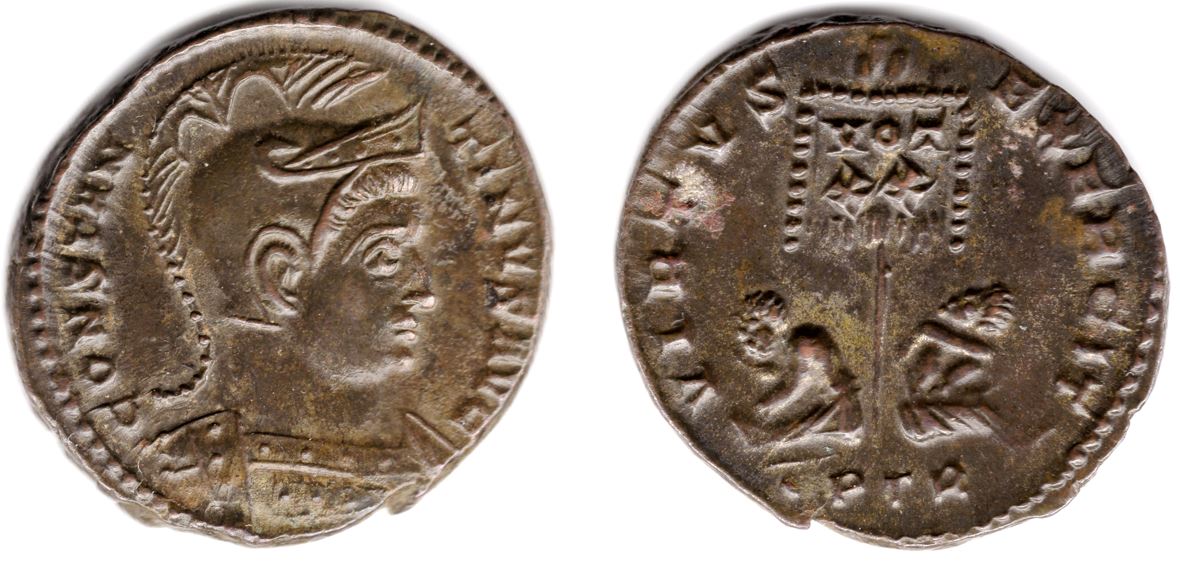 The years that followed on Constantine's victory over Licinius in 317 were relatively peaceful. Still, people needed to be reminded of Constantine's greatness, and the soldiers needed to be reassured of his esteem for them. So, coins praising the army were minted regularly and this type - most of them with Constantine in military attire - was favored by him around 320 AD and issued by many mints. Noteworthy is that Constantine also issued this type with Licinius's portrait, as befits a virtuous ruler. At the same time it is a VOTA coin: It is issued in conjunction with Constantine taking his imperial vows for 20 years as emperor. That happened in 326, but vows were usually taken several years ahead of their fulfilment. What the vows were we don't know, but we can assume they included keeping the empire safe, not least from barbarians like the two captives beside the standard. One of them seems to be contemplating the vota message, and its implications for the future of his people perhaps. (You can read more about VOTA coins here: VOTA coins of the Roman Empire.) Note:I am not aware of an exact translation of the Latin word virtus to English. From the original meanings of valor, courage, worth, etc it developed in later Roman times to also include prudence, justice, and self-control (source: Wikipedia). Perhaps virtue is the closest translation? |
|
Pillar of the Community
Sweden
2124 Posts |
Coin #9: 321-22 AD, Treveri (2nd officina). 3.0 g, 19 mm. RIC 353.Obv: Constantine II, laureate, draped, holding Victory on globe and mappa. CONSTANTINVS IVN NOB C Rev: Globe on altar with VOTIS XX. BEATA TRANQVILLITAS | VOTIS XX (Blessed tranquility | Vows for the 20th) 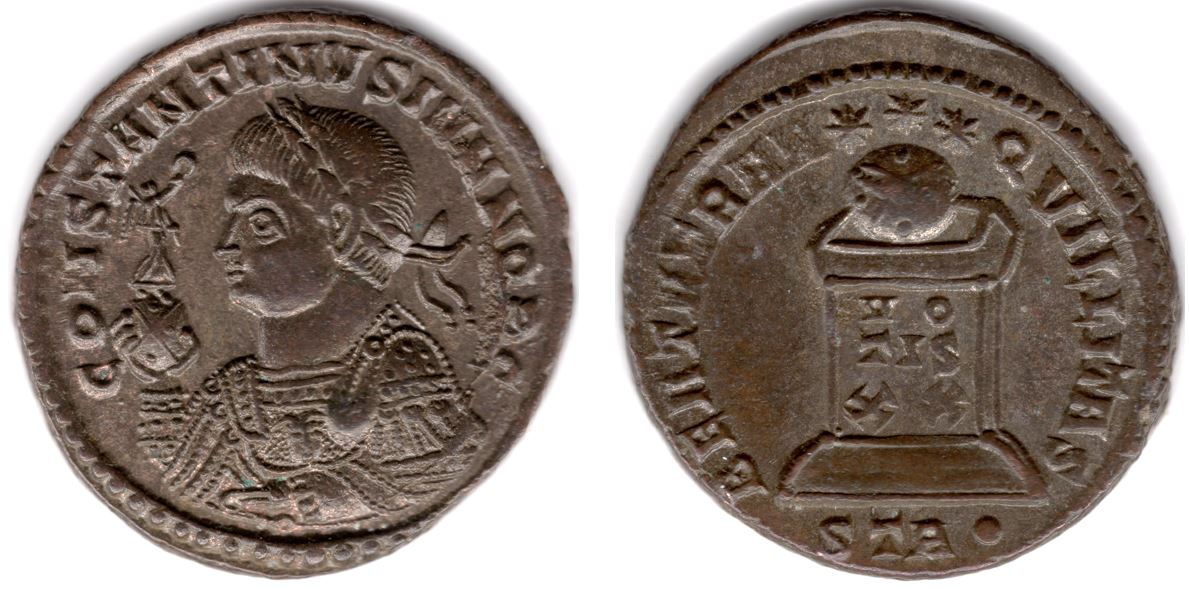 Constantine's 2nd son, also by the name of Constantine, was elevated to caesar as part of the peace treaty after the victory over Licinius in 317. He was then 1 year old. This is one of the many coins honoring "Constantine Junior," showing him with imperial attributes. What the inscription Blessed tranquility refers to is debated. Some want to see it as a commemoration of the law issued by Constantine in 321 that Sunday should be a day of rest. Another explanation is that it celebrates the relative calm in the empire that followed after the ending of the civil war between the emperors in 317. Some sort of tranquility brought about by Constantine, in any event. Like coin #8 this is a VOTA coin. We can assume that it refers to Constantine I's 20 years vows; Constantine II has to wait with those quite a while still. Note:Constantine II was called Constantine Junior to distinguish him from his father, Constantine the Great, who was called just Constantine (or rather, Constantinus). Thus the "IVN" on all coins with his portrait until 337, when Constantine the Great dies and Constantine II becomes the only living Constantine. After that he also becomes augustus and the "IVN" is dropped from his coins. |
|
Pillar of the Community
Sweden
2124 Posts |
Coin #10: 323 AD, Lugdunum (1st officina). 3.5 g, 19 mm. RIC 222.Obv: Constantine I, laureate. CONSTANTINVS AVG Rev: Victory with a trophy, foot on a captive. SARMATIA DEVICTA (Sarmatia vanquished) 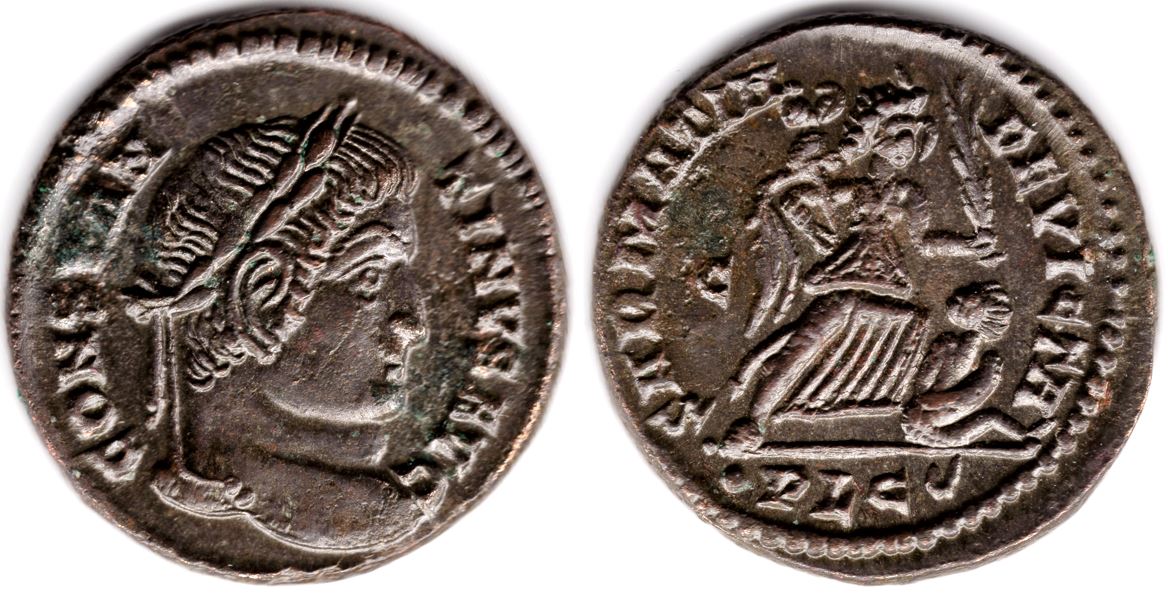 Calm did not last long in the Roman Empire. Along the Danube, Pannonian frontier river, the Sarmatians repeatedly made assaults into Rome. Constantine defeated them in 322 and again in 323, when he killed many, including the Sarmatian king, and took many prisoners. Constantine earned the title Sarmaticus Maximus - "Great victor of the Sarmatians" - and issued coins like this to commemorate the successful event. |
|
Pillar of the Community
United States
994 Posts |
Quote:
holding Victory on globe and mappa. The object that Constantine II is holding in his left hand is not always clear, but it is actually a parazonium which is a dagger with an eagle's head for the pommel cap. It has a long history of being misdescribed, but a few numismatists have gotten it correct. Below is a brief survey of some literature-- 2014 Roman Coins and Their Values by David Sear calls it a mappa. 2004 -- Die römische Münzserie Beata Tranquillitas in der Prägestätte Trier 321-323. by Alten and Zschucke call it a Kurzschwert (Lat.: Parazonium). 1982 Le Monnayage de L'Atelier de Lyon: De La Reouverture de L'Atelier en 318 a la Mort de Constantin (318- 337). by Pierre Bastien calls it a parazonium. 1982 Roman Imperial Coins in the Hunter Coin Cabinet describes it as a mappa. 1967 Roman Imperial Coinage VII describes it as a mappa. 1961 Die Spätrömische Kupferprägung: Ein Bestimmungsbuch Für Schlecht Erhaltene Münzen by Guido Bruck. This book is mostly line drawing and it shows a parazonium with a clear depiction of the eagle-headed pommel cap. 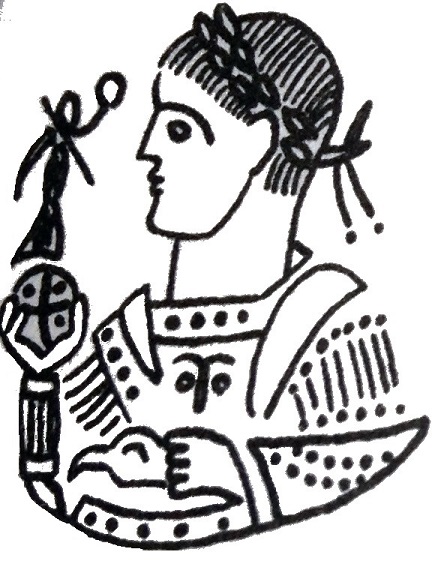 1908 Numismatique Constantinienne by Maurice describes it as a mappa. Below are some examples with clearer depictions of the parazonium-- 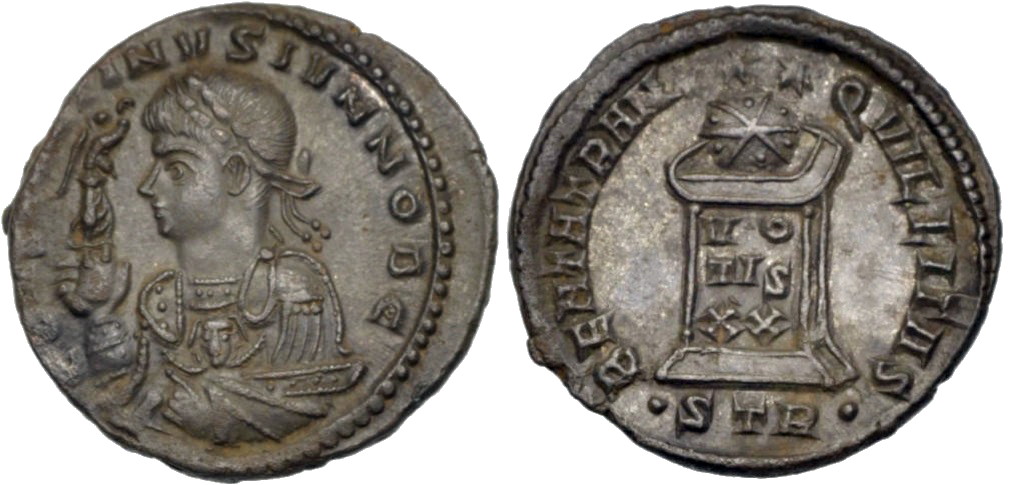 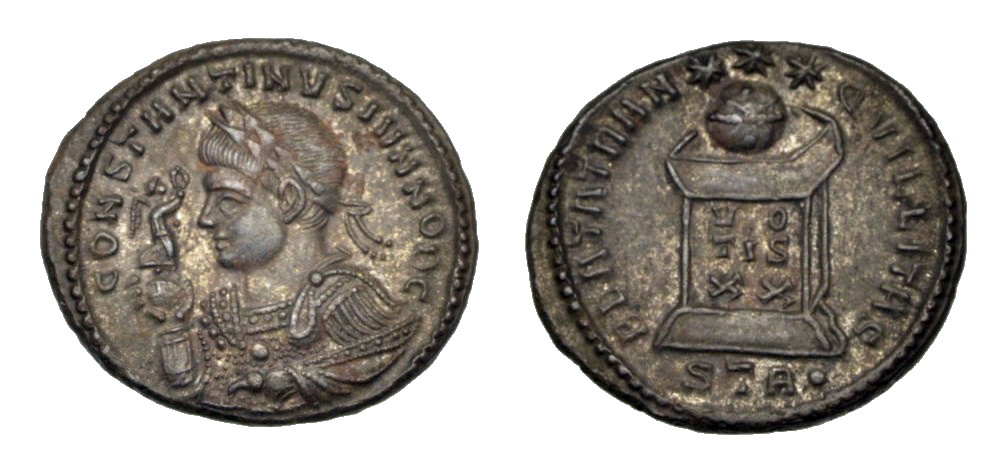 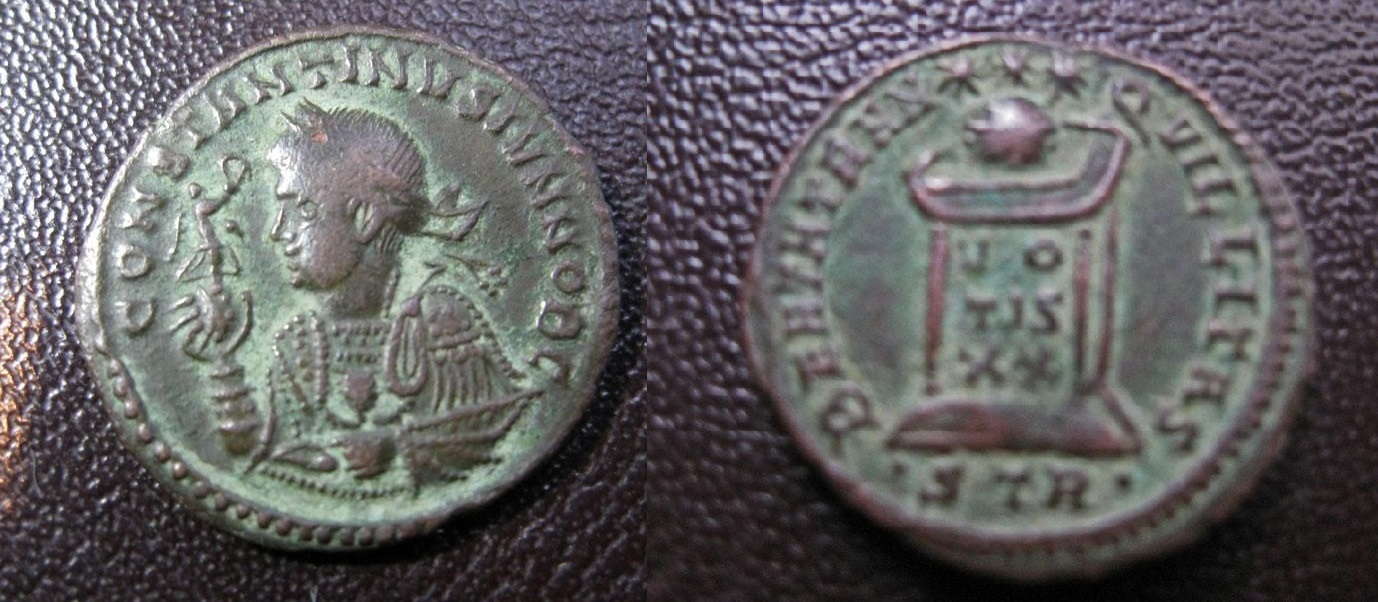 |
|
Pillar of the Community
United Kingdom
1168 Posts |
What an amazing thread this is turning out to be. Very informative, and some super specimens being shared. @Victor, an interesting point about the mappa/parazonium. I hadn't heard that before. @erafjel, your coin #10 sparked something in my memory. I have a few Constantine coins, but mostly not in very good condition. I looked through the Constantines and found this one which is similar to your #10, but with the Trier mint mark. 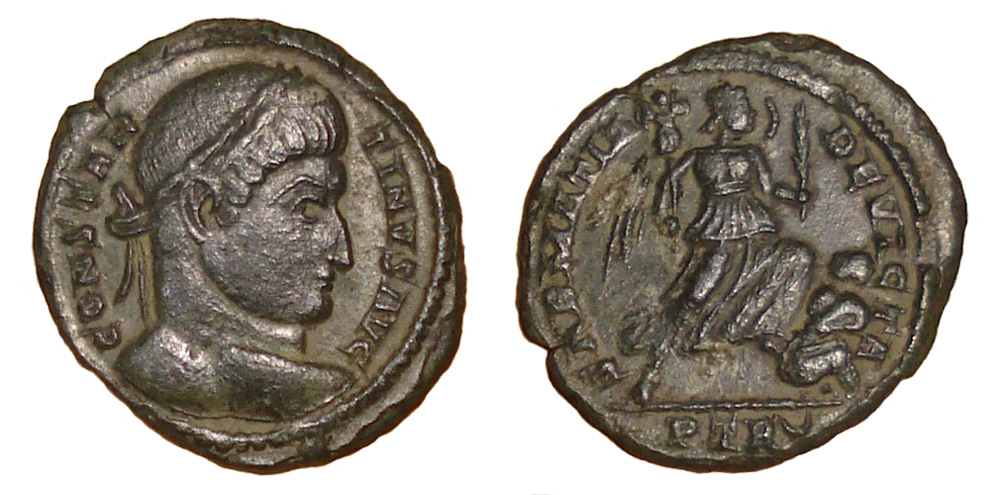 Constantine AE follis. 323-324 AD. Obverse: CONSTANTINVS AVG, laureate head right. Reverse: SARMATIA-DEVICTA, Victory advancing right, holding trophy on right arm, branch in left hand, spurning captive seated on ground right, head turned back. Mintmark: PTR crescent. Trier mint. Reference: RIC VII 435 |
|
Pillar of the Community
Sweden
2124 Posts |
Quote:
The object that Constantine II is holding in his left hand is not always clear, but it is actually a parazonium which is a dagger with an eagle's head for the pommel cap. Ok, cool! A bit more exciting than a napkin.  Thanks @Victor! @Novicius: Nice to see you show up here. I suspected you might have something to contribute. Today it's time for anothe close relative of Constantine: Coin #11: 326 AD, Treveri (1st officina). 3.1 g, 18 mm. RIC 481.Obv: Helena, Constantine's mother, wearing a diadem. FL HELENA AVGVSTA Rev: Securitas holding a branch. SECVRITAS REIPVBLICE (Security of the State) 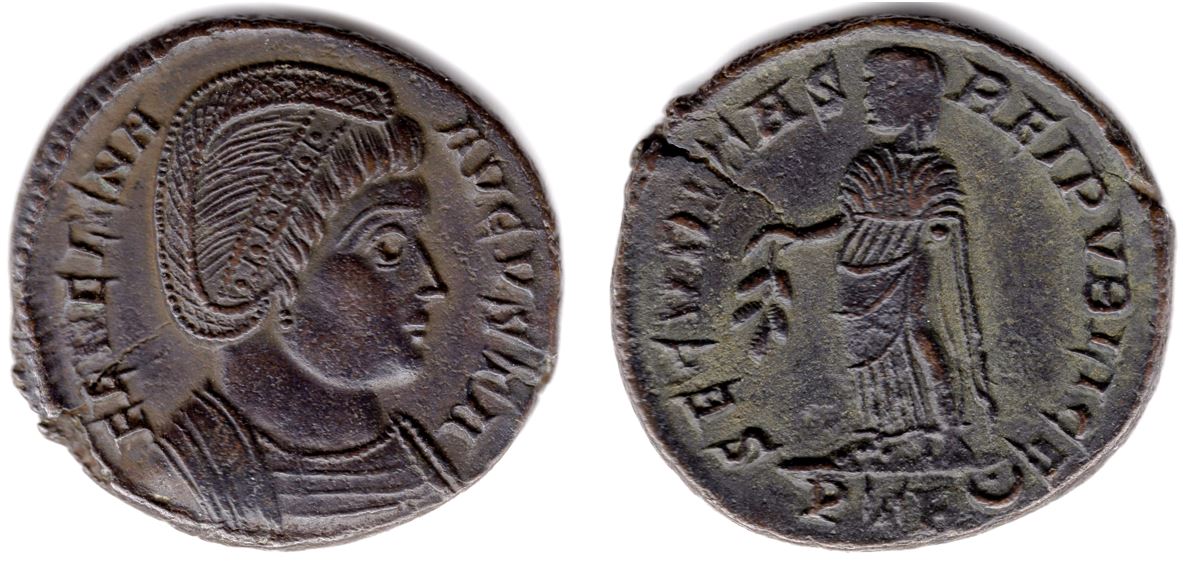 In 324 or 325 Helena, the mother of Constantine, got the honorific title of augusta. This followed shortly after Constantine's wife Fausta received the same honor and his 3rd son Constantius II was elevated to caesar, events that in turn followed on Constantine's final victory over Licinius, which made him sole ruler over all of Rome. Supposedly the elevation of the female members of the Constantinian family was a way to further mark the establishment of a ruling dynasty. Coins with Helena's portrait had been issued before, but on this type her title is present and even spelled out in full. Securitas, the goddess shown on the reverse, personified the security, safety and stability of Rome, something Constantine wanted to communicate that he and his family would be the guarantors of. Helena, being the mother of Constantine and thus the "founder" of the Constantinian dynasty, was put forward as the living personification of Securitas. Helena was a pious woman with a strong Christian belief. She probably played an important role in forming Constantine's view on Christianity. As augusta, she made use of the imperial treasury to build churches and acquire holy relics, the best known probably being the True Cross, remnants of the cross on which Jesus was crucified. She died around 330. Helena is a saint in several branches of Christianity. |
|
Pillar of the Community
United Kingdom
1168 Posts |
This thread is certainly evoking some memories, @erafjel. I have neglected the Romans for too long, so here is a similar coin of Helena. When I was stationed in the Falkland Islands in the 1980s and 1990s I met a few "saints", people from the island of Saint Helena in the South Atlantic Ocean, the island where Napoleon was exiled to in 1815. The island had been named after Saint Helena of Constantinople. I was intrigued by the fact that a Roman empress had been sanctified and had an island named in her honour. Her story was quite remarkable. Born Flavia Julia Helena in around 246/248 AD in Drepanum, Bithynia, of humble Greek parents, Helena was to become the consort of the future Roman Emperor Constantius Chlorus, and the mother of the future Emperor Constantine the Great. Helena was an important figure in the history of Christianity due to her influence on her son. During her religious tour of of Syria Palaestina and Jerusalem, ancient tradition says that Nicene Christian Helena discovered the True Cross. She is revered as a saint by the Eastern Orthodox Churches, Oriental Orthodox Churches, Roman Catholic Church, and is commemorated by the Lutheran Church. When Helena died around 330 AD, she would have been in excess of 80 years old. 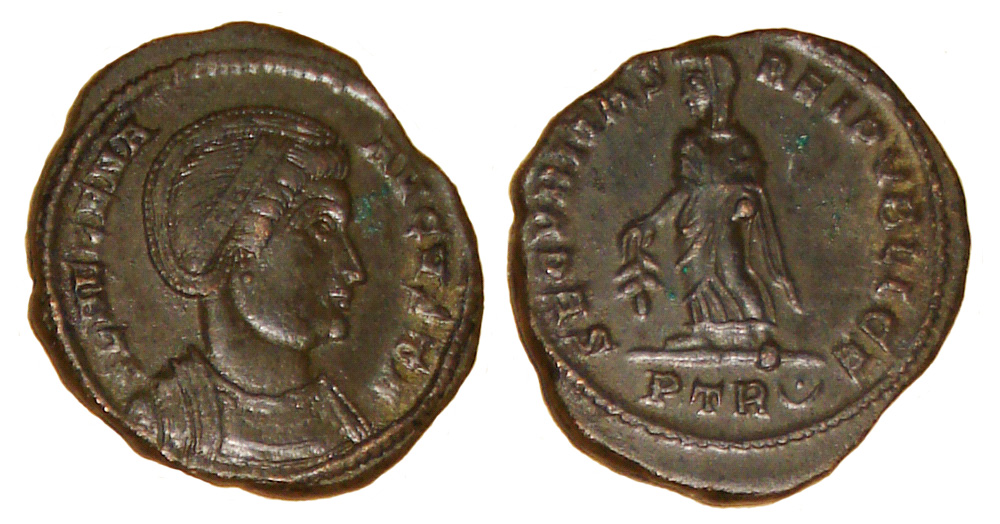 Helena AE Follis. Obverse: FL HELENA AVGVSTA, diademed and draped bust right. Reverse: SECVRITAS REIPVBLICE, Securitas standing left, holding branch in right hand. Mintmark PTR dot in crescent. Trier mint. Reference: RIC 481; LRBC 35; Sear 16593. |
|
Pillar of the Community
Spain
2752 Posts |
This is an excellent thread! ... Thoroughly enjoying the ride and have learnt a great deal so far! ..Thanks...Looking forward to more of these interesting posts....Some wonderful coins have been represented so far! The Constantine era is not an area of collecting I've ventured into yet but I can contribute at this point with a Helena having the same reverse but from a different mint than the 2 examples already shown...It depicts an alternate hairstyle and also shows the folds of her drapery running vertically as far as I know a unique detail associated with Siscia? Helena AE3 (19mm, 3.30g). Struck 326-327 AD Obv- FL HELENA AVGVSTA, Diademed and draped bust right. Rev- SECVRITAS REI PVBLICE, Securitas standing left, holding olive branch in extended right hand.raising hem of robe with left hand. Mintmark dot ΓSIS dot. RIC VII Siscia 204; Sear 16609. 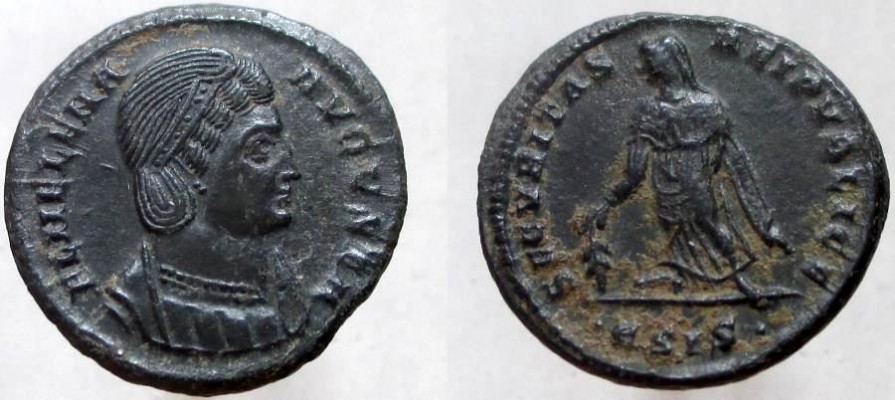 |
|
Pillar of the Community
Sweden
2124 Posts |
Thank you @Palouche, glad you enjoy the thread! And thank you and @Novicius for the Helenas, they are both real nice examples. It is interesting that her hair style seems to vary a bit between mints - I wonder what they had to base the portrait on? Another relative now: Coin #12: 323 AD, Lugdunum (1st officina). 3.2 g, 19 mm. RIC 216.Obv: Crispus, Constantine's first son, laureate, draped, cuirassed. FL IVL CRISPVS NOB CAES Rev: Laurel wreath, VOT X. CAESARVM NOSTRORVM | VOT X (Our Emperors' Vows for the 10th) 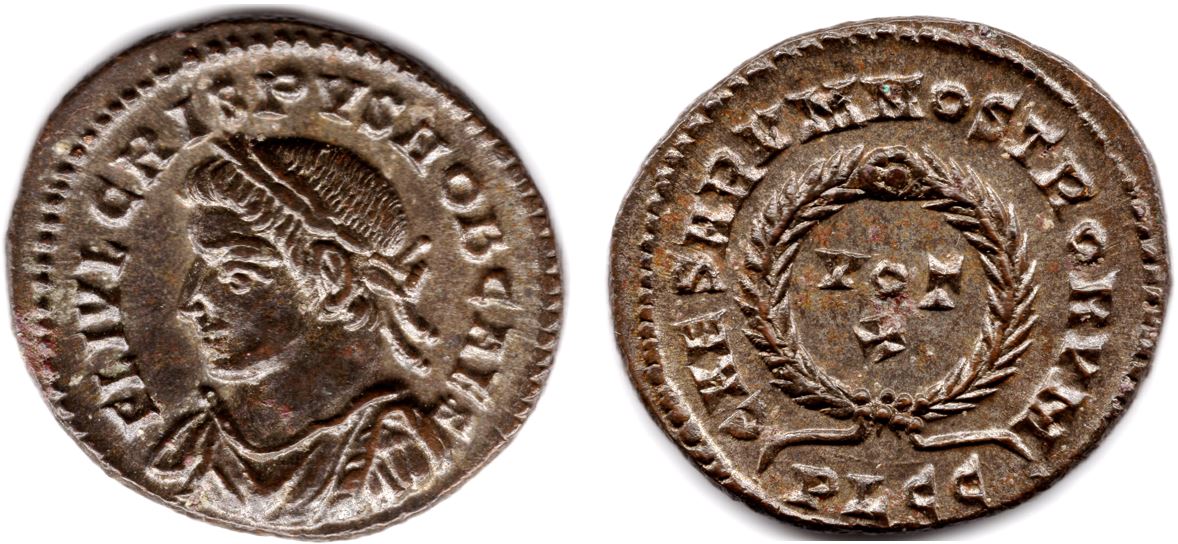 Crispus was Constantine's first son and was made caesar in 317 at the same time as his brother Constantine II and Licinius's son Licinius II. About five years into their reign it was time for their 10 year vows and VOTA coins were minted for all three caesars. 326 AD, the year the vows were to be fulfilled, was however an unfortunate year for Crispus. Following allegations of misconduct with his stepmother Fausta, Constantine had his own son Crispus executed. Fausta was to meet the same fate, but more about that in my next post. |
|
Pillar of the Community
United Kingdom
2121 Posts |
Dragging the thread back to coin #6. Whilst the type is most commonly found from Trier the type is attested to have been struck in Trier, Ticinum, Aquileia, and London (see Num. Chron. 152, 1992, 157-60).
|
|
Pillar of the Community
Sweden
2124 Posts |
Ok, thanks @maridvnvm, that is good information. The paper seems to deal mostly with Sol coins; for unsigned Mars coins like RIC 885 it shows strong evidence for minting also in Aquileia (die match with a signed coin), for the other mints I think it is more open-ended. Coin #13: 326 AD, Treveri (2nd officina). 3.5 g, 18 mm. RIC 483.Obv: Fausta, Constantine's second wife. FLAV MAX FAVSTA AVG Rev: Salus (or Fausta?), standing holding two children. SALVS REIPVBLICAE (Welfare of the State) 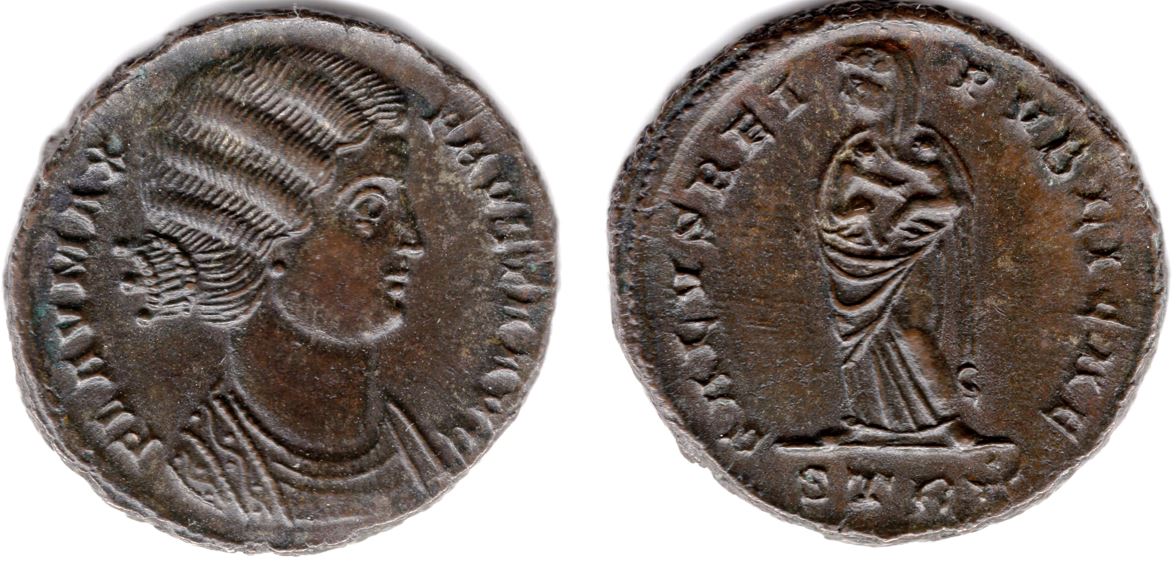 Constantine married emperor Maximian's daughter Fausta in 307 to seal the bonds of power within the tetrarchy. For this he had to divorce his first wife, Minervina, with whom he had his first son, Crispus. In 324, shortly after the downfall of Licinius and Constantine becoming sole emperor, Fausta was made augusta. As for Constantine's mother Helena, who was also made augusta soon after, coins were minted for Fausta. On her coins, she was associated with Salus (goddess of welfare, health and prosperity) or Spes (goddess of hope). On the coins, Salus/Spes is depicted holding two children, and it can be interpreted as showing Fausta as a living personification of the goddesses, holding two of her children with Constantine (which ones of the five they had is unclear). In any event, she represented the future of the Constantinian dynasty and thus the (bright) future of Rome. Her own future was not too bright, however. Exactly what happened in 326 is not clear and is poorly documented. According to some accounts Fausta accused Crispus, Constantine's son with his first wife, of having approached her inappropriately. Constantine, holding Fausta in very high esteem, then had Crispus executed. When the allegations were found to be false - speculations are that Fausta wanted Crispus out of the way in favor of her own sons - he had Fausta executed too. |
| |
Replies: 41 / Views: 5,257 |
To participate in the forum you must log in or register.
Disclaimer: While a tremendous amount of effort goes into ensuring the accuracy of the information contained in this site, Coin Community assumes no liability for errors. Copyright 2005 - 2026 Coin Community Family- all rights reserved worldwide. Use of any images or content on this website without prior written permission of Coin Community or the original lender is strictly prohibited.
Contact Us | Advertise Here | Privacy Policy / Terms of Use
|
| Coin Community Forum |
© 2005 - 2026 Coin Community Forums |
| It took 0.41 seconds to rattle this change. |
 |
|
| |
| |




 First Page


 Posted 01/03/2022 1:13 pm


