| Author |
 Replies: 23 / Views: 2,311 Replies: 23 / Views: 2,311 |
Page 2 of 2
|
|
|
|
New Member
 United States
6 Posts |
Reverse: checked and there is no glue or other coating. Sorry for initial bad photo. 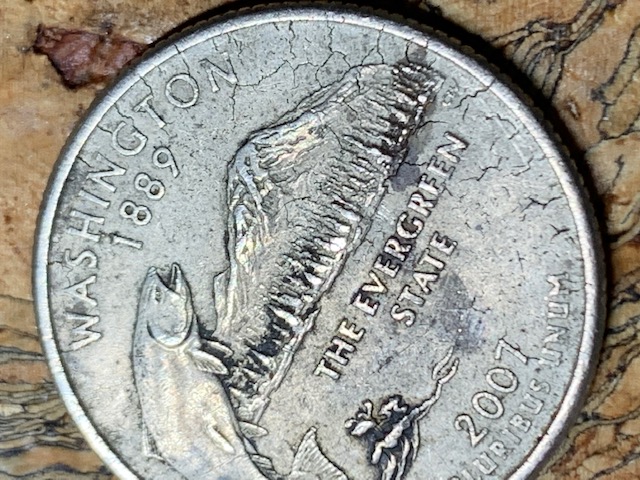 |
|
Pillar of the Community
Canada
6244 Posts |
Very nice photos BU2. What is show for me and I know some here will be very skeptical, is that the clad Ni roll was improper annealed at the manufacture, then was applied over the core and the forces applied make the clad to crack; what we say cracked clad. The forms of the cracks are characteristics to Ni molecular or crystalline structure. Other thing are those black spots who was develop due to the effect of the H2O in the atmosphere. Will be not long that the Cu oxides will come out.
Some will say: But the planchet was annealed. Correct, but the clad in the moment when was applied was not, so internal separated, not necessary out layout. Then the planchet was annealed at 600 deg C. for be prepared for the strike, which it is not enough for the Ni which need normally at least 700 deg C. then 80 tones was apply, so we see the results.
Except upper IGWT where you will say Lam the rests of the crack follow the strike flow of the metal.
My opinions and wait for the others also. Price for?!!! No idea. Collectors for this kind?!!! maybe, but me I do not know one of them.
|
|
New Member
United States
6 Posts |
I'm grateful for this explanation. Unless I hear otherwise, I'm going with your idea. I've learned so much from you. Thank you!
|
|
Pillar of the Community
 United States
7174 Posts |
Silviosi, are you saying that the different clad layers weren't the right temperature when they were fused together? Then when they cooled down, the nicu layer cracked?
|
|
Pillar of the Community
Canada
6244 Posts |
@Cujohn Exactly. It is not the first time I saw this. The producers of the clad rolls anneal the roll (we say the plates) before ship to the mint. Sometimes some parts of the roll is not well anneal. We find also those portions have a bad mixt of the metal or purge relative cold from the kiln.
Sorry to answer late.
Edited by silviosi
04/01/2022 6:01 pm
|
|
New Member
United States
19 Posts |
BU2,
For what it's worth, I'd buy that quarter if I saw it for sale.
I work in the machine maintenance field, so I love seeing errors and trying to imagine what was wrong with the minting machines to cause certain errors. Nice find!
|
|
Pillar of the Community
Canada
6244 Posts |
In 2007 they still use the rolling press cladding. So if the clad rolls has some molecular or crystalline deformations will be separate.. Working with those mechanisms you must understand the forces applied to the main. We have the directional and vertical forces, those forces will make the material have crystalline separation. The traces on this coin coincide with the NI separation.
|
|
New Member
United States
6 Posts |
I'm thinking about sending it into ANACS for grading to see what they say. Is there a way to stabilize the metal to prevent more oxidizing?
|
|
Pillar of the Community
Canada
6244 Posts |
Slabbing and vacuum, if you can.
Sending?!! You have to specify very well what you want and arguments. If not they will go by what already agreed in the past, Good Luck. You need some recognized specialist to say.
Try with Mike or Fred or KEN, just a few. Or Steven in Florida, maybe. At ANACS are some but they work others things. PCGS and NG will not go deep. VSS maybe, not sure.
You discuss here about forensic of the coin, not about daily minor DD or such. You discuss about production quality of the materials and manipulation. Hope help and welcome to the to words of collecting.
Edited by silviosi
04/01/2022 11:49 pm
|
|
New Member
United States
6 Posts |
I think what you're saying is that there is more knowledge here regarding the metal cladding process, and that coin grading services are less likely to delve deeply into that aspect of minting. I hadn't thought of that, and I appreciate your knowledge. I am new to all of this and have already shared your ideas with my other friends that are learning too. Thank you very much!
|
|
Pillar of the Community
Canada
6244 Posts |
It is not more or less knowledge. It is in fact that the TPG do business not more then this. This do not mean they do not can do forensic or really things. They can do, but they work certifying a coin from 30 sec to max 2 min. Your coin need tests, need different point of view of the traces, and more. For a coin like your in my Lab we spend around 6 to 7 hours with high tech equipment. They do not do this. Try with Mike Diamond (is here on the forum) he could help. Or VSS company (they do not grad but certify varieties and production errors). |
|
Pillar of the Community
United States
2752 Posts |
This is not an error. Alan Herbert called these "sewer coins", presumably because their prolonged immersion in human waste eats into the surface. At any rate, I've seen many other coins with similar chemical damage.
Error coin writer and researcher.
|
|
Pillar of the Community
Canada
6244 Posts |
This theorem make sense for me. The human body waste are very acidic full with the both kind of acid: strong and mild, and also very corrosive acidic bases. Make sense, maybe one day free, to test this theorem in the Lab. for the moment we test more the reactions of the Silver and Gold with the human body.
|
|
Moderator
United States
108341 Posts |
huh!, ok WOW! sewer coin - now I have heard everything. Very interesting.
|
|
Valued Member
United States
354 Posts |
Very interesting. I have learned something new on this one. Requires more research on my behalf.
|
|
Page 2 of 2
|
Replies: 23 / Views: 2,311 |
Page 2 of 2
|






 First Page

 Posted 03/29/2022 11:02 pm


