| Author |
 Replies: 19 / Views: 2,383 Replies: 19 / Views: 2,383 |
Page 2 of 2
|
|
|
|
Pillar of the Community
 United States
5727 Posts |
 It won't hurt, but it's highly unlikely it will help the appearance either. Not much you can do for a mild case of road rash. |
|
Bedrock of the Community
United States
94367 Posts |
Good luck, but guessing this is a lost cause.  Edited by Coinfrog
05/22/2023 6:25 pm
|
|
Moderator
 United States
110474 Posts |
give it a try, maybe most of that black gunk will come off it.
|
|
Pillar of the Community
 United States
6976 Posts |
To be fair, this is a test case. I've got coins like circulated bicentennial quarters that have literal wads of black gunk adhered to them. Others have paint, crud, and quite possibly asphalt or driveway sealer. I don't even like putting them into new, clean rolls with similar denominations because I don't want the other coins to be stained or discolored by contact.
|
|
Bedrock of the Community
Australia
21794 Posts |
Acetone is excellent for removing organic substances from coins
provided that any organic sulfur of chlorine chemistry is not in those substances.
If there is, they will react with the metal of the coin, to form inorganic residues, which can an often do, leave permanent inorganic stains on the coin.
Permanent fingerprinting is an example, where the fatty acid oils in the skin leave behind their characteristic markings.
Inorganic staining, be from skin oils or any other fatty acids, such as from foodstuffs, cannot be removed with acetone.
In the case of the pictured coin in question, it looks as if those small black spots may be of an inorganic nature, unfortunately.
Try acetone anyway; it certainly won't do any further damage.
|
|
Pillar of the Community
United States
6976 Posts |
The spots are on the metal. The ones by the eye even have greenish metal discoloration, probably due to the copper.
However, the black gunk in IGWT is not corrosion, it's something sticky that can be scraped with a toothpick.
That's an interesting tip about fingerprints and organic material. Sounds like the coin needs to be wiped thoroughly with hot water prior to acetone.
Is there any harm to plunking a coin into boiling water for a while?
|
|
Moderator
United States
198174 Posts |
Quote:
To be fair, this is a test case. Those are important to the learning process.  |
|
Pillar of the Community
United States
6976 Posts |
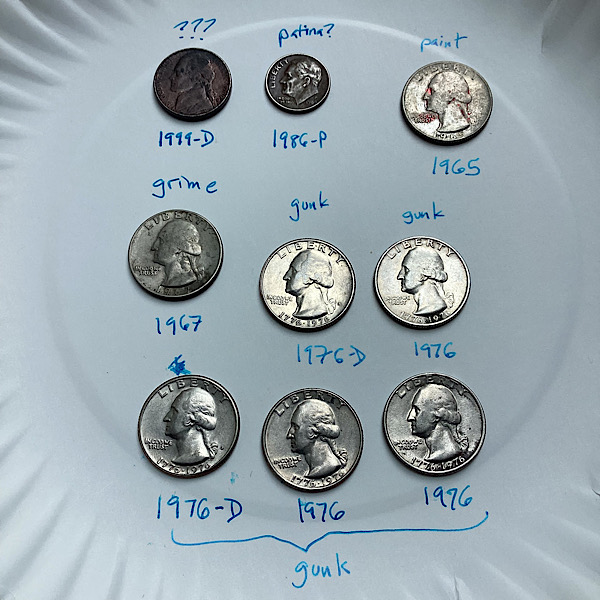 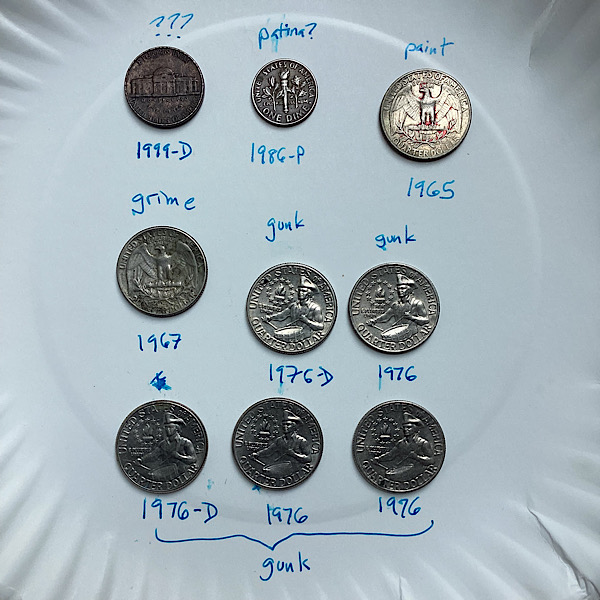 Ok, my first test batch. I decided against the 1939 Jeff because it might have some minor value, so I plunked that back into the 1940s Jeff jar. The 1999-D nickel, 1986-P Roosevelt, 1965 Washington have gone into a little jar of pure acetone from the car parts store. The 99 nickel has some sort of coffee colored "patina" on it. Seems like tremendous EVD, although the scratches have a very bright copper color. Maybe something selectively stripped nickel from the surface alloy, or maybe it's just thinner deposits in the scratches. I have a 95 with the exact same substance and appearance, and I've been curious what it is. The 86 Roosevelt has a much harder "patina" in the low spots. Not sticky or scratch-able with a toothpick. The 65 Washington has red ink or paint on it, and is also somewhat sticky. |
|
Pillar of the Community
United States
6976 Posts |
Oh, and I let them soak for an hour, no real change. Will let them in overnight and check again tomorrow at lunch.
|
|
Pillar of the Community
United States
6976 Posts |
After 3 hours, the nickel is clearing up considerably. No change to the dime, and surprisingly, no ink removed from the quarter. I haven't rubbed them though, just turned them over and returned to a cool, dark, isolated place.
|
|
Moderator
United States
198174 Posts |
Very interesting!  |
|
Moderator
United States
110474 Posts |
Nice experiment! can't wait for the results tomorrow.
|
|
Pillar of the Community
United States
6976 Posts |
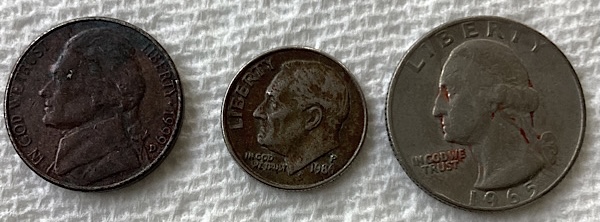 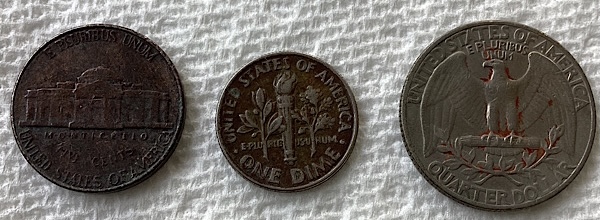 After 27 hours in the acetone, this is the result. Aside from some faint cleanup of the nickel, there was really no change in the coins. So I broke out my Toothbrush of Value Destruction +2 and scrubbed away. DO NOT DO THIS TO YOUR COINS.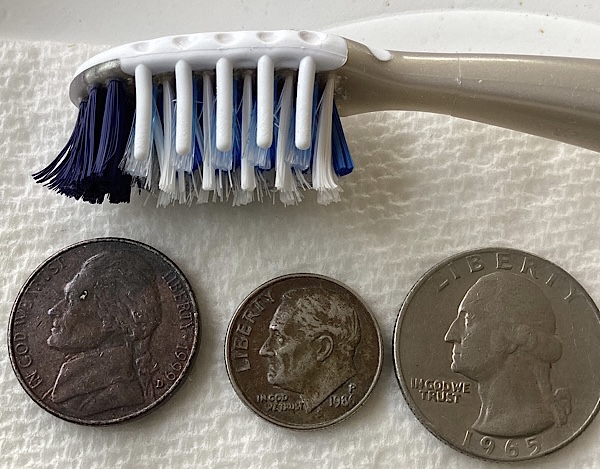 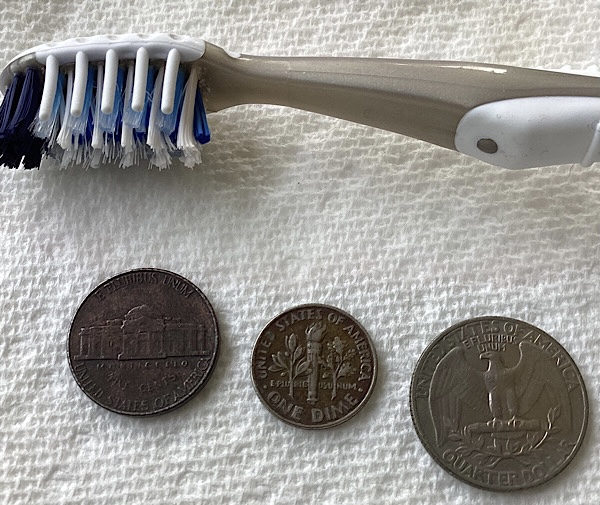 That cleaned the red ink right off the quarter. It didn't help the nickel, so I scrubbed it hard against a dry Scotch Brite scouring pad. As before: DO NOT DO THIS TO YOUR COINS.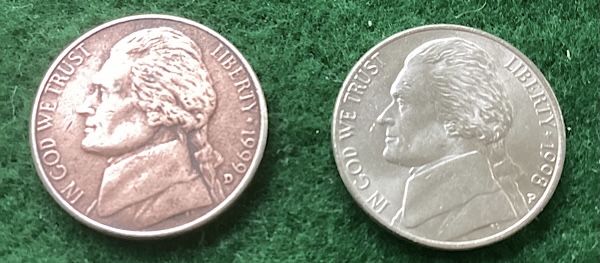 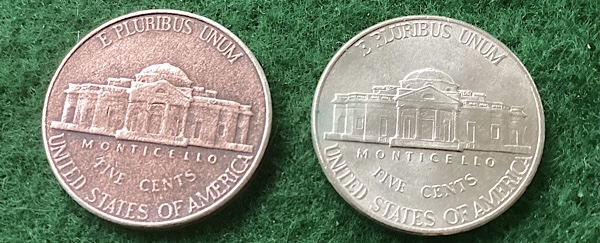 I am rather puzzled by the copper surface of the nickel. Did some kind of severe environmental damage preferentially strip the nickel and leave copper behind? I almost wonder if someone burned it in a fire, or dug it up at the beach where it was attacked by salt water. Before anyone says it: I know, I know, you want to know the mass. I don't have a gram scale handy. I will find one soon and post the results. |
|
Moderator
United States
110474 Posts |
Well the nickel is actually 75% copper and 25% nickel and in some conditions the copper can 'migrate' to the surface of the coin and giving it this coppery appearance.
|
|
Moderator
United States
198174 Posts |
Interesting results. A reminder to all that cleaning will change a coin.
|
|
Page 2 of 2
|
Replies: 19 / Views: 2,383 |
Page 2 of 2
|




 First Page


 Posted 05/22/2023 6:25 pm





