| Author |
 Replies: 21 / Views: 1,191 Replies: 21 / Views: 1,191 |
Page 2 of 2
|
|
|
|
Moderator
 United States
15990 Posts |
Beautiful coin and I fully concur with the comments praising your coin photography talents.  |
|
Moderator
United States
197031 Posts |
Outstanding! |
|
Pillar of the Community
 United States
2404 Posts |
Nice RPM on a beautiful coin! smat |
|
Pillar of the Community
 United States
6207 Posts |
Thanks so much for all the super kind comments! Much of what I post is meant to be descriptive of real errors and varieties, and pretty hard for folks to learn if they can't see what's going on very well. Thus I do try to post solid images of the coins. I have an interesting coin to try and get the lighting right up next, and hopefully get that worked out and posted in a bit. Coinfrog brushes up against another thing I try to bring to the board a little bit, and that is the coin's grade. This one is right down the middle a 65, and would be amazed if any TPG would grade it differently. Good images are key to helping folks actually see what the minor details on the coin look like and why a coin would grade this way or that way. |
|
Bedrock of the Community
United States
94367 Posts |
To me, the mark in the left obverse field, if as pronounced as it seems, keeps this at 64, and would on any modern denomination in my opinion.  |
|
Pillar of the Community
United States
2404 Posts |
Since it's out of 70...the couple of minor marks on the obverse is the reason this gets a 65...that reverse carries him...great strike with tiny hit on the N.
just a contrasting opinion...
I think he carries the grade "with" the attribution.
smat
|
|
Pillar of the Community
United States
6207 Posts |
Well, maybe it's that my photos show every nearly microscopic flaw, but it's not even remotely close to a 64. But again, not really strong enough to go 66. I pulled a random PCGS MS64 Lincoln Cent from my collection and took photos in the same light as the 1930-S shown above. Here is what a 65 looks like (1930-S/S FS-501) compared to a 64 (1953-D & D FS-502). 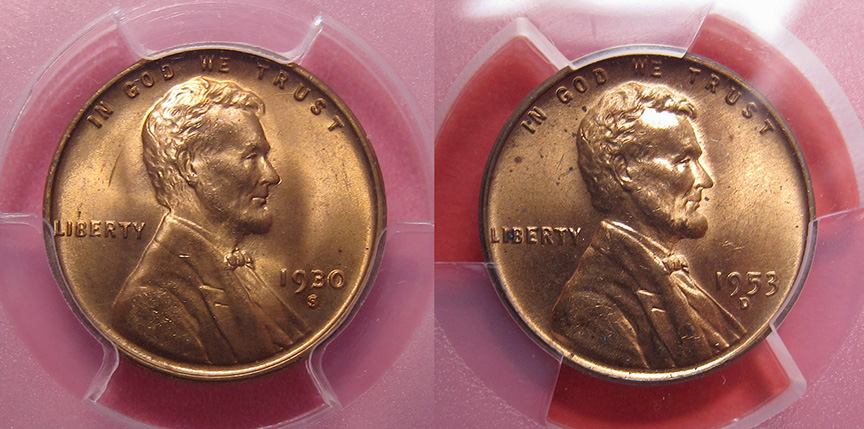 |
|
Pillar of the Community
United States
986 Posts |
TB - Your photo skills combined with the rarity of the coins you post are what distinguishes you from all other members on this board. Please keep up the outstanding effort. I look forward to learning more from your educational images and posts.
"We are all flawed, some MD and some PMD." NYI |
|
Pillar of the Community
United States
6207 Posts |
 Just trying to help folks know what to look for on the real deal coins. I've been time-crunched lately with a rare March/April bat project so haven't had much time to post things. |
|
Pillar of the Community
United States
5908 Posts |
Very nice pick and coin TB. Personally, I think it is accurately graded at 65. Quote:
...that reverse carries him...great strike with tiny hit on the N. ... One of the senior graders at PCGS comes to our local club meetings. He has stated many times the reverse cannot improve a grade. The obverse carries the grade unless the reverse has issues, then the reverse will lower the grade. I asked his opinion on a raw coin I was considering sending in. He actually looked at the reverse first. The reverse held the coin back in his opinion. Words of encouragement are one of the major food groups.
We need to consume them regularly to thrive and grow.
|
|
Moderator
United States
56855 Posts |
The reverse cannot improve a grade, but it can lower the grade  Let's think this through a bit. What am I missing.A coin has three sides and each needs to be graded and then come up with an average grade.I must be missing something, functional gray matter maybe  Stop agreeing with me LOL. John1  |
|
Pillar of the Community
United States
5908 Posts |
Quote:
The reverse cannot improve a grade, but it can lower the grade
Let's think this through a bit. What am I missing.A coin has three sides and each needs to be graded and then come up with an average grade.I must be missing something, functional gray matter maybe Stop agreeing with me LOL.
John1 Anyone that takes a PCGS grading class will hear that the reverse can lower a coin's grade (if the reverse has issues). The reverse can't "rescue" a grade even if the reverse is significantly nicer than the obverse. The reason the person I referenced earlier looks at the reverse first is to see if there are glaring issues with the reverse. If there are no issues on the reverse, then the obverse carries the grade. And remember that we, as variety collectors, use loupes looking for minute details. Graders generally use their eyes only, which is why glaring deficiencies to us (under a loupe) are less noticeable to them. Words of encouragement are one of the major food groups.
We need to consume them regularly to thrive and grow.
|
|
Moderator
United States
56855 Posts |
I either heard or read that graders use a 5x loupe. John1 |
|
Pillar of the Community
United States
5908 Posts |
Yep, he only uses the 5x loupe if he perceives an issue. He said 60% to 80% of the coins he looks at don't require anything other than the naked eye. Professional graders take about 5 seconds (or less) per coin.
(This only applies to the numerical grade.)
Words of encouragement are one of the major food groups.
We need to consume them regularly to thrive and grow.
|
|
Valued Member
United States
392 Posts |
Nice reminder that if you don't request error/variety designation, a TPG will slab it anyway without designation. Good find TB! |
|
Page 2 of 2
|
Replies: 21 / Views: 1,191 |
Page 2 of 2
|




 First Page


 Posted 04/08/2024 11:50 am





