| Author |
 Replies: 19 / Views: 2,224 Replies: 19 / Views: 2,224 |
Page 2 of 2
|
|
|
|
Pillar of the Community
United States
3364 Posts |
You might be interested in the making of Spanish cobs floyd. https://worldnumismatics.com/succin...per%20weightA measured volume of silver or gold was poured out on a surface to form a strip of 8 cobs. Without using a scale, the cooled strip was divided by sequentially balancing it and chopping it to make the planchets (which are usually within 1-2% of correct weight). The planchets were struck with a hammer, sometimes more than once. No time was wasted because there was a huge amount of metal to process. Spanish cobs are as crude as the most primitive 500 BC coinage from Mysia and Lydia. Judging from the high quality of most of the images, the dies were well engraved, but the fast-working coin and planchet makers weren't finicky about the quality of their product. The "planchets" for the early Lydian and Mysian coins I have are irregular lumps of metal squashed by the coin striker's hammer. They aren't flat and the edges are often cracked. In reference to Sap's comment, the earliest coin reverses were made on a chisel-like support instead of a die, sometimes leaving a swastika-like pattern. "Two minutes ago I would have sold my chances for a tired dime." Fred Astaire
Edited by thq
02/11/2025 8:11 pm
|
|
Pillar of the Community
United States
2361 Posts |
Thanks Sap and thg for your input.
|
|
Valued Member
 United States
86 Posts |
Yeah! This is super helpful and interesting!
|
|
Bedrock of the Community
 United States
27514 Posts |
Sap, do you have an estimate of how many coins a 3-man team could crank out in a day?
Inordinately fascinated by bits of metal with strange markings and figures
|
|
Pillar of the Community
 United States
8066 Posts |
Quote:
In short, ancient (and mediaeval) coins are frequently struck off-centre because, unlike modern mint machinery, there was no device or collar aligning the coin blank with the dies. That makes a lot of sense. In principle, if everything "fits," that is, the blank is nearly exactly the inside diameter of the lower die, likewise the upper die, then coins should be well centered. But as soon as the blank does not fit snugly, and/or the upper die does not, there is the opportunity for off-center outcome. |
|
Moderator
Australia
17016 Posts |
Quote:
Sap, do you have an estimate of how many coins a 3-man team could crank out in a day? If my reckoning is correct, that should be about 1000 coins an hour. I have no idea how much "rest time" would have been afforded the team; we're probably talking slaves here, so I'm guessing not too much, and there might have been a second team to take over during rest breaks, on an hour-on hour-off kind of thing. We don't know. If we can assume that at peak production an ancient mint could manage to get a strike rate up to 10,000 per day, that means that a typical coin die would last only two or three days - analysis of coin dies of surviving coins imply that a typical obverse die only lasted for about 20,000 coins, with reverse dies lasting even less. For estimates of how many three-man teams might have worked in the mint simultaneously, we'd have to try and work out actual total mintages for the mint as a whole and make assumptions about how "busy" the mint was in terms of processing available raw metal into coinage - which for most years during the Roman period is little more than educated guesswork. Surviving financial records of the early Empire's budget do seem to indicate that for some years during the early Empire the total annual mintage was around 2 million denarii; a single three-man team making 10000 coins a day, working 200 days a year (the Romans didn't have "weekends" but did have lots of public holidays), could produce those 2 million coins a year, but then you'd also need more teams to make the gold and bronze coins. Precise mintage figures for Roman coins are unknown. The Romans no doubt kept meticulous mint records, but these have not survived. For the Late Empire period, it's probably reasonable that each "officina" or mint-house within a city might have held one three-man team each. Don't say "infinitely" when you mean "very"; otherwise, you'll have no word left when you want to talk about something really infinite. - C. S. Lewis
|
|
Pillar of the Community
United States
6938 Posts |
1000 coins/hour would be a coin struck every 0.27s. That doesn't sound right for three humans. I would guess that a rate of maybe one coin every 5-10 seconds could be sustained for periods of time, but that's tremendous effort for the hammer swinger.
|
|
Pillar of the Community
United States
8066 Posts |
Quote:
1000 coins/hour would be a coin struck every 0.27s.  1000 coins/hr * 1 hr/3600 sec = 1 coin / 3.6 sec. I agree, however, that's probably not sustainable pace for a whole day. For what it's worth, if you fast forward to the late 15th century, we know from mintage records in the Low Countries that at the Antwerp and Bruges mints, quantities of around 500,000 per year each of two types were being produced. Taking into account the many Christian feast days in medieval times, I suspect we are talking about the same kind of math. |
|
Moderator
Australia
17016 Posts |
1000 coins an hour would be about 16 coins a minute, or one coin every 3.6 seconds - so not too far off your estimate. And yes, that's an absolute peak maximum production rate which could not actually be sustained by three people for an hour, let alone for a whole day.
Further reading on the operational structure within a Roman mint, I found a website which not only shows a couple of ancient Roman medals depicting the three-man scene within a mint, but also lists a ruined plinth excavated from the Roman forum, dating from AD 115, which appears to list all of the workers in the Roman mint at the time: 25 officinatores (officials and administrators), 39 malliatores (hammer-men), 11 suppostores (the guys who placed the coin blank under the die), and 17 signatores (reverse-die-holders). A total of 93 workers, of which 48 were freedmen and 45 were slaves. Note: the actual die-engravers (called "scalptores" in other sources) aren't listed, so the die workshop must have been considered a separate institution from the Mint.
That hammer-men outnumber the other two guys by over 3:1 indicates the hammer-men must have been frequently rested while the other guys continued their shift.
Don't say "infinitely" when you mean "very"; otherwise, you'll have no word left when you want to talk about something really infinite. - C. S. Lewis
|
|
Pillar of the Community
United States
2361 Posts |
I wonder if anyone in modern times have used the three man team to test how many coins they could strike per hour.
Edited by livingwater
02/13/2025 06:33 am
|
|
Pillar of the Community
United States
6938 Posts |
Doh. My mathematical mistake. It's 0.27 coins/second, which is a nonsensical stat because it's inverted. Since they are minting complete coins, you want s/c not fractional c/s. 1/27 is indeed about 3.6s per coin.
Still pretty fast on the hammer to sustain that for any length of time. How big was the hammer to strike those coins? It must have had heft to drive the design that deeply.
|
|
Valued Member
United States
86 Posts |
Were silver blanks hot at the time of striking?
|
|
Moderator
Australia
17016 Posts |
We don't think so. Silver is soft enough not to need it. Unlike with copper/bronze coins, there is no evidence the blanks were handled with tongs.
Don't say "infinitely" when you mean "very"; otherwise, you'll have no word left when you want to talk about something really infinite. - C. S. Lewis
|
|
Moderator
Australia
17016 Posts |
Quote:
How big was the hammer to strike those coins? It must have had heft to drive the design that deeply. We don't have any unequivocal coin-minting hammers that have survived, so all we have to go on are (a) surviving hammers of various kinds, which may or may not be relevant, and (b) illustrations of the hammers in pictures of coin manufacturing. For surviving hammers, the weight ranges from under 100g to over a kilogram; half a kilogram (two Roman pounds) seems like a typical blacksmith's hammer weight. For images, this old thread has a collection of pictures of coins which are believed to depict coin-minting tools. The hammers all seem to be quite small: 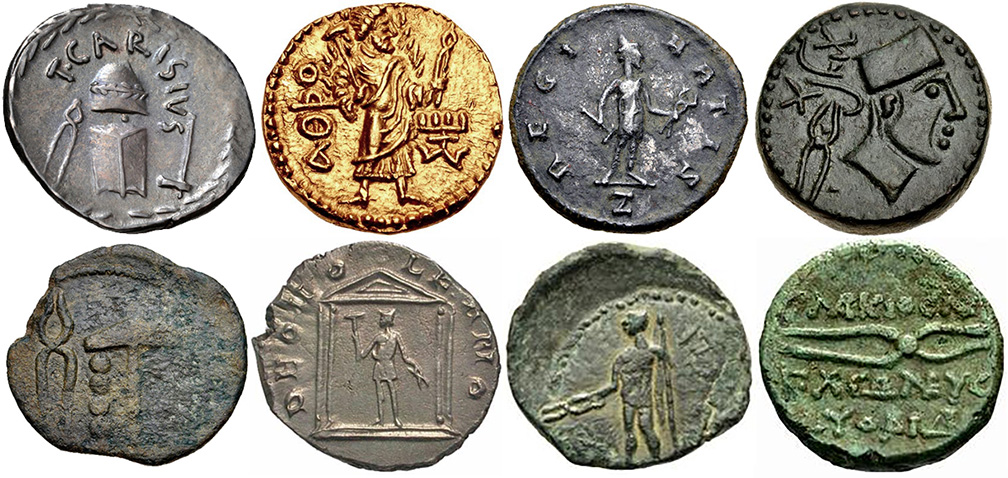 The figures depicted holding the hammers in the above examples are all holding them one-handed, though the long handle implies they were actually held two-handed during the striking. Don't say "infinitely" when you mean "very"; otherwise, you'll have no word left when you want to talk about something really infinite. - C. S. Lewis
|
|
Pillar of the Community
United States
8066 Posts |
Quote:
We don't think so. Silver is soft enough not to need it. I know we're talking about ancients, but I wonder if that changed with the introduction of large silver coins in the 15th century (since if diameter doubles you need to hit the coin four times as hard ... unless you soften it). |
|
Page 2 of 2
|
Replies: 19 / Views: 2,224 |
Page 2 of 2
|




 First Page

 Posted 02/11/2025 8:17 pm





