| Author |
 Replies: 35 / Views: 9,500 Replies: 35 / Views: 9,500 |
Page 3 of 3
|
|
|
|
Pillar of the Community
Thailand
1509 Posts |
Thanks swamperbob for the explanation and the illustrations. Your expertise never fails to amaze. Thanks Yober for that link. That's yet another weapon in the armoury (or should that be arsenal) for deciphering coins.
|
|
Pillar of the Community
United States
5362 Posts |
xshift The fact that the coin was made in Constantinople - fixes the country of location as Turkey - however at various times the size and shape of the Ottoman Empire varied. Places like Egypt were part of the Empire at times and issued coins (for example for Ali Bay in the same time period late 1700s) that used a Toughra design. The word Misr appears above the AH date in the place where the mint mark goes. Otherwise the coins of Turkey and Egypt at that time are rather similar. In the instance cited for Egypt Ali Bey used a Toughra actually belonging to Mustafa III. Ali Bey was a "pretender King" (I guess you would say). All this is really to say that at times knowing the mint location attributes the country of origin BELOW the level of Empire alone which is sometimes needed to locate the Krause entry. Yober Thanks for the link on the meaning of the Toughra - it is even more complex than I thought and I have bookmarked it. But the specifics resemble my earlier thoughts in general. Regarding the edition of Krause I am using - I have the First edition for the 1700's. I do not own the third but have seen the second which I didn't like. I know that some errors have crept into later Krause editions so in the later years I keep copies of several editions. In this case I am now sure the substitution of pictures is such an error. Unless there has been a discovery of an error like the 397 legend on a Year 2 coin - I stand by the comment that your coin can not be the 397. Regarding Regnal Year - Ottoman coins are dual dated. The first date usually expressed as 3 or 4 numbers is the Year that the ruler came into power. In this case that date is AH 1187. The date 1187 appears on all issues of the ruler and someplace else on the coin is a second number that gives the year of the reign. They year of the reign was often critical because the alloy changed over time and it could make a monetary difference. The dating system used here is similar to the way some older documents in England and other countries were dated in accordance with the year of the rule of a KING. So all you have to do is translate the AH date to a western date and add (in this case) 2. Of course AH (year of the Hejira) is not co-terminus with the western year - it floats a bit since they use a Lunar system not solar year. That is why you can only say the coin was made between about March 1775 and February 1776. It would be like calling January 20, 2009 the year of accession of Barack Obama and then numbering his years. January 3rd, 2010 would actually be numbered 2009//1 under such a system. They year would not become 2 until Jan 20th.  I do not have the complete interpretation of the readings on the reverse. But from the section on Egypt I do have a picture which shows where the Regnal year is found on Ottoman issues. This coincides with the earlier location of DCH and with my understanding of the location. Yober Does your comment mean that you are aware of a 4th variety - involving a Year Two Piastre that is a rarity not listed in Earlier editions of Krause?
|
|
New Member
 Canada
15 Posts |
swamperbob, the person who bought this coin for me as a Birthday present actually very seriously checked all the details on this particular coin (i.e. 2 specialists were involved prior to the purchase - an independent numismatic assessor and the assessor from the auction), based on their proffesional conclusion this AH 1187/2 Piastre(or Kurush) is a rarity. I don't have an explanation as to why so far this coin is not clearly listed in any of editions of Krause. May be I should contact Krause Publications and report this rarity? Here are the photos of my coin after 4 days of constant cleaning (lots of elbow grease  ) as per your instruction: 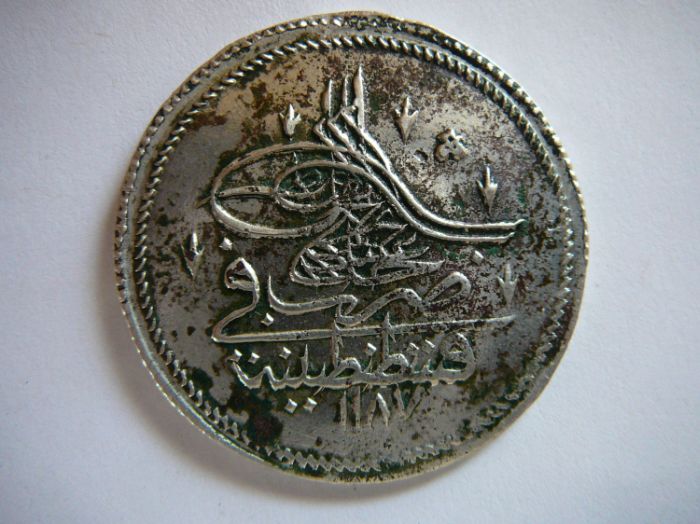 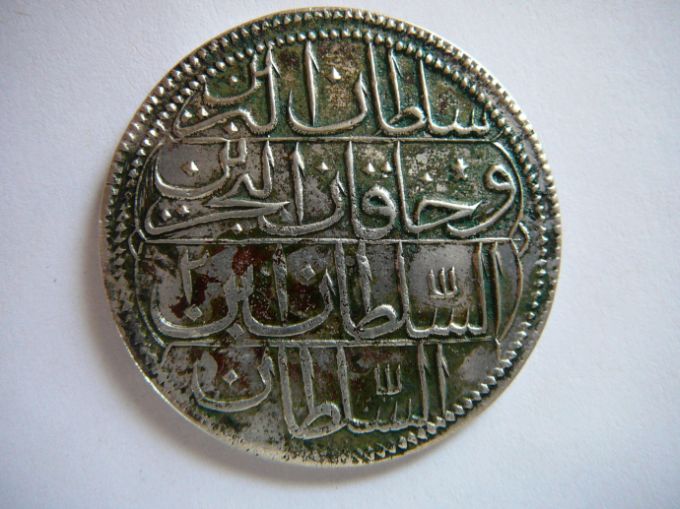 I wonder whether there are any other methods of cleaning the remaining layers of oxidation and etc. Just a wild thought - did anyone try to soak the coin in the fuel additives(something like STP which removes the deposits from the metal without corroding it)? |
|
Pillar of the Community
United States
645 Posts |
It would be like calling January 20, 2009 the year of accession of Barack Obama and then numbering his years. January 3rd, 2010 would actually be numbered 2009//1 under such a system. They year would not become 2 until Jan 20th
Year 1 is the inauguration year, 2009=2009/1, year 2 would begin the following year, 2010=2009/2, 2011=2009/3....
The conversion for this coin would be 1187+2-1=1188=March 14, 1774- March 3, 1775.
I have a 3rd(and 2nd) edition KM, the descriptions are below the pictures...this is definitely KM 396, not 397.
|
|
Rest in Peace
United States
1729 Posts |
This coin is similar to the one that got me started on this forum. The toughra (which is seen spelled in various ways) is the symbol which to me looks a little like a whale. It's the symbol of the emperor and was seen on coins from countries which were at one time part of the Ottoman Empire even after the collapse of the empire in the early part of the 20th century. The date on this coin is at the bottom of the obverse and resembles two slightly-curved vertical lines (1's), an inverted "V" (8), and a "V" (7). The other inscriptions are beyond me, but I love beautifully-designed coins like these with ornate Arabic inscriptions.
|
|
Pillar of the Community
United States
2669 Posts |
Yober - thank you for the link to the toughra information. I think that will take me a while to digest.. ..and I think you should stop conserving now. If this is a rare coin, you could send it to NCS (a division of NGC - they will get it to its absolute best state) and have them conserve and also slab the coin. Do NOT try the STP! Quote:
the person who bought this coin for me as a Birthday present actually very seriously checked all the details on this particular coin (i.e. 2 specialists were involved prior to the purchase - an independent numismatic assessor and the assessor from the auction), based on their professional conclusion this AH 1187/2 Piastre(or Kurush) is a rarity. Like I said earlier, if it's a rarity, then send it to NCS. They can conserve the coin the way it should be, without destroying value. They can also verify its rarity and if its the coin your birthday friends thought it was. swamperbob - thank you also for the information. |
|
New Member
Canada
15 Posts |
xshift, according to the experts my coin is rarity because it is not from the mass production, i.e. it was struck as a "mockup" or special order for the approval to proceed with the new year's production.
So the design of the dies for the mass production has been modified.
If you look closely and start comparing the locations of the symbols and letters on my coin compare to the one shown in the catalog or even the few ones 1187//2 which are for sale on the internet, you will eventually realize that the symbols (arrows, dots and flower) on my coin are not in the same locations. Plus the font is thinner and a bit different.
Edited by Yober
08/18/2009 03:09 am
|
|
Pillar of the Community
United States
5362 Posts |
Yober - I hear what you are saying HOWEVER - in the 1770s there was NO COUNTRY on earth (that I am aware of) that was using modern coining methods such as hubbed dies. Dies were crafted by hand one at a time and ALL dies were therefore UNIQUE. That is a very large part of studying early numismatics.
I do not doubt for a minute that you were told the coin was rare, but if the rarity is based on position of the elements and thickness of the design only - your experts need to provide a written source for this data. It sounds like a sales pitch unless there is documentation for the specific coin in some technical literature somewhere.
Without such information (not verbal) I would believe it is a typical year two issue.
|
|
Pillar of the Community
United States
2669 Posts |
Yober, I wasn't questioning whether or not it is a rarity, I was just pointing out that having a professional clean and conserve it might be the best way to go. I'd hate to see any value destroyed due to cleaning attempts at home. (I've done my share of damage  ) Thank you for the information, though, on what does make it a rarity - sometimes those types are called "patterns". Any and all information is welcome  , and I'll definitely be comparing as you said so I can see the difference. |
|
Pillar of the Community
United States
2669 Posts |
Yober, maybe the 2 specialists have access to documentation they would be willing to share with you?
|
|
Moderator
 Australia
16954 Posts |
I've been away for a week and missed this thread. Sorry about that.
Yober: as far as I can tell, swamperbob is correct: it looks exactly like the coin pictured in Krause as KM# 396. I'm pretty sure it isn't a trial strike, or pattern, or anything rare or unusual, except it does seem to be in better condition than the one illustrated in Krause.
Secondly, please stop cleaning it. It's fine the way it is. It was even finer the way it was. This coin is made of billon, a very low-grade silver that corrodes and tarnishes easily. It's not supposed to look nice and shiny. If it actually were a rare and valuable type, your treatment of it could have wiped out thousands of dollars worth of value. Fortunately, it's not a rare type, but that's no reason to degrade it any further.
Don't say "infinitely" when you mean "very"; otherwise, you'll have no word left when you want to talk about something really infinite. - C. S. Lewis
|
|
New Member
Canada
15 Posts |
swamperbob and xshift, did you noticed few differences on my coin verses all the rest of piastre 1187//2? For example: 1) on the reverse - the year 2 symbol of my coin has a dot right under it. The same symbol on all the other piastre 1187//2 which I've seen so far has that dot shifted to the right side. 2) on the obverse - in the name of the mint "Questentiniyah" the 3-rd dot on top of the word on my coin is touching the tip of a symbol and is more to the right (between the vertical bars from left and right). The same dot on all other piastre 1187//2 which I've seen so far is shifted to the left and is more to the middle between those vertical bars. 3) on the obverse - the upper left arrow on my coin doesn't touch the toughra's "outer egg" line. On all other coins I see that this arrow is touching the "outer egg" line. 4) on the obverse - below the toughra and above the name of the mint "Questentiniyah" there are words which meaning "made in". To the left of these words there is a dot and an arrow. So on my coin that dot is located above and to the left of the last letter(which looks like a cobra's head) and the arrow is completely to left. On all other coins the arrow is almost touching the head of the "cobra" and the dot is shifted to the left. There are more shifts of dots and symbols on the reverse - but I think that the list above should be enough highlights for the comparison. 
Edited by Yober
08/23/2009 8:46 pm
|
|
Pillar of the Community
United States
5362 Posts |
Yober I see what you mean by variations in the die used to make your coin. But the variations you list are all the type that I would EXPECT to find on hand made dies of this time period. Each die should be different. Every die used to make Piastres was different. They were hand engraved and they never get the details exactly the same.
To say that your particular die is RARE would require a published analysis in a numismatic journal or technical book that would PROVE it is indeed special.
|
|
New Member
Canada
15 Posts |
dear swamperbob my friend actually saw this document, hence the purchase was made. So now I'm working on getting a copy of that document from the library of the University of Istanbul.
I wonder how many dies were actually made for each year.
Do you know?
|
|
Pillar of the Community
United States
5362 Posts |
The numbers of coins that a die can produce will vary over a very wide range, based on the type of die and how the coins are struck. Luck is also involved. Modern dies used in the US mint have broken on the FIRST strike and in other cases have produced millions of coins. So it is impossible to know for sure but estimates can be made so that you can determine a rough average.
The first thing you need to determine is how a coin was made. Based on what I know about Ottoman issues of the late 1700s they were struck in an open sided screw press.
US Bust Half dollars were also made on an opensided screw press and Overton lists the number of dies used each year and the total production. A little math provides estimates of the number of coins made by a typical die. I did just one year 1830. There were 4.7 million coins made using 15 obverse and 20 reverse dies. (The hammer dies typically last a shorter period of time in practice.) So it works out to 250-300K per die.
I think that number is a conservative total.
Next you also need to know the total annual number of coins made. That is a lot more difficult for the coin in question. If you know the number of coins made divide that by about 250,000 and you will have a rough number of dies made.
Based on the size of the Ottoman Empire and the cost of Piastre today - I have to believe that there were far more than 2 dies. But how many more ??
|
|
Page 3 of 3
|
Replies: 35 / Views: 9,500 |
Page 3 of 3
|






 First Page
 Previous Page

 Posted 08/16/2009 1:14 pm


