| Author |
 Replies: 23 / Views: 4,328 Replies: 23 / Views: 4,328 |
Page 2 of 2
|
|
|
|
Pillar of the Community
Canada
1928 Posts |
I think that this might be the second coin that you mention in your post oklacda, what would the rarity of this coin be? It is the single footed N and the N in one id doubled at the bottom. 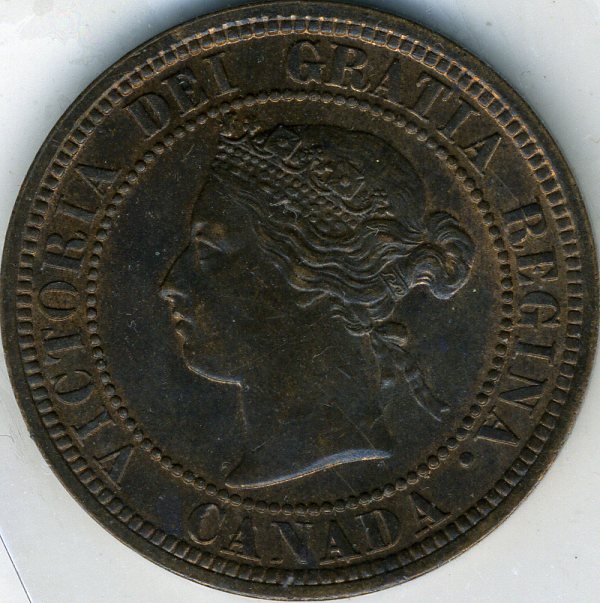 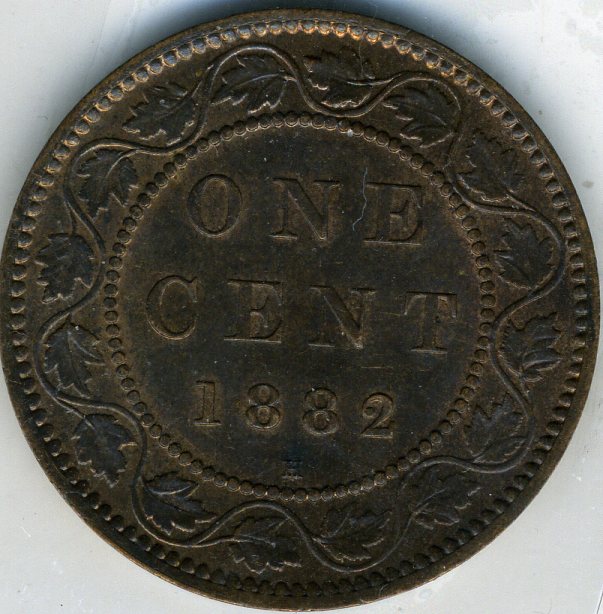 |
|
Valued Member
197 Posts |
GR-93a. Griffin writes. For bust type #1a. "This variety also has the N as in the 1876H Cents, but the left side of the leg in One has been slightly recut. R-6." I don't think that the foot being recut would count; it needs the leg. Although Griffin assigns an R-6 to both the single-footed Obv 1a's, which is his same R as a '59 DP#1, I find them relatively common and would give them a 4, with the one with the recut leg an R-5.
|
|
Valued Member
197 Posts |
BTW, papeldog, your post with the "2 pics of 1882 Obv 1's" where you thought one was a single-serif and one full, I just looked at them again. The first (top) one is not an Obv 1, but rather the Obv 2 that I spoke about with the rounded chin/throat, but the crown tip and neck truncation of an Obv 2. Sometime in the relatively near future, an explanation will be out that will explain how this Obv die anomaly came to be. For now, think of it as an Obv 2 with an asterisk and they will always have full-feet. They are not really scarce, but you have to look a little to find them. I would place the ratio at about 15-20:1 of the rounded chins that you find, based upon my long-time searches.
|
|
Pillar of the Community
Canada
1928 Posts |
oklacda, here's a better picture of the coin you mention that is of a type 1 ad 2 obverse combined 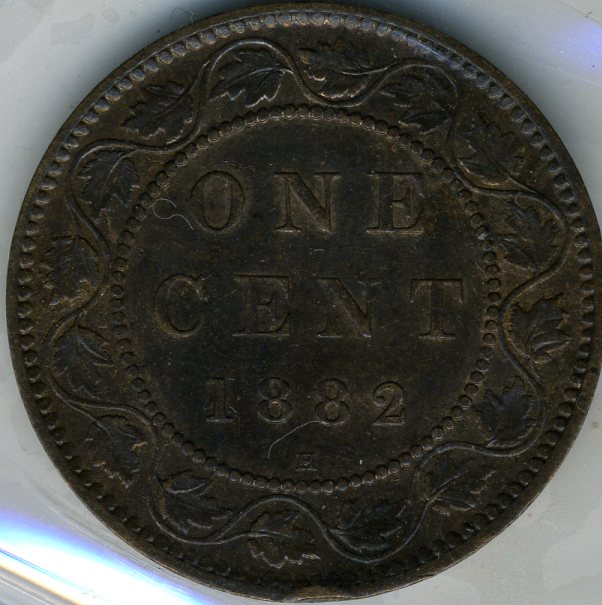 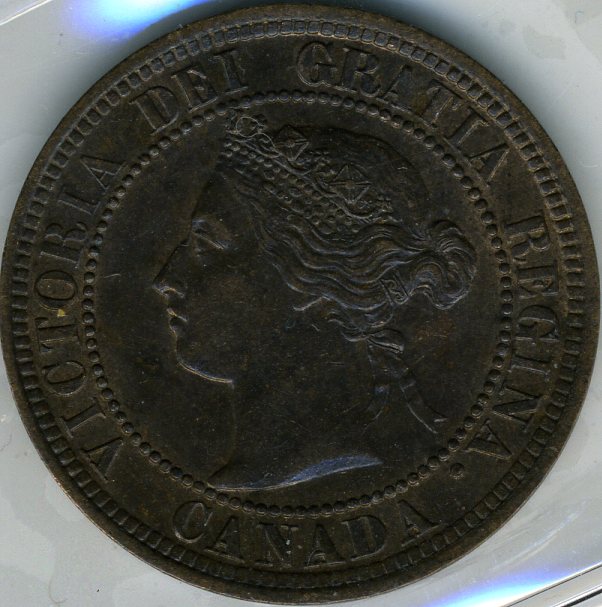 |
|
Valued Member
United States
324 Posts |
Yes, this is an obverse 2 resunk over an obverse 1a. The obverse 2 hub that was used to resink the obverse 1a has a dot in the E. There are a number of other characteristics from both dies that can be found. There are also obverse 2's with the dot in E and there is even 1884 obverse 2's with the same dot in the E of Regina. There are a number of versions of this 2/1a. Note that resinking dies to extend die life was a common practice in the late 1800's. Seems like your coin has doubling at the base of the portrait and the beads just below the portrait. If that's the case, this is the first I have seen of this particular version.
|
|
Pillar of the Community
Canada
1928 Posts |
mkb, The coin has traces of red on it and the doubling that you are revering to is just that traces of red, it would have been nice. The dot marker that you refer to is in the upper part of the E in Regina correct, if so thanks for the info I didn't know that marker.
|
|
Valued Member
197 Posts |
There was no "resinking" of dies for Canadian coinage by the Brit mint. They did do it for the regular British coinage to save money, since it was on their nickle and it is recorded as being so for their coinage. Since Canada was paying full-freight for their coins from the mint, there was NO resinking of dies on purpose during the 1880's, nor any other period. There wil be something formally published in the near future that will explain the smooth chin/throat 1882 Obv 2's, but it was not "resinking" in the accepted sense to prolong die life. The "dot" that is spoken of is very common on a great many dies, so it came from the master hub, not the working die.
|
|
Valued Member
United States
324 Posts |
Here's an excerpt from a CNA commentary: "2 - NUMBER OF DIES USED: These figures indicate the number of obverse and reverse dies used to strike a particular denomination during a given year. As mentioned above, instances occurred when some dies used in the course of a year may have been manufactured and dated the previous year. It was also common practice in some years (mostly in the 1800s) to reprocess selected worn dies which had lost their sharpness of detail but were still otherwise sound. Such dies were softened, resunk and again prepared for coining. They were counted along with the new dies and included among the "number of dies used" for the year. Therefore, it is easily possible for a die (more likely an obverse die) to have been used to strike coins during one year and after being refinished, used again the following year. However, it is unlikely that such dies were in service for more than two years, since the refinishing process greatly reduced the die's life, making it much more susceptible to developing cracks which would eventually render it unfit for further use (for a more detailed explanation, see my article The Quality and Efficiency of Royal Mint Dies A Century Ago in the September 1978 issue of The Canadian Numismatic Journal." he URL is: http://www.canadian-numismatic.org/review.php |
|
Pillar of the Community
Canada
1487 Posts |
Does't matter if the obverse was a obverse 2 over 1 when originally hubbed or if it was when the die was refurbished, we agree it seems to be a 2 over 1. If The Royal Mint sent dies to Heaton and Heaton had to pay for them? wouldn't heaton want to reverse produce their own punches so they could produce their own cheaper dies. Or were punches supplied to Heaton so they could produce dies? I don't know all the facts, but I am quite sure these are 2 over 1's. The Royal Mint would likely charge both Heaton and Canada for the dies, if they could get away with it. Perhaps the obverse 1 dies with the weak letters were the result of Heatons production of their own dies or using a die to produce a punch? |
|
Pillar of the Community
Canada
1487 Posts |
If the last bead in the crown on you coin is stronger than the one in the third photo perhaps you have a obv 1 over two. first photo is obv 1, second is obv 2 and finally a blend of 2 over 1. 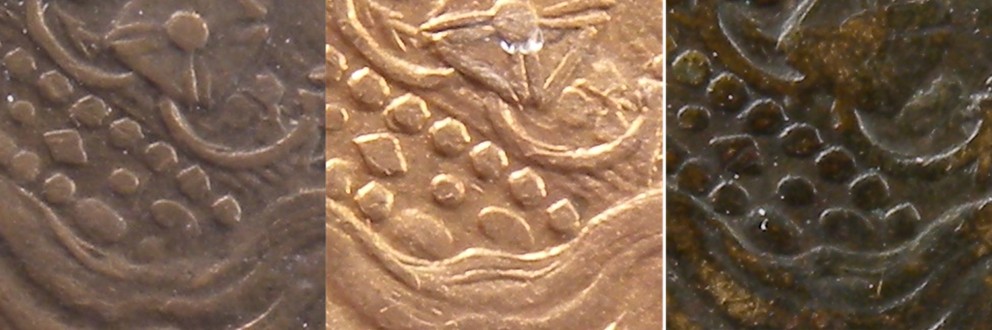 |
|
Pillar of the Community
Canada
1928 Posts |
Zonad, The crown on my coin is like your first picture
|
|
Pillar of the Community
Canada
1487 Posts |
That's what I thought. Definitely a 1 over 2 possibility given the last bottom bead which is replaced by a new strand of hair in an obv.2.
|
|
Pillar of the Community
Canada
1928 Posts |
Sorry Zonad, I must have grabbed the wrong 1882 coin I should have said that the third picture is my coin
|
|
Valued Member
Canada
207 Posts |
|
|
Valued Member
197 Posts |
Without seeing the crown tip/bead junction and a rightside-up scan of the truncation/bead relationship with the C in Canada, I would say it's a well-worn Obv 1a. Sometimes it's possible on less-worn coins to get a Griffin number as well, but you have to see the whole Obv legend, especially the N's in Canada and Regina. Coins less than VF make it too difficult to see recuts or repunches for identification.
|
|
Page 2 of 2
|
Replies: 23 / Views: 4,328 |
Page 2 of 2
|








 First Page

 Posted 09/22/2009 3:27 pm


