| Author |
 Replies: 23 / Views: 4,329 Replies: 23 / Views: 4,329 |
|
Valued Member
United States
147 Posts |
I have received a variety of these cents, and wonder if there different mint marks. Might try to put together a set, looks like it can be done fairly inexpensively.
What are the keys, semi if any ?
Thanks in advance
|
|
|
|
Pillar of the Community
Canada
1931 Posts |
Here is a list of large cents from Charlton.
PROVINCE OF CANADA
1858 2 types both types are key
1859 6 listed types, many known varieties 4 types are key
CANADA
1876 specimen
1876H 2 types
1881H 2 types
1882H 3 types
1884 2 types one type is key
1886 2 types one type is key
1887
1888
1890H
1891 6 types 4 types are key
1892 3 types
1893
1894
1895
1896
1897
1898H
1899
1900
1900H
1901
1902
1903
1904
1905
1906
1907
1907H one type is key
1908
1909
1910
1911
1912
1913
1914
1915
1916
1917
1918
1919
1920
this is just the basics and there are more known varieties. Sorry if I missed anything but I'm sure someone will fill in the gaps if I did
|
|
Valued Member
 United States
147 Posts |
Malissadawn, Thanks for your help with the information. Following one of your links at the end of your post I see you recently lost your mother in law. Sorry for your loss, it is interesting though, I inherited these coins from my mother in law also. She also lost a battle with cancer. |
|
Pillar of the Community
Canada
1931 Posts |
I'm very sorry for your loss adco. Cancer is a monster. It takes not only the victim but also a part of everyone around it. I hope you and your family are doing well.
|
|
Bedrock of the Community
United States
10045 Posts |
You might also find a few photos in the forums. I have pictured a few of the varieties, such as this 1882 H/H:  |
|
Valued Member
197 Posts |
All 1882H's have a large H over a small H, but some of the underlying small H's are pretty faint and any well worn coin will probably obliterate it, but all have R/P'd mintmarks. 1882 is a wonderful variety year. You have Obv 1's, 1a's, 1/1a's, Obv 2's and Obv 2's with the smooth round chin/throat of a #1, but Obv 2 where the crown tip meets the bead and at the neck truncation. Look closely at the N's in Canada and Regina and although not as much variation as in the 1881's, you will see lots of repunching.
|
|
Bedrock of the Community
United States
10045 Posts |
oklacda, that's good info to know--thanks!  That important detail was not covered in my Charest or Charlton books. |
|
Pillar of the Community
Canada
1928 Posts |
Here's a picture of two different obverse 1's one with full serif N's and one with single serif N's both coins are 1882 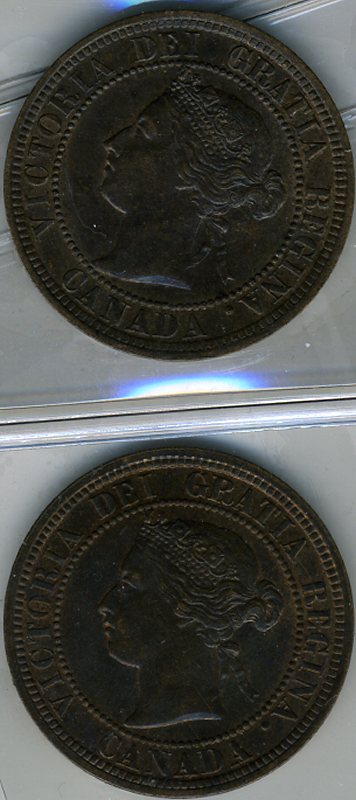 |
|
Valued Member
197 Posts |
Both single and full-footed N's are relatively common for the 1882's and all Obv 2's have full-feet, although some harshly R/P'd like the 81's. For the Obv 1's, the less common is the full-serif with a D/B in Regina. For the Obv 1a, the less common is the single-serif and some with single serif and left leg of the N in One recut. For those of you who visit another coin site, this is B I B.
|
|
Pillar of the Community
Canada
1928 Posts |
I think that this might be the second coin that you mention in your post oklacda, what would the rarity of this coin be? It is the single footed N and the N in one id doubled at the bottom. 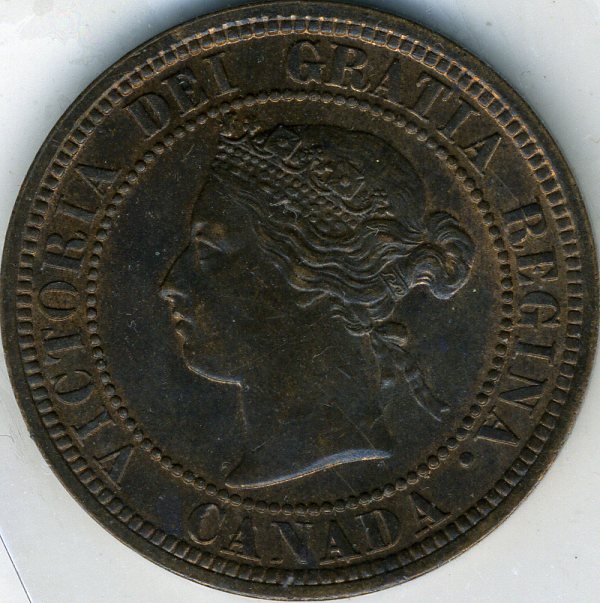 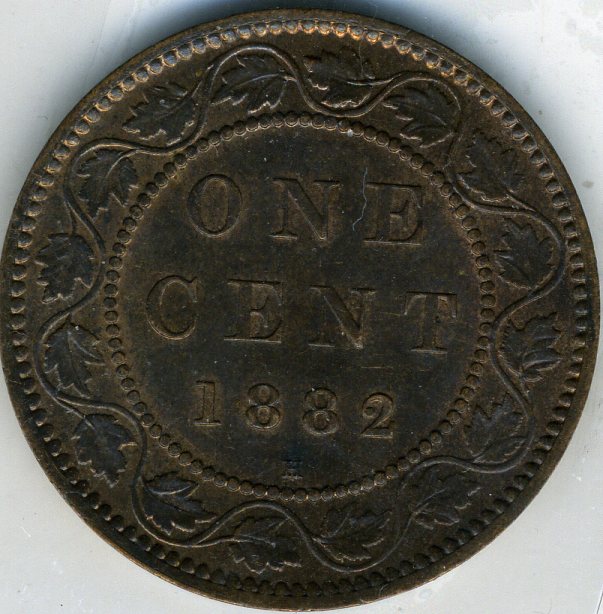 |
|
Valued Member
197 Posts |
GR-93a. Griffin writes. For bust type #1a. "This variety also has the N as in the 1876H Cents, but the left side of the leg in One has been slightly recut. R-6." I don't think that the foot being recut would count; it needs the leg. Although Griffin assigns an R-6 to both the single-footed Obv 1a's, which is his same R as a '59 DP#1, I find them relatively common and would give them a 4, with the one with the recut leg an R-5.
|
|
Valued Member
197 Posts |
BTW, papeldog, your post with the "2 pics of 1882 Obv 1's" where you thought one was a single-serif and one full, I just looked at them again. The first (top) one is not an Obv 1, but rather the Obv 2 that I spoke about with the rounded chin/throat, but the crown tip and neck truncation of an Obv 2. Sometime in the relatively near future, an explanation will be out that will explain how this Obv die anomaly came to be. For now, think of it as an Obv 2 with an asterisk and they will always have full-feet. They are not really scarce, but you have to look a little to find them. I would place the ratio at about 15-20:1 of the rounded chins that you find, based upon my long-time searches.
|
|
Pillar of the Community
Canada
1928 Posts |
oklacda, here's a better picture of the coin you mention that is of a type 1 ad 2 obverse combined 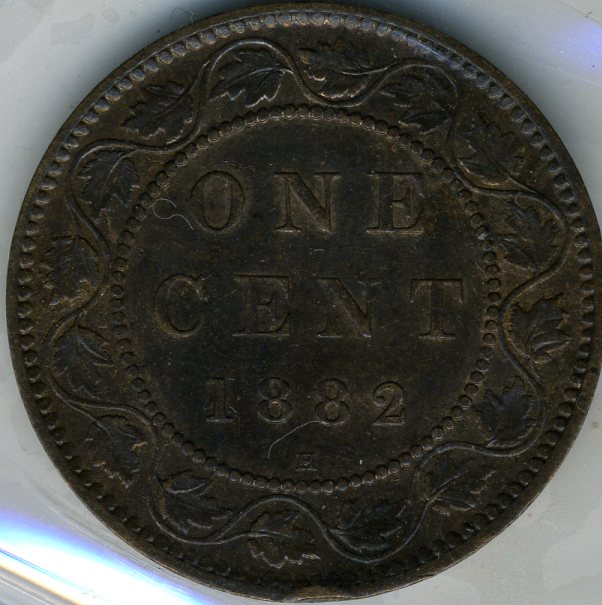 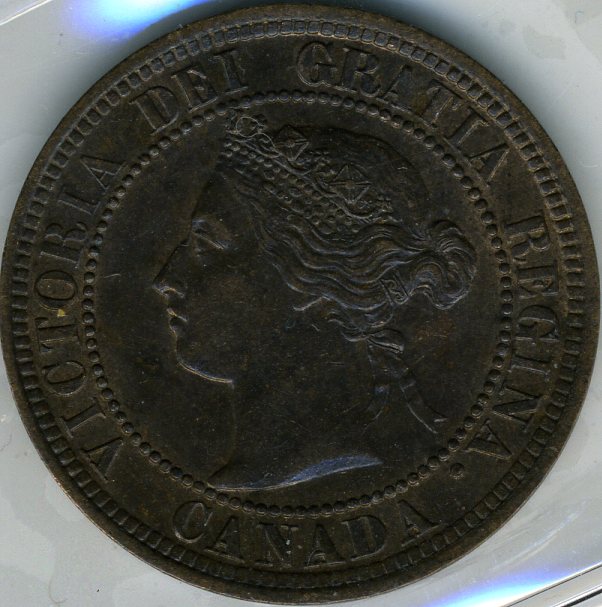 |
|
Valued Member
United States
324 Posts |
Yes, this is an obverse 2 resunk over an obverse 1a. The obverse 2 hub that was used to resink the obverse 1a has a dot in the E. There are a number of other characteristics from both dies that can be found. There are also obverse 2's with the dot in E and there is even 1884 obverse 2's with the same dot in the E of Regina. There are a number of versions of this 2/1a. Note that resinking dies to extend die life was a common practice in the late 1800's. Seems like your coin has doubling at the base of the portrait and the beads just below the portrait. If that's the case, this is the first I have seen of this particular version.
|
|
Pillar of the Community
Canada
1928 Posts |
mkb, The coin has traces of red on it and the doubling that you are revering to is just that traces of red, it would have been nice. The dot marker that you refer to is in the upper part of the E in Regina correct, if so thanks for the info I didn't know that marker.
|
|
Valued Member
197 Posts |
There was no "resinking" of dies for Canadian coinage by the Brit mint. They did do it for the regular British coinage to save money, since it was on their nickle and it is recorded as being so for their coinage. Since Canada was paying full-freight for their coins from the mint, there was NO resinking of dies on purpose during the 1880's, nor any other period. There wil be something formally published in the near future that will explain the smooth chin/throat 1882 Obv 2's, but it was not "resinking" in the accepted sense to prolong die life. The "dot" that is spoken of is very common on a great many dies, so it came from the master hub, not the working die.
|
| |
Replies: 23 / Views: 4,329 |










 Posted 09/20/2009 11:28 pm


