



Coin Community Family of Web Sites Join Thousands of Coin, Bullion, & Money Collectors
Royal Estate Auctions - $1 Coin AuctionsSpecializing in Modern Numismatics Royal Canadian Mint products, Canadian, Polish, American, and world coins and banknotes. Join Thousands of Coin, Bullion, & Money Collectors Coin, Banknote and Medal Collectors's Online Mall Vancouvers #1 Coin and Paper Money Dealer 300,000 items to help build your collection!


Username:
Password:
Save Password
Forgot your Password?


This page may contain links that result in small commissions to keep this free site up and running.

Welcome Guest! Registering and/or logging in will remove the anchor (bottom) ads. It's Free!

Large Canadian Cent "Question"

To participate in the forum you must log in or register.
Author Previous TopicReplies: 23 / Views: 4,192Next Topic
Page: of 2
Valued Member
United States
324 Posts
 Posted 09/23/2009  8:31 pm  Show Profile   Bookmark this reply Add mkb to your friends list Get a Link to this Reply
Here's an excerpt from a CNA commentary:

"2 - NUMBER OF DIES USED: These figures indicate the number of obverse and reverse dies used to strike a particular denomination during a given year. As mentioned above, instances occurred when some dies used in the course of a year may have been manufactured and dated the previous year. It was also common practice in some years (mostly in the 1800s) to reprocess selected worn dies which had lost their sharpness of detail but were still otherwise sound. Such dies were softened, resunk and again prepared for coining. They were counted along with the new dies and included among the "number of dies used" for the year. Therefore, it is easily possible for a die (more likely an obverse die) to have been used to strike coins during one year and after being refinished, used again the following year. However, it is unlikely that such dies were in service for more than two years, since the refinishing process greatly reduced the die's life, making it much more susceptible to developing cracks which would eventually render it unfit for further use (for a more detailed explanation, see my article The Quality and Efficiency of Royal Mint Dies A Century Ago in the September 1978 issue of The Canadian Numismatic Journal."

he URL is: http://www.canadian-numismatic.org/review.php
Pillar of the Community
Zonad's Avatar
Canada
1472 Posts
 Posted 09/23/2009  9:07 pm  Show Profile   Bookmark this reply Add Zonad to your friends list Get a Link to this Reply
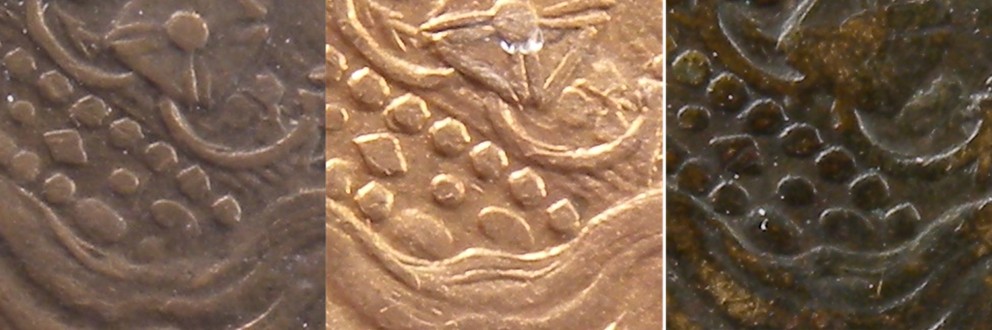
Does't matter if the obverse was a obverse 2 over 1 when originally hubbed or if it was when the die was refurbished, we agree it seems to be a 2 over 1. If The Royal Mint sent dies to Heaton and Heaton had to pay for them? wouldn't heaton want to reverse produce their own punches so they could produce their own cheaper dies. Or were punches supplied to Heaton so they could produce dies? I don't know all the facts, but I am quite sure these are 2 over 1's. The Royal Mint would likely charge both Heaton and Canada for the dies, if they could get away with it. Perhaps the obverse 1 dies with the weak letters were the result of Heatons production of their own dies or using a die to produce a punch?
Pillar of the Community
Zonad's Avatar
Canada
1472 Posts
 Posted 09/23/2009  9:43 pm  Show Profile   Bookmark this reply Add Zonad to your friends list Get a Link to this Reply
If the last bead in the crown on you coin is stronger than the one in the third photo perhaps you have a obv 1 over two. first photo is obv 1, second is obv 2 and finally a blend of 2 over 1.


Large-Canadian-Cent-
Pillar of the Community
papeldog's Avatar
Canada
1923 Posts
 Posted 09/23/2009  10:18 pm  Show Profile   Bookmark this reply Add papeldog to your friends list Get a Link to this Reply
Zonad, The crown on my coin is like your first picture
Pillar of the Community
Zonad's Avatar
Canada
1472 Posts
 Posted 09/23/2009  10:34 pm  Show Profile   Bookmark this reply Add Zonad to your friends list Get a Link to this Reply
That's what I thought. Definitely a 1 over 2 possibility given the last bottom bead which is replaced by a new strand of hair in an obv.2.
Pillar of the Community
papeldog's Avatar
Canada
1923 Posts
 Posted 09/24/2009  11:32 am  Show Profile   Bookmark this reply Add papeldog to your friends list Get a Link to this Reply
Sorry Zonad, I must have grabbed the wrong 1882 coin I should have said that the third picture is my coin
Valued Member
adanak44's Avatar
Canada
207 Posts
 Posted 09/24/2009  11:40 pm  Show Profile   Bookmark this reply Add adanak44 to your friends list Get a Link to this Reply
Opinion on this 1882H please.Large-Canadian-Cent- Large-Canadian-Cent- Large-Canadian-Cent- Large-Canadian-Cent- Large-Canadian-Cent- Large-Canadian-Cent- Large-Canadian-Cent-
Thanks.
Valued Member
197 Posts
 Posted 09/25/2009  06:32 am  Show Profile   Bookmark this reply Add Bill in Burl to your friends list Get a Link to this Reply
Without seeing the crown tip/bead junction and a rightside-up scan of the truncation/bead relationship with the C in Canada, I would say it's a well-worn Obv 1a. Sometimes it's possible on less-worn coins to get a Griffin number as well, but you have to see the whole Obv legend, especially the N's in Canada and Regina. Coins less than VF make it too difficult to see recuts or repunches for identification.
  Previous TopicReplies: 23 / Views: 4,192Next Topic
Page: of 2

To participate in the forum you must log in or register.


Disclaimer: While a tremendous amount of effort goes into ensuring the accuracy of the information contained in this site, Coin Community assumes no liability for errors. Copyright 2005 - 2026 Coin Community Family- all rights reserved worldwide. Use of any images or content on this website without prior written permission of Coin Community or the original lender is strictly prohibited.
Contact Us  |  Advertise Here  |  Privacy Policy / Terms of Use

Coin Community Forum © 2005 - 2026 Coin Community Forums
It took 0.28 seconds to rattle this change. Forums