| Author |
 Replies: 16 / Views: 12,450 Replies: 16 / Views: 12,450 |
Page 2 of 2
|
|
|
|
Valued Member
 United States
106 Posts |
Hi 'Zaggy', thanks for your interest. To be completely honest, German coins, in general, are not really my area of expertise. I have a few other coins from the Third Reich, with various mint marks, but these are my rarest. I have a 1 Reichsmark with Martin Luther's profile and a few 2 and 5 Reichsmark coins with Paul Von Hindenburg.
My main area of interest is Russia and Eastern Europe.
~Daniel
|
|
Pillar of the Community
United States
1418 Posts |
What mint has what mint mark?
|
|
Valued Member
United States
106 Posts |
Hi 'tumbleweedtrumpet'. Here is the list of the mints that I know of.
German Mint Marks 1933-1945
A- BERLIN
B- VIENNA (1938-1944)
D- MUNICH
E- MULDENHUTTEN
F- STUTTGART
G- KARLSRUHE
J- HAMBURG
~Daniel
|
|
Valued Member
Australia
432 Posts |
Different era's have seen different mint marks used. The list above is obviously for 33-45 (although Vienna was known as Wien, Munich was known as München and Muldenhutten is Muldenhütten)... since 1871, the list looks like:
A - Berlin
B - Hannover (-1878)
B - Wien (1938-1945)
C - Frankfurt Am Main (-1879)
D - München
E - Dresden (-1887)
E - Muldenhütten (1887-1953)
F - Stuttgart
G - Karlsruhe
H - Darmstadt (-1882)
J - Hamburg
and if you want to include the entire Reich
T - Tabora (1916 only - Deutsche Ost Afrika)
Of course the years mentioned are only a guide as to when the mints opened and definitively closed (in the period 1871 - current), numerous mints spent some time in a variety of states where there was no production of a specific years denominations; Upgrades and Refurbishments, Repairs, Awaiting new Facilities, Moving to new facilities, and etc...
If you start to dig further back in time that 1871 (back into the German States and HRE), you'll find many other Mintmarks too...
See why German coinage is interesting? :)
|
|
Valued Member
United States
106 Posts |
Thanks for the list 'Zaggy'. That's an interesting list you provided. I know there were other previous mints, but I just listed the mints that were operational during the Third Reich. I appreciate your input.
~Daniel
|
|
Pillar of the Community
United States
1418 Posts |
|
|
Valued Member
Australia
432 Posts |
Some ppl I know (who are researching mint histories right back to their inceptions pre-Kaiserreich), even like to break those Mintmarks up even further, based upon the Name/Operator of the Mints - personally, I don't NEED to go that far. However to illustrate the point:
A - Berlin - Preußische Staatsmünze (1871-1947)
A - Berlin - VEB Berlin Münze (1947-1990)
A - Berlin - Staatlichen Münze Berlin (1990-)
Same with Muldenhütten:
E - Muldenhütten - Sächsische Staatsmünze (1887-1947)
E - Muldenhütten - VEB Münze Muldenhütten (1947-1953)
Those are the two examples I can explicitly remember, but there are others - Karlsruhe and Stuttgart's names changed when they were united under the 'Staatliche Münze Baden-Württemberg' umbrella, I can't remember when off hand!
Don't get me wrong, I like detail oriented; but splitting the Münzzeichen up to that degree is missing the point a little - I guess its more important when you're looking at the history and evolution of the Mint Business! ;)
|
|
Pillar of the Community
Poland
3201 Posts |
Here's a coin that I think is relevant to this thread. Can anyone tell me anything about it? For example where and how long did it circulate? 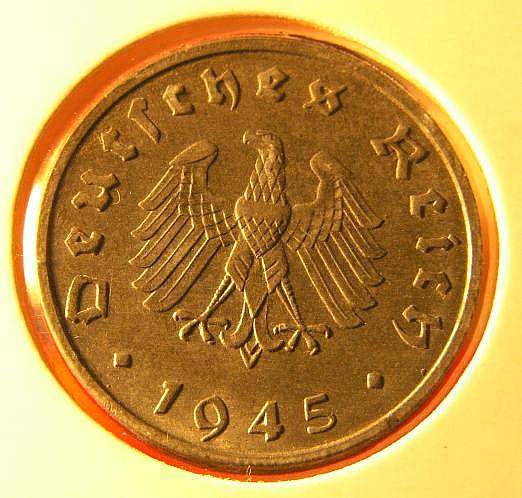 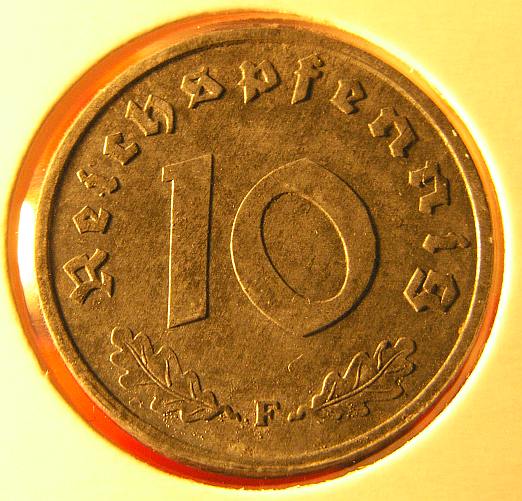 |
|
Valued Member
Australia
432 Posts |
German Occupation 1945-1948; Minted at Stuttgart (F) - 5.942 Million Minted - Zinc
Circulated in Post 1945 Germany (including the Saar) and Austria until the Deutsches Währungsreform in June 1948, after which it was revalued at 1Pfg (DM) in the west and withdrawn in 1949; same in Austria, was withdrawn in 1949. In the Saar (under French Occupation at the time), the coin remained in circulation until 1947.
Anything else you'd like to know about it?
Edited by Zaggy
12/27/2009 11:54 am
|
|
Valued Member
United States
106 Posts |
Thanks for sharing 'DL20K'. That's actually a Allied Issue of the 10 Reichspfennig. The pattern is almost identical to the Third Reich issue, except the swastika and wreath have been dropped. That's a beautiful specimen with a sharp image and a clean looking planchet. As 'zaggy' said, Allied Issues were minted between 1945-1948.
~Daniel
|
|
Pillar of the Community
Germany
1238 Posts |
People interested in nazi coinage can skip this post.  Let me just nitpick a little ... Quote:
A - Berlin - VEB Berlin Münze (1947-1990) The mint in Berlin was actually called "Münze der DDR" (with the addition "Berlin" as long as there were two mintmarks), and "VEB Münze der DDR" between 1974 and 1990. Quite a few GDR commems, by the way, do not have a mintmark at all. Well, as there was only one mint in the country then ... Oh, and the Baden-Württemberg "umbrella" (like that term) opened in 1998. Officially the result of the merger is called "Staatliche Münzen Baden-Württemberg", with the -n indicating a plural. So one may say it's two mints, or one mint but two production facilities. But as you wrote, Zaggy, what counts for those who are into mintmarks is that the F and G are still there. Christian |
|
Pillar of the Community
Poland
3201 Posts |
Thank you, Zaggy and DJB1968. By the way, what was a 10 reichspfennig exchanged to in Austria (did it equal 10 groschen)?
|
|
Pillar of the Community
Germany
1238 Posts |
When Austria re-introduced the Schilling in late 1945, it was 1 Reichsmark = 1 Schilling first. Then, in the November 1947 currency reform, 3 old schillings became 1 new schilling. (With special regulations regarding how much could be exchanged etc.) However, the low denomination coins (1, 5 and 10 Rpf) were not affected and kept their old value. In fact, the 1 Reichspfennig coin continued to be legal tender (though practically worthless) in Austria until the end of February 2002 ...
Christian
Edited by chrisild
12/28/2009 06:14 am
|
|
Valued Member
United States
106 Posts |
Quote:
When Austria re-introduced the Schilling in late 1945, it was 1 Reichsmark = 1 Schilling first. Then, in the November 1947 currency reform, 3 old schillings became 1 new schilling. (With special regulations regarding how much could be exchanged etc.) However, the low denomination coins (1, 5 and 10 Rpf) were not affected and kept their old value. In fact, the 1 Reichspfennig coin continued to be legal tender (though practically worthless) in Austria until the end of February 2002 ...
Christian Wow! The Reichspfennig circulated in Austria until 2002? I wonder why they continued to use it, especially considering that it was practically worthless? That was very interesting information. Thanks Christian. ~Daniel |
|
Valued Member
Australia
432 Posts |
Well, I'm not sure if it actually 'circulated', but it was legal tender; if memory serves, was valued at 1/7th Groschen at that point? So yeah, you need 7 of them to even begin to do anything useful with - and it could ONLY be 1Rpf coins; the 5 and 10Rpf were demonetised and withdrawn in the late 1940's.
So I guess if you happened upon a mint-bag of 1Rpf coins before Feb 2002, you could have wandered down to your local branch and exchanged them for Euro's! However, you'd be mad, as the collector value even then was superior for the monetary value!
And DJB is correct in that the coin posted is a really nice, clear 45F; I'd happily have one that looks that nice!
Chris: There are more 'sub-variations' of the Münzzeichen/Business Name thing than I knew! Hahahaha
|
|
Page 2 of 2
|
Replies: 16 / Views: 12,450 |
Page 2 of 2
|





 First Page

 Posted 12/26/2009 10:27 am





