| Author |
 Replies: 19 / Views: 11,390 Replies: 19 / Views: 11,390 |
Page 2 of 2
|
|
|
|
New Member
 Canada
44 Posts |
in response to Archraz the silver coins 1 weighs 10.4 grams - 2 coins weigh 10.2 - and the last 11.3 - that seems strange to me all 4 of these chinese coins look identical - the copper coin weighs 8.1 grams - and the twenty cash weighs 10.7 grams - any thoughts on the weights
|
|
New Member
Canada
44 Posts |
I FIGURED OUT PHOTOS LOLOL 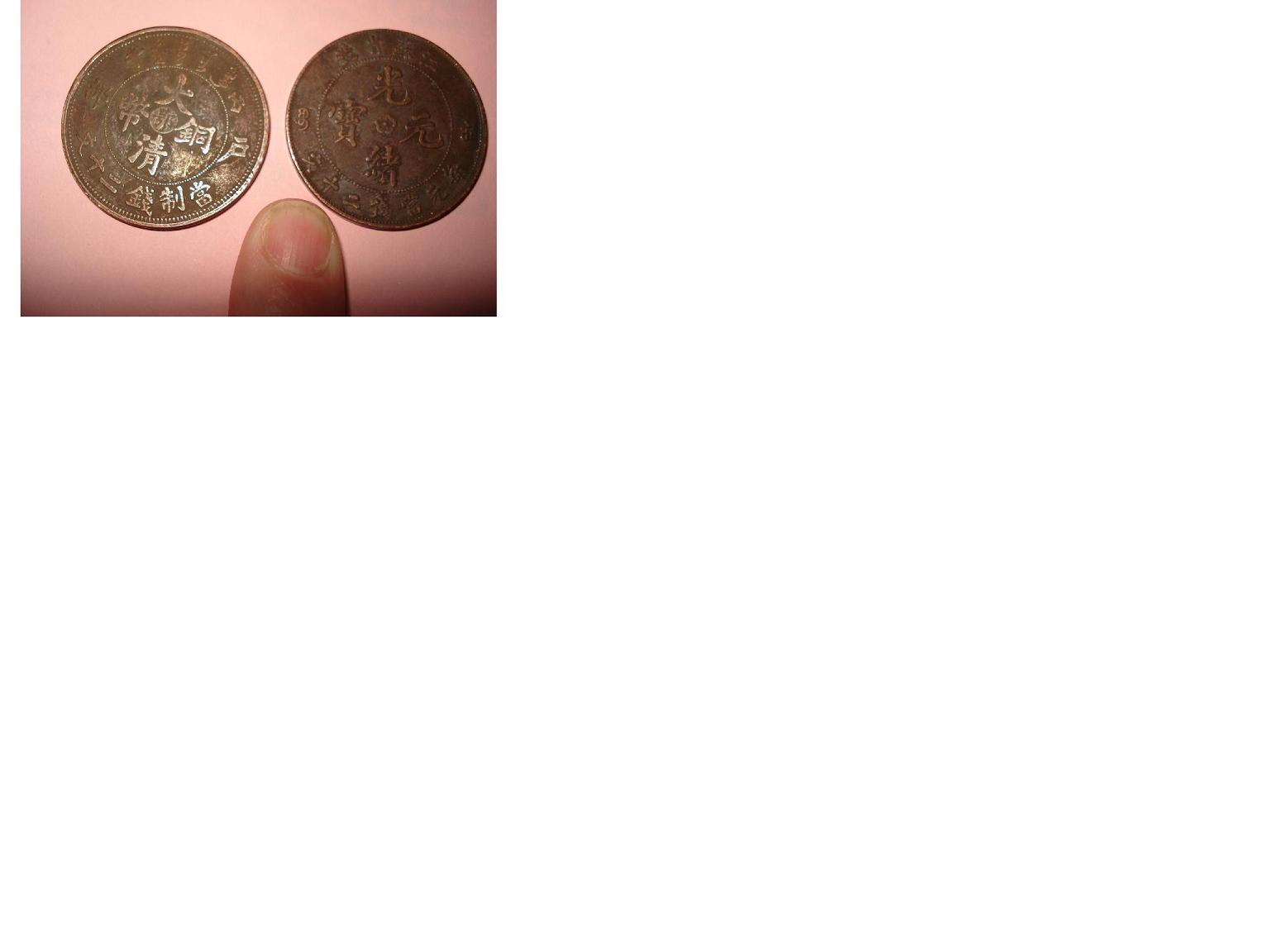 |
|
Moderator
 Australia
17002 Posts |
Quote:
...the silver coins 1 weighs 10.4 grams - 2 coins weigh 10.2 - and the last 11.3 - that seems strange to me all 4 of these chinese coins look identical... Sorry to be the bearer of bad news, but that's a bit too strange, I'm afraid - there's no genuine silver coin with those weights; a 50c should be about 13.6 grams, a 20 cent should be 5.3 grams. Whatever denomination the "silver" coins are claiming to be, they're not silver, and not genuine. The copper coins say (in Chinese) that they are 20 cash pieces. Unfortunately, the one on the left is a scarce coin from Hupeh Province (KM/Y# 11j), worth over $100. I say "unfortunately" because this means that this coin too is almost certainly fake (the weight doesn't help much in this case, since Krause doesn't give the weights of copper coins). The one on the right is a slightly scarce coin from Kiangsu Province; the side shown is KM/Y# 163, though the reverse text in English should be "KIANG-SOO TWENTY CASH", not the "Tai Ching Ti Kuo" legend that all the other coins have; if it is actually the Tai Ching Ti Kuo reverse, then it's a "mule", and a sure sign of being fake also - especially if it came with all the others. Don't say "infinitely" when you mean "very"; otherwise, you'll have no word left when you want to talk about something really infinite. - C. S. Lewis
|
|
New Member
Canada
44 Posts |
SAP WROTE: The one on the right is a slightly scarce coin from Kiangsu Province; the side shown is KM/Y# 163, though the reverse text in English should be "KIANG-SOO TWENTY CASH", not the "Tai Ching Ti Kuo"
Thanks for the info - my mistake on my twenty cash coin - it reads on the front in block letters KIANG-SOO TWENTY CASH with a dragon figure in the centre
As for the 4 SILVER COINS (thats what the coins read) I have looked closer and noticed slightly different chinese lettering I will get a photo posted and if you could look for me and give me your comments I would really appreciate it thanks Jennifer
|
|
New Member
Canada
44 Posts |
Hi - here are photos of the front and back of the chinese copper coin and the twenty cash coin - thanks for any comments or information 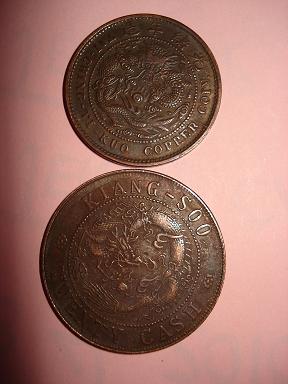 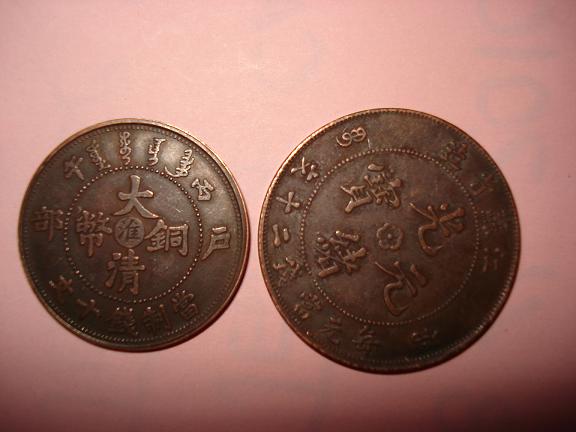 |
|
New Member
Canada
44 Posts |
and here are the front and back of the 4 chinese silver coins - thanks 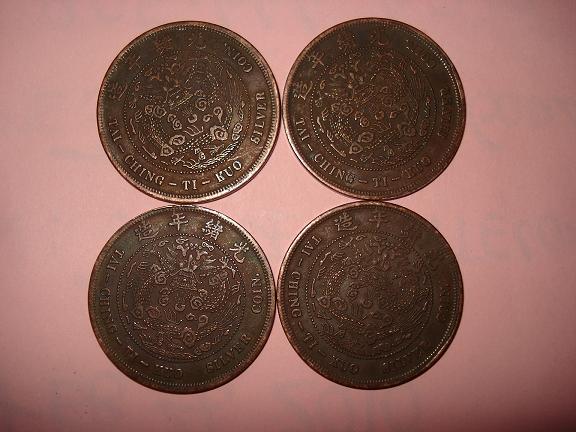 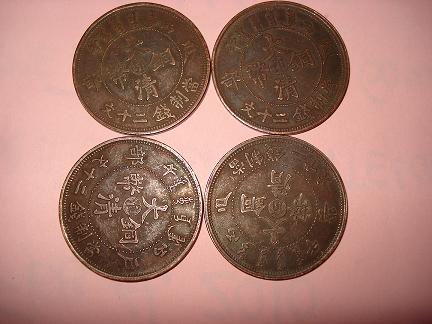 |
|
Pillar of the Community
United States
3499 Posts |
jmcgowan- well, those silver coins certainly do look to be copper. So based upon what I can see I declare those fakes.
|
|
Moderator
Australia
17002 Posts |
And unfortunately, those "silver" coins all say "20 cash" in Chinese on the other side; 20 cash (or 2 cents) is a copper denomination. So, those are definitely fakes.
And I see what's happened, here - I thought the two pics in post #7 were of the two "copper" coins, not of some of the "silver" ones. My conclusion about one of them is wrong.
The slightly smaller coin claims to be a 10 cash, or 1 cent. The mintmark in the centre is that of the Zhenjiang (Chinkiang) mint, in Kiangsu province - but unfortunately, this particular mint never issued "incused mintmark" coins for general circulation. It was struck as an extremely rare pattern coin (listed with the regular coins as KM/Y# 10d.6); there are no more than a handful of genuine specimen known. It is therefore excessively improbable that this coin is genuine.
The larger one is a Kiangsu mint 20 cash, as I stated above (KM/Y# 163). This is the only coin that isn't "impossible" like the other five are; a genuine example in this condition would probably cost $50 or so. Unfortunately, if it came from the same place as the other five, then it suffers from guilt by association.
Don't say "infinitely" when you mean "very"; otherwise, you'll have no word left when you want to talk about something really infinite. - C. S. Lewis
|
|
New Member
Canada
44 Posts |
thanks for all the info - these coins along with some chinese war medals and a collection badges were in my grandfathers collection - he had a variety of coins - such as 5 indian head pennies - ranging in dates - canadian 50 cent pieces - lira - etc - and now I have this coin collection - and some other odd things LOLO - thanks again
|
|
Valued Member
United States
303 Posts |
If you want to post the medals I can help some...
|
|
New Member
Canada
44 Posts |
Hi here are some photos of the medals - thanks for your help The oval shaped medal has 1938 stamped on the backside and the round one is dated 1950 on the front - thanks again 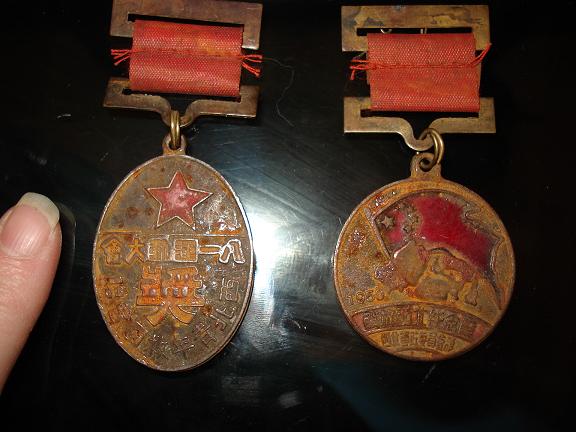 |
|
Valued Member
United States
303 Posts |
Well, I was thinking if the coins were not real, I was suspecting you may have the medals with this type of ribbon. Although I beleive I have seen the oval one a few times on ebay (with the big "jiang" character in the middle, which translates to "medal"), but these two were probably made for the tourists in China as souvenirs. There are many people who believe these date from that period, but there are many details that the fakers leave off. Would you know how your grandfather came to obtain these items? Did he visit China or bought it from a dealer or another person? I don't think I have seen fake 10 and 20 copper/cash coins... but it seems anything is possible to fake. |
|
New Member
Canada
44 Posts |
HI my grandfather travelled a great deal - in his youth he traveled during the war and later in his years for enjoyment - he never spoke of his time during the war - and it was known in my family to NEVER ask him about that subject - thanks for your info
|
|
New Member
Canada
44 Posts |
SAP WROTE It was struck as an extremely rare pattern coin (listed with the regular coins as KM/Y# 10d.6);
KM/Y# 10d.6 - what does this mean? it is a reference - please help thanks
|
|
Moderator
Australia
17002 Posts |
Quote:
KM/Y# 10d.6 - what does this mean? it is a reference - please help thanks Yes, it's a catalogue reference. The Krause coin catalogues usually use Krause-Mishler (KM) numbers, but for some series they haven't got around to creating their own numbering system yet and use the numbers from the old Yeoman (Y) catalogue. China is one such series. KM/Y #10 is the basic type for the Tai Ching Ti Kuo mintmarked 10 cash; subtype d all bear the Chinkiang mintmark and variety 6 is the one with the incused mintmark on a raised disc. I have double-checked the rarity by looking it up in my copy of the Woodward specialized catalogue for these 10 cash coins; back in 1926 when that chapter of the book was first written, there was only one specimen of that variety (listed as #168 in Woodward) known to exist in private hands; it was rated "unique". The fact that Krause gives no values for this coin means that no genuine examples have been offered for sale in recent decades. Don't say "infinitely" when you mean "very"; otherwise, you'll have no word left when you want to talk about something really infinite. - C. S. Lewis
|
|
Page 2 of 2
|
Replies: 19 / Views: 11,390 |
Page 2 of 2
|






 First Page
 Posted 02/11/2010 8:38 pm





