| Author |
 Replies: 71 / Views: 11,206 Replies: 71 / Views: 11,206 |
|
|
|
|
Pillar of the Community
United States
709 Posts |
Basining produces a uniform radius of curvature suitable for coining. If taken to extreme, the result is a loss of design, not a noticeably curved field. However, the zinc basining tools had a fixed radius with different tools being used for different denominations and dies.
There are coins that show the effects of incorrect basining: usually a weakness of strike near the rim.
Dollar dies were slightly convex. When combined with the correct planchet upset angle and diameter, this produced flat coins with the minimum amount of striking pressure. But, radius, planchet and pressure had to be carefully balanced.
|
|
Pillar of the Community
United States
709 Posts |
Zee, that information comes from your same source.
|
|
Pillar of the Community
3660 Posts |
Postulation is overshadowed by principle in my 'opinion'.
Yes Oz, I recognize the flow pattern of the words, however, this is not in reference to clashing.
|
|
Pillar of the Community
United States
3076 Posts |
now we come back to the topic, hehehe, to late at night to answer but love to see the whole principles arise.....(my meaning is. it's not a simple answer and there are many points involved)...great to see this surface....been away.
|
|
Pillar of the Community
3660 Posts |
Quote:
Do we postulate, then, a convex result to basining, or a concave one? The die is convex. Quote:
Why do no headband letter transfers include any measurable transfer from the edges of the headband itself? Because although the letters within the headband are at field level, the edges of the headband are not. The headband is a device within a device, and is therefore relatively deep. Quote:
All the same, it's extremely rare that more than a single letter of IGWT is transferred. Why is that? Does it say something about the surface of the face of a die? The obverse and reverse dies are not mirror images of each other....Depending on the size of the main device (eagle or head), the high points of obverse and reverse die fields (due to radial curvature) will differ on these opposing dies. So 'I' would certainly think that this 'would say something about the surface of the face of a die', wouldn't you? |
|
Moderator
 United States
23522 Posts |
Thank you, zeewool. Could we then theorize that not all dies received the same basining treatment, and that a decent letter transfer not only requires a strong enough clash, but also the providential pairing of dies whose preparation made them "compatible?" Understanding that these are two convex surfaces coming together, a "deeper" pair would be much less likely to transfer. We know that clashing is very common among Morgans, but letter transfer is not. Furthermore, not every clash transfers the same quantity or degree of the "usual" transferred details - the line at the neck junction of the obverse; the spike from the wing under the "n" of IGWT, and the curve on the (viewer's) right of the wreath. I'll picture these below. Please excuse the images; they're among my earliest attempts at coin photography (2004) but they pretty clearly show the 3 most common clashing transfers: 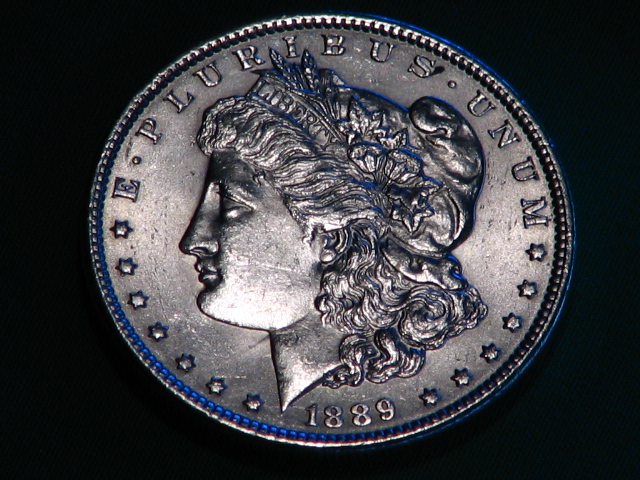 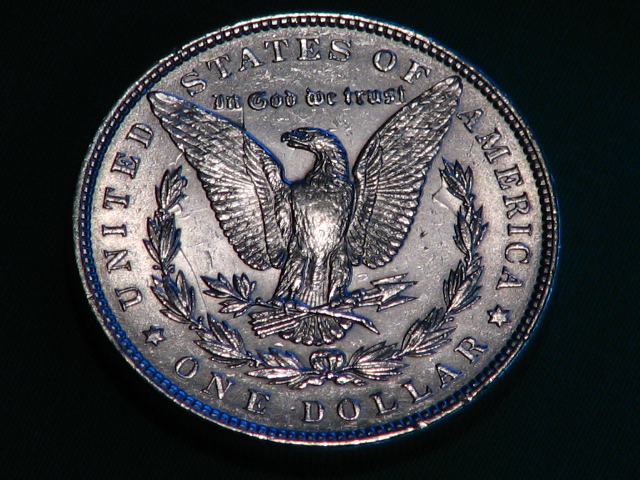 Note the strength of the clash, especially on the reverse. Numerous uncommon features have been transferred - above and left of the arrowheads, the "u" shaped feature is a transfer. Now. Below is an 1878 VAM-41C, known as the "Bearded Lady" due to the striking clash transfers under the chin. 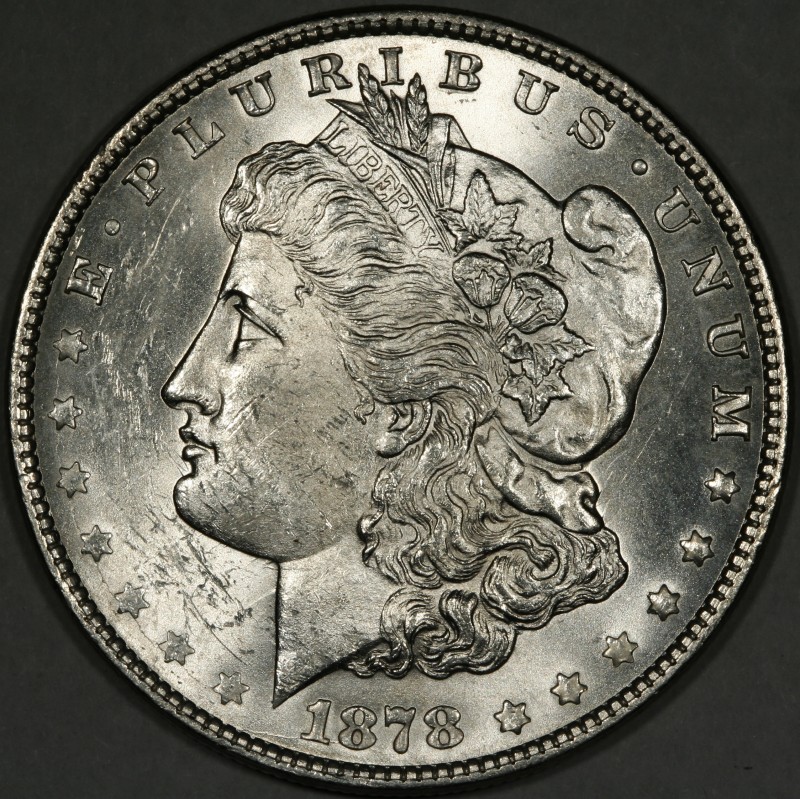 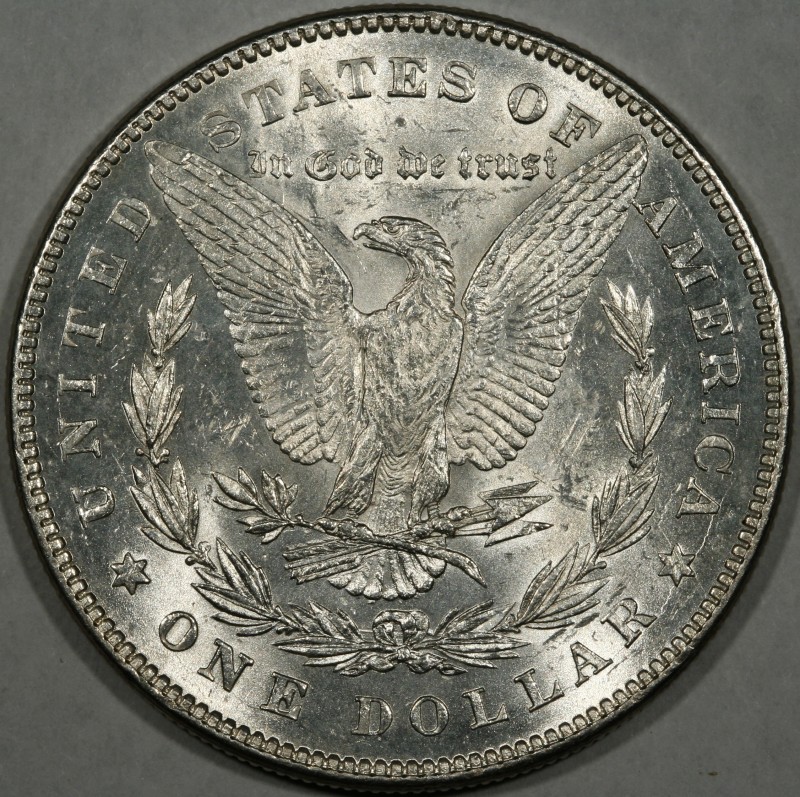 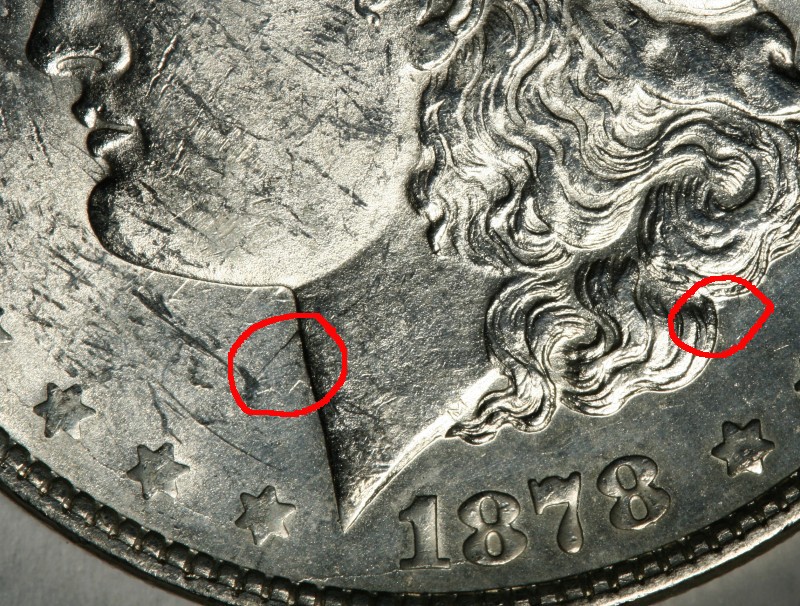 Note the strength of the details transferred to the obverse. Note, also, the location of the usual diagonal line on the neck (left red-circled feature) - it's much lower than normal, implying die rotation. The letter transfer (both red-circled features) is obvious. Now see that only one "normal" transfer feature is found on the reverse - the line below IGWT, and it weakly. One might assume that the original clash destroyed the reverse die, and another was inserted to strike the coin shown. But look more carefully. I draw your attention to the washed-out inside wing details and tailfeathers. Importantly, this is a 7/8TF coin, having been somehow treated to remove the 8TF and replace with 7. I use the ambiguous term "somehow" because, having examined the coin minutely, I saw no polishing lines. I note "something" around the wreath: 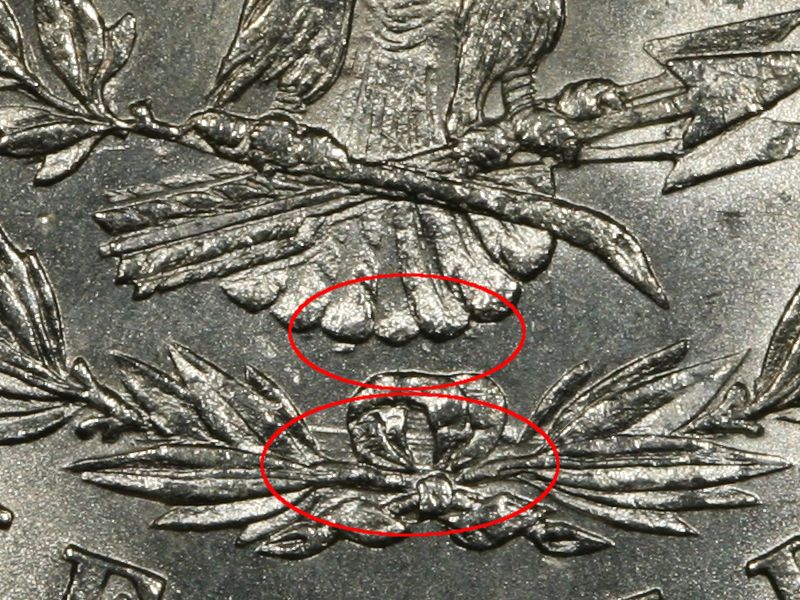 These are not, IMO, polishing artifacts. I'm guessing that the 8TF-7TF change was done via basining technique rather than hand-polishing, leading to an abnormally-deep convex reverse die which is far less likely to receive clash transfers. Of course, if the reverse was strong enough, close enough, to the obverse for so much letter transfer to happen, why didn't it pick up details of it's own? Perhaps the reverse was basined both before and after the clash, to remove the clash damage. Why, then, wasn't the obverse die treated also? I offer this monologue not to explain, because I don't feel there has been an explanation, but to illustrate how frustrating it is to find a definitive explanation to anything regarding Morgan varieties. All we'll ever have are working theories. |
|
Pillar of the Community
3660 Posts |
You know Dave, (and I am singling you out), I like you, and that is the reason that I chose to follow up with my previous post. I give honest answers based on my perception of the knowledge of the questioner........... When asked a question, I will give my answer, and in some audiences, I expect that my answer will be considered with virgin thought, with an open mind, leading to further discussion..........hence, I reply. In other audiences though, I expect that my answer will be viewed as imaginative speculation and disregarded without thought based on what the questioner feels he/she already knows. In the case of the latter, I usually refrain from engaging in further discussion as I feel it would lead nowhere. I no longer talk to walls, and some of my statements in this and previous posts may seem a bit curt, this is why ..........I consider my own 'postulations' as fact, based upon what I have come to believe through certain physical principles and my own experiences (yes I actually do have a few), with or without the assistance of the scientific method. Quote:
Could we then theorize that not all dies received the same basining treatment, and that a decent letter transfer not only requires a strong enough clash, but also the providential pairing of dies whose preparation made them "compatible?" Those are my exact thoughts and beliefs Dave, (with the exception of the 'strong enough clash' part).....I don't believe that pressure was as much of a player as was proximity. Upper die placement is key to the clash regardless of how much pressure is applied. The die stops at a predetermined point based on initial press setup. Yes, I believe also that despite exacting basining efforts, each die was, in itself, unique, this, and set up of the die in the press should also be considered variable factors in the overall equation. I doubt that the flat spots ground into the cylindrical die body (for rotational alignment) were applied so precisely as were the die face engravings either. Thanks for the bevy of pictures Dave. Please give me a while to digest them and your embedded dialogue accompanying them. |
|
Moderator
United States
23522 Posts |
Quote:
Thanks for the bevy of pictures Dave. Please give me a while to digest them and your embedded dialogue accompanying them. While you're at it, factor in what we know about the inexact science of annealing of the day. Could the basining process possibly generate sufficient heat to have an effect? |
|
Pillar of the Community
3660 Posts |
It is my belief that one each (obverse and reverse) of the 8TF hubs were ground down, reengraved, and used to rehub new master dies, from which working hubs were made and used to create working dies of the 7/8TF species while Morgan simultaneously worked on the new 7TF hubs. I have absolutely no basis for thinking this other than it would have been the fastest and easiest way of cutting down the relief of the high profile 8TF hubs as well as causing an odd number of TF to the eagle (which Linderman seemed to be adamant about) as the 8TF relief design was clearly unsatisfactory, and coin production was already behind. Certainly the dies produced by these newly altered hubs would require basining and as the area of the wings that (I think) you refer to are very shallow in depth anyway, I could see how die basining of the covert overlay of the primary feathers of the left wing, and the covert overlay of the secondaries on the right wing (as well as the same on the tail feathers) would completely remove design elements. "Efforts is ingenuity" is what Barber called it, but in reality, it was just a short cut that served the purpose of averting a suspension in coin production until Morgan's new 7TF hubs were completed and ready to create the 7TF dies. As you imply though, just another unprovable theory, unless a researcher can find memorandums in the Archives. It is also my belief (as Smitty eluded to in another thread) that production was job #1, so I doubt that removing clash marks was a front burner type of issue. Basining was a total failure on the 8TF dies, (and although improved on later dies), I rather think that overbasining was such a dreaded possibility (in those particular early days of the Morgan dollar) that it was done frugally and hesitantly, Beyond that, I don't know Morgans well enough to even venture a SWAG, so I may concede that your guess is probably better than mine. |
|
Pillar of the Community
3660 Posts |
I highly doubt it (my opinion), as the basining was done at such slow speed that heat should not have been a factor, but then again, I am only speculating, and you might have something there, and this deserves further consideration for sure.
edited to add:
I have thought about it now, and my answer would be no. The heat generated would not be sufficient enough to alter the steel of the die, as would annealing.
I know I sound like a broken record, but I really do believe fervently that all dies are unique in many ways. Basining has an effect as does hubbing, but certainly the greatest effect is caused through annealing. Some are hard, some are soft, some are inherently bubble filled, some have fissures at creation. No two are of exact equality....... if a clash is imagined between a hard die, and a softer one, the result is quite predictable.
Edited by zeewool
10/08/2010 2:00 pm
|
|
Moderator
United States
23522 Posts |
That question was "genuine." I don't know if basining was slow- or high-speed. Being slow, I doubt it's relevant.
|
|
Pillar of the Community
 United States
1285 Posts |
Quote:
I offer this monologue not to explain, because I don't feel there has been an explanation, but to illustrate how frustrating it is to find a definitive explanation to anything regarding Morgan varieties.
Even though MOI (I / me) is a new comer to vamming, moi did figure this out rather quickly.  |
|
Pillar of the Community
3660 Posts |
You are more perceptive than I am then Ceylon.....I am sorta dense, and I think Dave is kinda tricky....(He is always messin' with me).  |
|
Pillar of the Community
United States
1285 Posts |
David From this below Quote:
the line at the neck junction of the obverse; the spike from the wing under the "n" of IGWT, and the curve on the (viewer's) right of the wreath.
Do these have a corresponding clash on the reverse and have you seen them with and without on the reverse? Also Can it be "assumed" even the "slightest / Faintest" clash at that "junction" of neck and chin is related meaning it's a clash. (London calling and rock the casbah -- come to mind - just kidding). The reason I bring this is up is cos now I have 3 or 4 "O" mints that have this. I have put these away but I can go back and get the dates if you are interested. BTW, I like your pics as they are very educational. Thanks |
|
Moderator
United States
23522 Posts |
Quote:
Do these have a corresponding clash on the reverse and have you seen them with and without on the reverse? You will find every possible combination of detail transfer. Sometimes only obverse, sometimes only reverse, both sides with one far stronger than the other (like the 1878 I posted). They could pull one die or the other for polishing after the clash, leaving the other still striking coins with the transferred clash features. Transfer features wear away during striking, making the clash less and less strong as time goes by. Quote:
Also Can it be "assumed" even the "slightest / Faintest" clash at that "junction" of neck and chin is related meaning it's a clash. It's really unlikely that a postmint mark can show up at the exact "right" place to be thought a clash feature. Yes, I've seen it happen. So, you really can't be positive without enough magnification to be sure it's raised from the field, rather than gouged into it. Call it "99% likely" that the neck mark is a clash. And thank you for the earworm. Now I have to download that song and listen to it, to get it out of my head.  |
|
|
Replies: 71 / Views: 11,206 |
|
To participate in the forum you must log in or register.
Disclaimer: While a tremendous amount of effort goes into ensuring the accuracy of the information contained in this site, Coin Community assumes no liability for errors. Copyright 2005 - 2026 Coin Community Family- all rights reserved worldwide. Use of any images or content on this website without prior written permission of Coin Community or the original lender is strictly prohibited.
Contact Us | Advertise Here | Privacy Policy / Terms of Use
|
| Coin Community Forum |
© 2005 - 2026 Coin Community Forums |
| It took 0.31 seconds to rattle this change. |
 |
|







 First Page
 Previous Page

 Posted 10/07/2010 12:20 am





