First Page


 Posted 11/12/2010 3:19 pm


Apprehension attacked the psyche of many Union soldiers at the Battle of Cold Harbor in May of 1864 in what is now Mechanicsville, Va. Most were veterans of numerous battles and knew all too well the difficulty of identifying the dead whose bodies were severely maimed and disfigured. They feared that their loved ones, back home, might not know what happened to them if they fell in battle-the troops had noticed far too often their deceased comrades interred in shallow unidentified graves.
And they were right to be worried as it turned out to be one of the bloodiest battles of the war with thousands of Union soldiers killed or wounded in what was a hopeless frontal assault against the fortified troops of Confederate Gen. Robert E. Lee.
Under the sounds of fire from artillery and musketry closing in, many of the soldiers busied themselves pinning pieces of paper with their names written on them, onto their uniforms. Earlier, some of the Union troops had carved wooden tags to identify themselves.
Government issued identification tags, now known as dog tags, were nonexistent during the American Civil War. In May of 1862, John Kennedy, a resident of New York, proposed in a letter to Secretary of War Edwin Stanton, that each Union soldier be issued an ID tag. The overture was rejected. The soldiers were on their own.
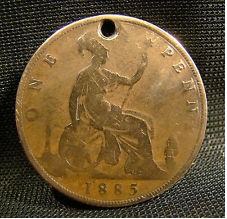
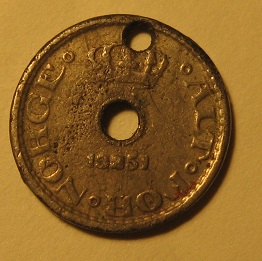
While there is little anecdotal evidence of Confederate soldiers using some type of body identification, Most if any used real money that they put a hole in and wore as a necklace, a rubbing was taken at the time of making it as to prove it was theirs alone, so some holes are found in odd places on the coin, this was no accident and would have served them well if they had won the war. The truth is the surviving or opposing, soldiers would take them as a prize and this grisly practice ruined most hope of ever being able to identify the person it was intended to identify. they can be found on ebay to this day for sale as a damaged coins. Most people would never know of their sad necessity
a number of different types of Union soldier ID tags and badges have been discovered. The most common appear to be round metal token-type tags. Some are homemade, created by the soldier himself, usually made from a coin. Others were commercially manufactured, in gold or silver, and sold mail-order. Less expensive examples were produced in brass or steel. Sutlers accompanying the army would set up shop along the soldiers' tramp.
The soldiers had good reason to worry that no one would identify them if they died in battle. Of the more than 325,000 Federal soldiers buried in National Cemeteries, almost 149,000 are marked 'unknown.'
On more than one occasion as a father, son or brother left home to shoulder a musket, concerned kin placed a token in the palm of their hands. They had taken care to crudely stamp the recruit's name into the bit of lead, copper or possibly an old coin; giving strict instructions for battle-ready men to secure it tight to their person. Those with means might have followed the advertisements in Harper's or Leslie's magazines for the more ornate and expensive gold or silver pins.
And they were right to be worried as it turned out to be one of the bloodiest battles of the war with thousands of Union soldiers killed or wounded in what was a hopeless frontal assault against the fortified troops of Confederate Gen. Robert E. Lee.
Under the sounds of fire from artillery and musketry closing in, many of the soldiers busied themselves pinning pieces of paper with their names written on them, onto their uniforms. Earlier, some of the Union troops had carved wooden tags to identify themselves.
Government issued identification tags, now known as dog tags, were nonexistent during the American Civil War. In May of 1862, John Kennedy, a resident of New York, proposed in a letter to Secretary of War Edwin Stanton, that each Union soldier be issued an ID tag. The overture was rejected. The soldiers were on their own.
While there is little anecdotal evidence of Confederate soldiers using some type of body identification, Most if any used real money that they put a hole in and wore as a necklace, a rubbing was taken at the time of making it as to prove it was theirs alone, so some holes are found in odd places on the coin, this was no accident and would have served them well if they had won the war. The truth is the surviving or opposing, soldiers would take them as a prize and this grisly practice ruined most hope of ever being able to identify the person it was intended to identify. they can be found on ebay to this day for sale as a damaged coins. Most people would never know of their sad necessity
a number of different types of Union soldier ID tags and badges have been discovered. The most common appear to be round metal token-type tags. Some are homemade, created by the soldier himself, usually made from a coin. Others were commercially manufactured, in gold or silver, and sold mail-order. Less expensive examples were produced in brass or steel. Sutlers accompanying the army would set up shop along the soldiers' tramp.
The soldiers had good reason to worry that no one would identify them if they died in battle. Of the more than 325,000 Federal soldiers buried in National Cemeteries, almost 149,000 are marked 'unknown.'
On more than one occasion as a father, son or brother left home to shoulder a musket, concerned kin placed a token in the palm of their hands. They had taken care to crudely stamp the recruit's name into the bit of lead, copper or possibly an old coin; giving strict instructions for battle-ready men to secure it tight to their person. Those with means might have followed the advertisements in Harper's or Leslie's magazines for the more ornate and expensive gold or silver pins.