Coin Community Family of Web Sites Join Thousands of Coin, Bullion, & Money Collectors
Coin, Banknote and Medal Collectors's Online Mall Vancouvers #1 Coin and Paper Money Dealer Royal Estate Auctions - $1 Coin AuctionsRoyal Canadian Mint products, Canadian, Polish, American, and world coins and banknotes. Join Thousands of Coin, Bullion, & Money Collectors Specializing in Modern Numismatics 300,000 items to help build your collection!


Username:
Password:
Save Password
Forgot your Password?


This page may contain links that result in small commissions to keep this free site up and running.

Welcome Guest! Registering and/or logging in will remove the anchor (bottom) ads. It's Free!

And Speaking Of Pillar Dollar Fakes.....

To participate in the forum you must log in or register.
First Page  Showing last 15 replies.
Author Previous TopicReplies: 19 / Views: 5,179Next Topic Page 2 of 2
Pillar of the Community
Learn More...
United States
2448 Posts
 Posted 12/10/2010  9:53 pm  Show Profile   Bookmark this reply Add carmykle to your friends list
Thanks SwamperBob, I have not heard of that for years. I still have an old hydrometer in the garage. I'll have to give it a test run.
Pillar of the Community
United States
1801 Posts
 Posted 12/10/2010  11:59 pm  Show Profile   Bookmark this reply Add jfransch to your friends list
Odentheviking
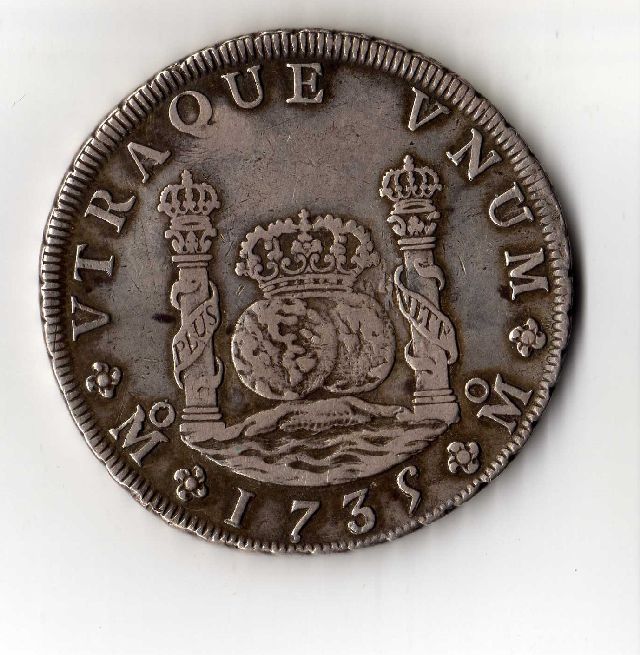
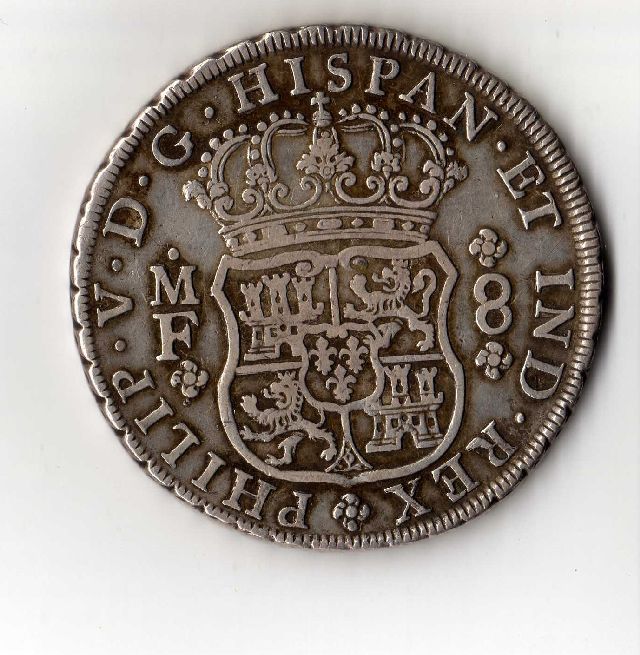
I have seen other real pillars that have been gold plated and put in jewelry and sold as "8 Escudo" coins. I believe both of your coins are real, they look fine to me. I am posting a 1735 so you can compare features since you said you did not have access to one for comparison.


And-Speaking-Of-Pillar-Dollar-Fakes.....
Valued Member
United States
425 Posts
 Posted 12/12/2010  3:26 pm  Show Profile   Bookmark this reply Add odentheviking to your friends list
Thank you jfransch for the scan of the 1735, very helpful,(If you get a chance would you mind also scanning the obverse?), again, thank you!

SwamperBob, I had not even heard of a spec grav test until I was reading one of your posts. I just found a video on the net that shows how to do it, so I will chime back in with the results if I can figure it all out! I just got a nice scale in grams and have been playing around weighing all my coins!

Many Thanks to you all for taking the time to help me with this and voiceing your opinions. Paul.
Pillar of the Community
United States
1801 Posts
 Posted 12/12/2010  5:36 pm  Show Profile   Bookmark this reply Add jfransch to your friends list
As you requested. Any other images you need?

And-Speaking-Of-Pillar-Dollar-Fakes.....
Valued Member
United States
425 Posts
 Posted 12/12/2010  7:44 pm  Show Profile   Bookmark this reply Add odentheviking to your friends list
Thank you jfransch, your coins "F" and mine are very much alike! But this makes it harder for me to understand. I just did the Spec. grav. Test,and I think I failed! The only thing I did differant was I could not hang the coin vert. in the water, it hung horizonial as my scale can only handle 100 grams....... anyway.
The 1735 came out to be 9.99

The 1757 came out as a 10.05

For fun I tried the 1770 fake I posted a while back and it came out 10.07

And just to see if I was doing it right, I tested a silver round and came out with 10.4

So what does all this mean?
Pillar of the Community
United States
5362 Posts
 Posted 12/12/2010  10:53 pm  Show Profile   Bookmark this reply Add swamperbob to your friends list
odentheviking Provided the tests were not flawed by methodology which I do not suspect - the results are fairly conclusive. Pure silver - like the round is 10.4 (The chart says 10.46 but your results are close). That means you are at most only 0.06 off.

Here is a good site for SG's of various materials.
http://www.reade.com/Particle_Brief...ec_gra2.html

The readings of 10.05 and 9.99 are not good news. The coins are counterfeit. They are well outside the range for REAL coins. Coin Silver that has an alloy of 90% silver 10% copper is 10.31 (that is a fabricated or struck density). Pure copper (rolled) is 8.91. Nickel is lower at 8.67 (rolled). So an SG near 10 will be debased considerably below 90% for copper alloys. I do not have access to my table of deviations but it equates to roughly 1% of silver for every 0.015 points of SG (using Cu alloys). So the coins are about 75 to 80% silver at best based on doing calculations in my head. That is a very typical result for recent Chinese counterfeits AND for some of the later Bullion forgeries made ca 1900.

The next logical question to ask is: Were "real" Mexico City mint products ever made with SG's that low?

The answer is a highly qualified - Yes. Those instances occurring in the Mexico City mint were very VERY RARE. If you check Riddell's work you will see that very few real coins have silver contents below 90%. So I suspect that what you actually have are in fact "Bullion Forgeries" of the type from the late 1800's or equally possibly they could be modern fabrications in the Numismatic Forgery class - perhaps Chinese in origin.

But even if the coins were REAL. That is, even if they were produced in the year shown and in the Mint shown - they are still debased FRAUDULENT issues. John Riddell first established the "Debased" category in his 1845 book but he used it sparingly and included in that group instances where real dies were stolen from the mint and instances where scrap dies were sold and re-used by forgers.
Valued Member
United States
425 Posts
 Posted 12/13/2010  9:38 pm  Show Profile   Bookmark this reply Add odentheviking to your friends list
OK, So just for fun,(and to see if I know what I am doing!), I set the test up again tonight and checked the SG of the 1758 Pillar that I am 99.9% sure is a real one......... it came out 10.33!

So then I re-checked/tested the other two. The only thing I did differant was I weighed the coins w/the string on, that added about .03 grams to each coin.

This time the 1735 came out at 10.22,
and the 1757 came out at 10.25
But I am guessing that this does not change much as the magic number is 10.31 or higher......correct?

I do not think these are modern copies, but the "Bullion Forgeries" sound much closer to me!
(And just when I was starting to believe they were the real thing!) Oh well, I guess they go back with the other counterfeits in my collection.....thats where they started.
Thanks to all, the story of these coins could not have been uncovered with out your help!
Pillar of the Community
United States
5362 Posts
 Posted 12/14/2010  01:11 am  Show Profile   Bookmark this reply Add swamperbob to your friends list
I am back home now. The SG results now equate to 850 and 870 fine silver (they were 715 and 750 before). The newer results would place the coins in the older Bullion forgery category based on tests I have conducted in the past. The Chinese copies I have checked are usually under 10.1 not over 10.2 and many older bullion forgeries are in the high 800s.

However, I am concerned about the large change in your results 9.99 jumped to 10.22 for the 1735 and what you said in your post about how you adjusted your numbers.


Quote:
The only thing I did different was I weighed the coins w/the string on, that added about .03 grams to each coin.


There is no need to add the weight of the hangar to the coin.

Lets go back to the start.

The Specific Gravity of any item is the density relative to water. It is determined by dividing the weight of an object by its volume. Water is 1.0 grams per cubic centimeter at "room" temperature at sea level.

So for our purposes, the SG is the weight of the coin in air (with NO hangar) divided by the difference in weight between the coin weighed in water and in air.

So the first weight, (the numerator) is simply the coin itself.

The denominator of the fraction is the difference between the coin AND hangar in air and the coin and hangar in water.

The weight of the hangar in this case nets out to ZERO because the weight of the hangar is included in both the wet and dry weights of the coin.

If you just add the weight of the hangar to the weight of the coin in the numerator, you are just artificially increasing the SG as a result.

But, I also noticed that you said "string". That could be a small flaw in the methodology. I have never used a string as a hangar because it floats. It has a density below that of water and usually it is porous. The effect of a buoyant material like string DECREASES the apparent SG of the coin because it disproportionately increases the difference in weight making the coin appear much larger in volume.

Typically, I use a fine drawn silver wire as a hanger (jewelry supply houses can provide some very fine wire with known SG) but any non porous wire can be used. The thicker the wire hangar the more effect there is on the test. So big knots and excess hangar material all heighten the effect. But you can use any wire if you zero out its effect on the results. I have also successfully used stainless steel, piano and copper wires.

But the key fact here is that the hangar has a VOLUME itself and therefore it has a displacement effect when the coin is in the water. You do need to adjust your results for the effect of the hangar not simply for the weight of the hangar. I typically check the hangar assembly EMPTY (weighing it in air and then in water) to determine the net effect the hangar has on the displacement weight of water (the delta - the difference between the dry and wet weight of the coin.)

Remember the net weight of the water displaced EQUALS the volume of the coin. It is the volume of the coin that is needed for the SG determination. One Cubic Centimeter of water weighs exactly ONE GRAM so if the coin is 3 grams lighter in weight it has a volume of 3 cubic centimeters.

For a very fine silver wire the effect can be very minimal in the range of 0.002 grams (cc's) and using 900 fine silver renders the deviation meaningless when dealing with 900 fine coins since the density matches. The effect of the 900 fine hangar will alter SGs that are lower than 10.31 by raising them slightly. Conversely a 900 fine hangar will drop higher SGs. But for doing an authenticity check on most 900 fine coins for authenticity the silver wire can be IGNORED with no net effect.

I also use silver wire for testing gold coins - the effect is more significant there but is removed in the identical manner. If I am testing a debased gold coin for the actual value of gold it contains the silver hangar needs to be accounted for or I will get an incorrect result.

As a result many people do not bother with the hangar effect when they use drawn silver wire. I agree with that. Remember it is NOT THE WEIGHT of the hangar that is the problem. The weight cancels out. It is the VOLUME of water displaced by the hangar that is critical. In many of my tests it can have an effect of 0.012 cc.

Other hints to getting accurate results in an SG test are as follows.

Repeat each test THREE times to make sure you have a good repeatable result. This is critical for debased silver coins in the 800 fine and up range where a small difference is critical - not really critical for plated copper where the difference is enormous.

Remember that you can nullify a test result by being imprecise. An air bubble can get trapped and missed resulting in an incorrect SG.

At times, a coating on the coin (if thick enough) can lower the SG slightly. Always look for oils or excessive dirt first and if possible remove thick deposits before testing. Oils should be removed (I use acetone).

You need to use room temperature (same temperature as the coin) distilled water with a small amount of detergent (1 or 2 drops) per cup of water to break surface tension. You can boil tap water to remove dissolved air and achieve decent results.

Do not let the coin sit in the water any longer than necessary because air bubbles can form on the coin surface quickly under the incorrect circumstances.

Also make sure there are no significant air currents blowing on the scale (fans - even your breath on the apparatus can cause a deviation). In most laboratories the analytical balance is kept in a glass box.

Finally always check your balance before and after each test to assure it is set up correctly (level) and will zero with the balance empty.

Sorry of I start to sound like a Lab professor but a bad result can get a real coin labeled as a fake and vice versa.

Valued Member
United States
425 Posts
 Posted 12/15/2010  01:57 am  Show Profile   Bookmark this reply Add odentheviking to your friends list
OK, I made a little wooden frame and made a hanger/basket from the thinest copper wire I could find and picked up distilled water. I dipped the wire basket into the water and zero-ed the scale. Placed my 31.1 gram silver round,(.999 pure), into the basket and into the water. Got a reading of 2.98, four times. This comes out to a SG reading of 10.436.

So, am I doing it right?
Pillar of the Community
United States
5362 Posts
 Posted 12/15/2010  4:28 pm  Show Profile   Bookmark this reply Add swamperbob to your friends list
That procedure certainly sounds better than using a string. Zeroing the scale with the hangar basket in place deducts the effect of both the weight and buoyancy of the basket leaving the displaced weight of the coin only. So far so good.

The only issue I would see as effecting the results is the level of accuracy of the SG number. I would express your results as 10.4 or perhaps 10.44 but not 10.436. The scale accuracy determines the final accuracy of the SG.

Based on your stated weights 31.1 gram and 2.98 grams, I am not certain what the accuracy level of your scale is, but I presume 0.01 gram. On most scales a reading of 2.98 grams means that the item weighs more than 2.975 grams and less than 2.985 grams. But some electronic digital scales have a stated accuracy level over and above the reading level. Some of the less expensive Chinese digital scales clearly state they are accurate to 0.2% of total weight. That is a range of 0.05 gram for a 27 gram item. (That is the same as example above so 2.98 means 2.975 to 2.985). But others I have seen (the really cheap ones) say accuracy of 1% or even 2% is anticipated. That is 0.27 to 0.54 grams as a range. The potential difference in weight using a 1% range is 2.71 to 3.25 - a huge range. A 2% range is double - almost worthless in terms of SG.

So the differential you state is 2.98 grams (2.98 cc.) But based on the scale accuracy that could actually be 2.99 or 2.97 as well.

If the scale weighs to the 1/100th gram ACCURATELY, then the accuracy of the fraction that creates the SG is to the 1/100th level AT BEST (two decimals) not the 1/1000th level. If it is plus or minus 1 full gram the calculation produces a ONE DECIMAL result.

I know that is scientifically picky but the difference needs to be discussed. A plus/minus of 1/10th in SG is roughly a 50 point range spread in silver/copper alloy.

The procedure you employ is ENTIRELY CORRECT. The results may simply be overstated based on the scale used.

Your procedure is also simpler than the one I am using but physical limitations of my current apparatus (a 4 beam analytical balance) preclude that approach. It is a manual balance and so does not automatically zero and the space available is under 3 vertical inches. If I had a good digital scale that zeroed automatically and had space for a hanging basket and a large water reservoir that would be even better, but a reliable high accuracy digital scale (accuracy to 0.001 gram) is too costly for me right now. The only ones I know of run $500 or more.

I do own an inexpensive digital scale ($30) and use it for quick tests but the results are accurate only to 0.01 gram which as indicated above is a significant range in SG testing. BUT 0.01 GRAM IS DEFINITELY GOOD ENOUGH FOR QUICK IDENTIFICATION OF COUNTERFEITS. It produces alloy results that are in the 2 decimal point range or roughly 10 points of fineness. But that will identify most debased or off metal counterfeits. I only use the more accurate scale when time and accuracy requirements necessitate. It can literally take a half hour to do an accurate set of tests start to finish.

You are on the right track and if using your new method confirms even a 10.2 reading (or 10.22 and 10.25) for the two coins - then I would believe they were not real but are bullion forgeries.

What result does your new test produce using the basket?

The next step on the discussion of SG is the chart or table of SGs best suited for interpretation of your results. That is a later discussion.
Valued Member
United States
425 Posts
 Posted 12/15/2010  11:05 pm  Show Profile   Bookmark this reply Add odentheviking to your friends list
Again Thank you Swamperbob for the information. Sometimes I feel like a child learning to tie my shoes!

My scale,(brand new from China!), is accur. to 0.01 grams, (I think?). I have two silver rounds that state they are 31.1 grams, but on my scale they read at 31.09 and 31.07 grams,( used the 31.09 gram one for the earlier test).

I repeated the same test I did on the silver round last night, with the three Pillars in this thread.

The 1758 that I believe to be real, weight: 26.86, came in at a SG of 10.33,(Same as my earlier test I think?)

The 1735 (Goldie), weight: 26.96, came in at a SG of 10.24 and......

The 1757, weight: 26.52, came in at a SG of 10.28

Both just a little higher, but still not a 10.31
How much affect does the plug at the 12 o'clock on the 1757 have?
Pillar of the Community
United States
2605 Posts
 Posted 12/16/2010  01:57 am  Show Profile   Bookmark this reply Add svslav to your friends list
I have absolutely nothing on Pillar Dollars but I can speak for Statistics.

Quote:
My scale ... is accur. to 0.01 grams, (I think?).

The term you are looking for is "precise to 0.01 g." whether accurate or not. Usually accuracy can be calibrated on a digital scale. Precision is a fixed characteristic.

Quote:
I have two silver rounds that state they are 31.1 grams, but on my scale they read at 31.09 and 31.07 grams.

It's almost impossible to find two coins of the same type, even same year, which weigh the same (especially if you increase precision). All weights have normal (bell curve) distribution with a given mean, 31.1 g. in your case, and a certain standard deviation.
For example vending machines are usually set to accept coins within two st. deviations of the mean, which means they will reject about 5% of legal coins for they are either "too" heavy or "too" light.
New Member
France
4 Posts
 Posted 12/16/2010  09:02 am  Show Profile   Bookmark this reply Add aqua to your friends list
Hello,

I am new on this forum and as a french I am not very good in english, so excuse me..

I began to collect some mexican modern bullion, read books about colonial spanish period and like pirate history !
I am also a numismatic amateur...

So, logicaly, I am interest in Colonial Pillar Real and search for informations.

Ok.
I recently found this seller :
http://cgi.ebay.com/ws/eBayISAPI.dl...TRK:MEWAX:IT

Can anyone say me if this is a genuine coin ?
Thank you very much.
DG.
Valued Member
United States
425 Posts
 Posted 12/17/2010  11:30 am  Show Profile   Bookmark this reply Add odentheviking to your friends list
Hello Aqua and welcome to the forum!
I am sorry but I can not tell you if this coin is the real deal or not. I did some searching on the internet and found that the paper work they show is the common certificate used for these coins, and that many of these coins look very good for ones that have been at the bottom of the ocean for 250+ years!
This coin may be just fine, but It does have some of the signs of a fake. The weight seems right at 26.8 grams. No edge picture was offered and this often will reveal a fake. The toning or color looks odd to me, but it is a sea-salvage coin. There is a point on the sheild, on the obverse side, right were it points at the "M" that I don't like ....... its just not very clean of an edge at that point. It also seems to be a lower price than most of the dealers are asking for this rare coin. And, it seems there are many of these coins on E-bay right now.
Thats the best I can do......sorry.

I guess I am lucky as when I started to collect Pillar Dollars I wanted the counterfeits, copies, and fakes. Only problem is when you see a fake, that then sells as an original and you can not get it! C'est la vie!

Paul.
New Member
France
4 Posts
 Posted 12/18/2010  05:20 am  Show Profile   Bookmark this reply Add aqua to your friends list
Thank you Odentheviking. I understand it is a very difficult exercise..

I simply search for a serious professional seller.
Private Message if someone want's to help.

Page 2 of 2   Previous TopicReplies: 19 / Views: 5,179Next Topic Page 2 of 2
First Page  Showing last 15 replies.
To participate in the forum you must log in or register.


Disclaimer: While a tremendous amount of effort goes into ensuring the accuracy of the information contained in this site, Coin Community assumes no liability for errors. Copyright 2005 - 2026 Coin Community Family- all rights reserved worldwide. Use of any images or content on this website without prior written permission of Coin Community or the original lender is strictly prohibited.
Contact Us  |  Advertise Here  |  Privacy Policy / Terms of Use

Coin Community Forum © 2005 - 2026 Coin Community Forums
It took 0.39 seconds to rattle this change. Forums