| Author |
 Replies: 35 / Views: 3,566 Replies: 35 / Views: 3,566 |
Page 3 of 3
|
|
|
|
Moderator
 United States
23522 Posts |
They're all my own pics.  Although I've massaged them to bring details into greater prominence, I can assure you that they were all shot with my usual attention to parallelism vs. the camera. Actually, my poor choice of terms led to a misinterpretation on your part - the "drawing" aspect is very common on San Francisco coins. It's part of the fascination. I have only a dozen San Francisco coins pictured in my archives, comprising 8 different VAMs. Every single one shows the date "drawing" to one extent or another, and half show it on the reverse as well. The only unique feature shown in my pics is the characteristic VAM-1L diagonal lines from the denticles - the "strange field textures" - more pronounced in person than my pics indicate. You got pic #3 exactly right - it's a strong, clear strike, interesting for that as the only one of the 4 which can be described that way. If we use it as the basis for an assumption of "misaligned die," why, then, doesn't the other end show some similar pattern? I have on the desk in front me me a VAM-1Y, whose defining characteristic is the same type of denticle line as 1L, only one per denticle instead of two. It's a Mint State coin - to my knowledge, the only Uncirculated example known - and although the strike is abysmal, it lends itself to conclusions regarding strike process without having to factor wear. This one shows a slightly different pattern. The date is sharply drawn; the corresponding reverse less-sharply drawn than the 1L I pictured but still showing the signs. At the other end, the obverse top is weak and slightly drawn; the corresponding reverse bottom sharply-struck. I could envision this being struck by one die in alignment, while the other was slightly off-horizontal, favoring the bottom of the reverse while everything else was fairly weak. Even a slight misalignment, in a coin this weakly-struck, should be easily visible. 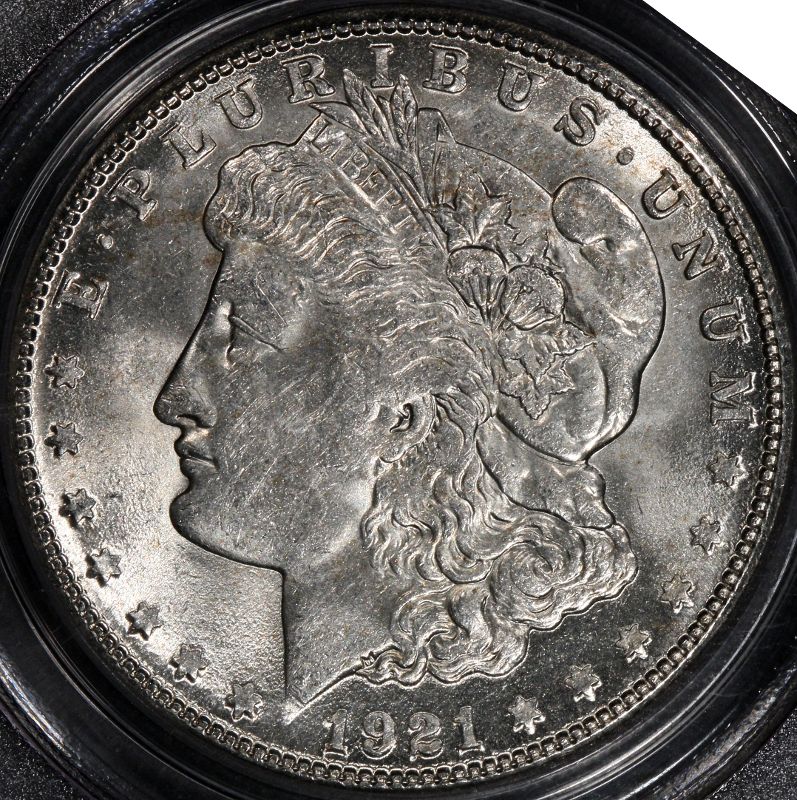 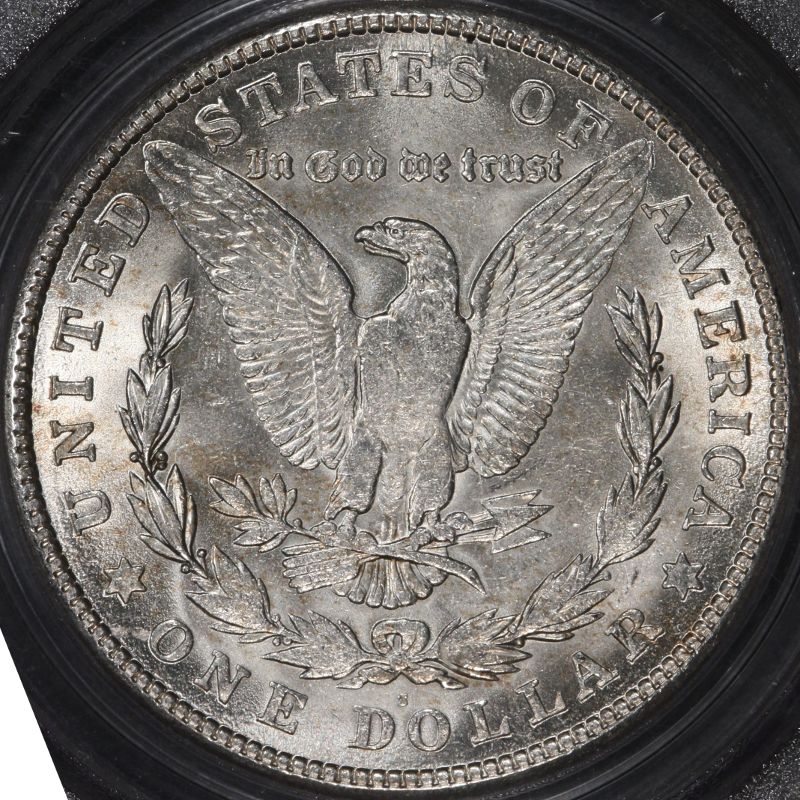 |
|
Pillar of the Community
3660 Posts |
That is one really interesting coin Dave...is this what is called an 'orange peel' surface? ....what do you think was the cause of that? ...or am I seeing things again?..... I hope that you know that I am taking your word for everything that you say here because I fully realize that you have forgotten more about this stuff than I will ever know....and I find it fascinating. What are these little teats on top of the denticles in this picture Dave? I have never seen them before, and they seem to be on every dentil. 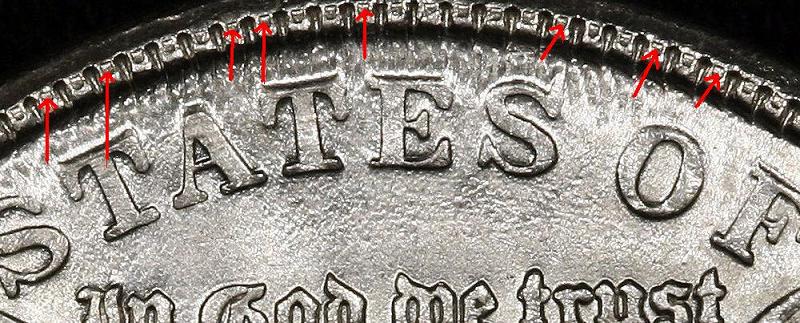 |
|
Moderator
United States
23522 Posts |
I'd call it "orange peel," if you're referring to the stuff most easily seen below STATES (although it's elsewhere, too). I'll answer the "why" with a question - what would the fields of the coin look like if striking pressure was so low as to fail to shove the planchet into 100% of the places it was supposed to go? The other possibility is long-term deterioration of the die face due to overuse(?). My first theory might explain the fascinating details you point out in the denticles - they're incompletely struck. My VAM-1Y (of the abysmal strike) shows the same denticle details. I'd like to see the reeds, but I ain't going to crack it out to see them.  |
|
Pillar of the Community
3660 Posts |
I am following your logic quite well...I am just a step or two behind you because you have the advantages of experience (and coins)....  |
|
Moderator
United States
23522 Posts |
Actually, my questions were for you - your knowledge of press mechanics and metallurgy exceeds mine.
|
|
Pillar of the Community
3660 Posts |
Oh, well, in that case, let me clue you in on something...I am no metallurgist, not by any stretch of the imagination....as far as what I might think the die fields could look like if striking pressure was too low to fill the devices, my answer would be not like that coin.....I would think that the fields would necessarily be the first feature on the coin to achieve completeness, followed by the central devices, and finally the periphery of the coin. Personally, I like "The other possibility (of) long-term deterioration of the die face due to overuse." Aw, come on.....crack it outta there, and let's see what those reeds look like.. edited to add: I've had a whole lotta fun here today, but I gotta go now for a while... Edited by zeewool
12/18/2010 7:52 pm
|
|
Pillar of the Community
United States
3076 Posts |
well done SD... I do concur, I did feel the UM break was so distinct
That it had to have been vammed.....BUT how tuff the 21's are...especially the scribbles ugggg............
|
|
Pillar of the Community
3660 Posts |
Hey Gene, how is your eye by now buddy?...Better, by now I hope. Quote:
BUT how tuff the 21's are...especially the scribbles ugggg........... Seemingly, and I think that may be why the 21's are left to to a small handful of people like Dave, however, when it comes down to the scribbles thing, I think that we just are not yet aware of how blessed these things really are going to turn out to be......if you want to be able to play the die is the die card, these scribbles are the fingerprints. OT....I have notice lately that you have begun to separate your sentences with several periods.....Is there a reason for this? |
|
Pillar of the Community
United States
3076 Posts |
LMOA ZEEE....and yes.....and thankyou, and the eye, at least one is better .....and as free flowing of thought as many of my threads are, I have been trying to STOP.at points..so you all might follow what I am thinking about.... |
|
Moderator
United States
23522 Posts |
Ironically, fenton's 1CB was originally designated as a "scribbles" VAM. It just happened to have been listed at VAMworld with enough relevant information to make the attribution. |
|
Pillar of the Community
3660 Posts |
I know of a few others that are scribbles varieties including 1AR and 1X.....There is probably a whole slew of others as well......(I really think that if another 1X is found, it will be found through the scribbles, and will cause a revision to either the newly found or the existing die state)....I truly believe that anyone who is searching for the next 1X, is wasting their time looking for a big hulking Cud..... |
|
Pillar of the Community
United States
3076 Posts |
any one seeking knowledge on 21's has a brain impairment.........I'm glad we have them here...... its far worst the the 78 series......I'm glad we have them here!! |
|
Moderator
United States
23522 Posts |
Trouble is, the only known 1X is circulated. Worse, as you might understand, it's a pretty weak strike. If there are scribbles, they're probably long gone or never struck anyways.
There are two fascinating features on that coin, though, which will probably be relevant to the identification of another example, pre-cud. There's a characteristic crack from the first two stars to below the 1 in the date. Second, the I in UNITED is missing the top serifs, while the adjacent letters are fully-formed. I think this is an unrelated incident to the die.
There are currently 81 1921-D varieties which are titled "Scribbling Scratches" only, and many more which mention them.
|
|
Pillar of the Community
 United States
4992 Posts |
Thanks Dave! Does 1cb give the coin any extra value in today's market?
|
|
Moderator
United States
23522 Posts |
Quote:
Thanks Dave! Does 1cb give the coin any extra value in today's market? Nope, not really. Too little information regarding rarity, and too little demand. It's one of those ones I always recommend to hold at least for the middle term - 5 or 10 years - while VAMming shakes itself out. The VAM collector base may never reach the size where true rarity generates its' own demand, but maybe it will, too.... |
|
Page 3 of 3
|
Replies: 35 / Views: 3,566 |
Page 3 of 3
|





 First Page
 Previous Page

 Posted 12/18/2010 5:30 pm


