| Author |
 Replies: 49 / Views: 4,758 Replies: 49 / Views: 4,758 |
|
|
|
|
Pillar of the Community
3660 Posts |
Much of what the Congress passes as law is steeped in absurd redundancy or meaningless babble...... As far as the issue of legal tender status goes, this Act gave legal tender status to the U.S. Trade dollar, but was beyond that, nothing more than a restatement of existing law. The limitations placed on the number of Two Cent Pieces allowable to be tendered in a single transaction was repealed a very, very long time prior to 1965..... The 1864 Act placing such an unenforceable law on the public is a prime example of the caliber of folks that we elect as our representatives to enact law on our behalf that we do not need...... What law enforcement agency was to enforce the maximum tender of 10 Two Cent coins in a single transaction? What court system would uphold cases involving such idiocy? I assume that this is the verbiage that causes the OP to feel that unlimited legal tender status was bestowed upon the Two Cent coin in 1965: Quote:
United States coins and currency including Federal reserve notes and circulating notes of Federal reserve banks and national banks are legal tender for all debts, public charges, taxes, and dues. What that means is that the 1865 Two Cent Piece and the 1934 $500 Federal Reserve Note, and the 1901 $10 United States Note, and the 1861 $20 Demand Note, and the 1957 $1 Silver Certificate, and the 1895 Morgan dollar and the 1916 SLQ are all obligations of the United States Treasury and the United States Government at face value, just as every other piece of currency or coinage issued for circulation is. What it does not mean is that any portion of the public is required to accept any of these legal tender instruments as payment or in change..... Just try buying a $350,000 car with that equal amount in dimes.... Walk into a convenience store that displays a sign on the door stating "No bills higher than $20 will be accepted".... Just try invoking the 1965 law on them..... The fact of the matter is that there is no such law restricting the number of coins that can be used in a single transaction, nor is there any law giving unlimited legal tender status to any denomination of coin or currency.... Go to a merchant who refuses to accept any form of cash money, but will only accept credit cards..... Invoke this 1965 law.... just try. Here is a $10 bill (MY NOTE) issued by a bank that no longer exists..... 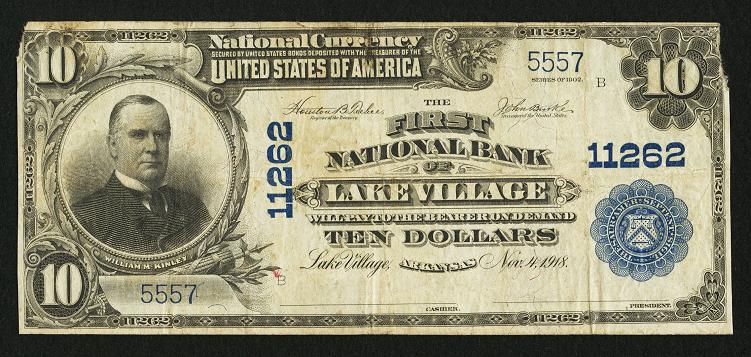 Is it legal tender today? Yes, it most certainly is..... Why?.... It is an obligation of the United States Government, not the bank that no longer exists..... Is it required of 'anyone' to accept it as acceptable tender? No..... "Unlimited legal tender status" means only that the U.S. Government is obligated to buy back those coins and currencies at face value... any and all of them. A comment was made earlier about the $10,000 Gold Certificate available to collectors today..... These notes were not circulating currency..... they were in essence, checks made payable "to the order of" (usually Federal banks, agencies, or cities.... not the general public)... they were intended for one time use, and were canceled after redemption, just as your personal checks are today, and as such, have no legal tender status. NOT my note..... NOT currency..... NOT legal tender. 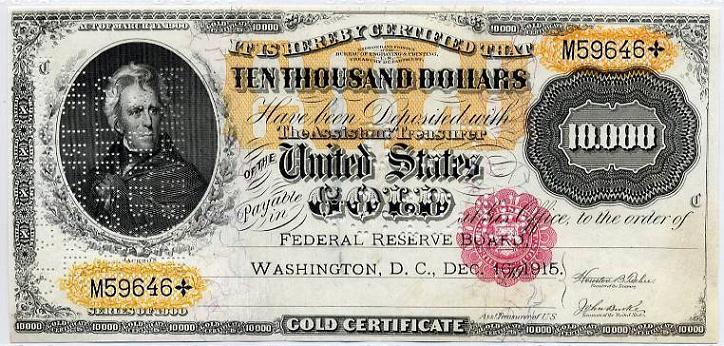 |
|
Pillar of the Community
 United States
3234 Posts |
Based on the language of the 1933 Act, it appears Conder is correct that it did give legal tender status to all previous coins but makes an exception for underweight gold coins. Very interesting and eye opening.... My humble appreciation to Conder for opening my eyes to this one. I still will need to confer with the experts at Coin World who will be reviewing my article to see what we'll actually print. |
|
Pillar of the Community
3660 Posts |
Every piece of coin or currency is given legal tender status by Act of Congress prior to being produced by the mint, private banknote company, or the BEP.... There is no need whatsoever to bestow legal tender status again at a later date.
An understanding of the intent of the Act of 1933 is necessary to relate this to legal tender status..... This was an emergency Act, and that is why the exception of underweight gold coins..... What did this entire Act revolve around? Gold. Quote:
"All coins and currencies of the United States (including Federal reserve notes and circulating notes of Federal Reserve banks and national banking associations)hereunto and hereafter coined or issued, shall be legal tender for all debts, for public and private, public charges, taxes, duties, and dues," Was this anything new? No, this did not give legal tender status to these legal tender instruments that were already legal tender..... This was a statement of reassurance that these coins and currency are still, and would remain, legal tender at face value. Quote:
"except that gold coins, when below the standard weight and limit of tolerance provided by law for the single piece, shall be legal tender only at valuation in proportion to their actual weight." This is the heart of the statement, and effectively demonetized gold coins as private citizens were restricted to ownership of $100 in gold coin...... (who is going to use gold coin as legal tender at face value, when face value is less than actual weight value)? The government wanted the gold, and gave citizens a May 1st deadline to turn it in at the redemption value of just over $20 per ounce, or risk uncompensated seizure. Profits made by the government from the Act were great as the government increased the price of gold for foreign transactions the following year to $35 per ounce. |
|
Pillar of the Community
United States
3234 Posts |
Ufans, the Act seems to imply that coins such as Half Cents became legal tender (and never were before) with its passage. Not only that, but the implication is unlimited legal tender (which was what the 1965 act also did). This is why it's interesting and maybe changes a lot of people's perceptions as to when certain coins became legal tender. For the moment, I'm completely ignoring the issue of gold. |
|
Pillar of the Community
3660 Posts |
Quote:
The Coinage Act of April 22, 1864 legislated the creation of the 2-cent piece (among doing other things) Your words Prethen, and they were most correct.... This is when that particular coin became legal tender, not before, and not after.... Legal tender is an Act of Congress, without it, no coins or currency are minted or printed by or for the U.S. Government. The Gold Act of 1933 had absolutely nothing to do with the legal tender status of previously issued coin or currency beyond restating such status. All of your previous statements in this thread are true and correct.... The problem I had with any of it was that the original questions were ambiguous in my opinion, and the answers provided did not clearly answer those questions as stated..... If the questions were more along the lines of "What is the maximum number of coins that could be used in a single transaction per wording of law?", I would have ignored the entire thread rather than going overboard on semantics. (Legal tender status of a Two Cent coin is Two Cents, and has not changed since April 22nd, 1864). |
|
Pillar of the Community
United States
2669 Posts |
Quote:
If the questions were more along the lines of "What is the maximum number of coins that could be used in a single transaction per wording of law?", I would have ignored the entire thread rather than going overboard on semantics. Then we would have missed out on all this wonderful information. And you would wish that upon us, why?  |
|
Pillar of the Community
United States
3234 Posts |
There is one aspect of the 1933 Act that David Lange and I are discussing in e-mail right now....was it ever signed into law by the President? I actually thought of that very question as soon as Conder referred to this House Resolution. The House Resolution passed on June 5, 1933 but makes no mention of when it was signed into law. I have to wonder if that's why the 1965 Act is the only one that was signed into law on this issue.
Stay tuned!
|
|
Moderator
 United States
196100 Posts |
I think what some are missing is that just because a coin is authorized to be minted, does not mean it is granted any specific legal tender status. People could legally refuse any number of them (or in the case of later legislation, an excess amount of them) as payment for a debt.
|
|
Pillar of the Community
3660 Posts |
Quote:
The day following Roosevelt's signing of the resolution, My words, and idiotic words they were.... I was recalling the Executive Order 6102. Good point Prethen..... and again correct.... There is no reason for a President to sign a House Resolution.... A House Resolution is nothing more than a unified statement of position or support. In the wake of the banking emergency of Feb-Mar 1933, there was a great deal of political positioning including: Executive Proclamation 2039 in March The Emergency Banking Act of 1933 in March Executive Order 6102 in April The Gold Clause Resolution in June Executive Order 6260 in August The Gold Reserve Act in January 1934 and various other mumbo-jumbo with intent to leverage absolute control over nearly everything, but especially gold. These all acted as successive spring boards with the goal of grabbing gold from the U.S. citizen. |
|
Pillar of the Community
United States
3234 Posts |
Ufans, are you confirming that it was signed into law by the President or that it's still open for debate? If so, do you have a reference of that order/law that I can use as an officially published reference? I'm still trying to figure that out. Thanks!
|
|
Pillar of the Community
3660 Posts |
No, I confirm no such thing...... Congressional Resolutions are not forwarded to the President for signing into law. In this case, Roosevelt had the backing of Congress for Executive Order 6102 of April 1933 which laid claim to the gold in citizen's hands.
If you are compelled to find verbiage signed into law by a President concerning legal tender status of coin and currency, you would probably be safe in sticking with your original answers, however, this sort of stuff is deeply buried in obscure places in laws that don't have even the most remote correlation to coins or currency..... My guess would be that (somewhere), sometime, prior to 1900 that the 10 coin limit was repealed or amended.
|
|
Pillar of the Community
United States
3234 Posts |
Yes, the 10 coin limit was limited to 2 coins in 1865 and left that way until the 20th century. Thanks for clarifying your statement. My thoughts are similar to yours on the subject. It can be crazy hard to pinpoint an exact answer. I had a similar conondrum on another topic last year. I actually "won" that argument with Coin World's editor but it was only after she plunged into some of her own research. |
|
Rest in Peace
United States
9104 Posts |
Quote:
This is a Federal Reserve Bank Note You sure that's not a National Bank Note (as opposed to National Currency)? Wouldn't the series 1934 FRN be the new kind of note, with different wording? |
|
Pillar of the Community
3660 Posts |
Quote:
You sure that's not a National Bank Note (as opposed to National Currency)? Yes Fred, I am sure..... As I have been dragging this thread through the mud already with currency as opposed to the coin which was the original intent of the thread, I will apologize to Prethen, and make this very brief: I order to understand the differences between a National Bank Note and a Federal Reserve Bank Note and a Federal Reserve Note, it might be helpful to first be familiar with the National Banking Act of 1863 and the Federal Reserve Act of 1913. VERY basically, the National Banking Act of 1863 became law to alleviate the situation of privately owned banks issuing their own money locally (which led the public at large to be unsure as to whether the money was good, or even real).... currency was not accepted as payment very far from the bank that issued the note, and gold and silver remained the standard mediums of tender.... land could only be purchased with gold or silver coin..... In order for a bank to remain in business, it required the confidence of the public that it dealt with, and the public had confidence in gold and silver, not locally printed paper money on a bank that was very loosely chartered and poorly controlled by individual states. The National Banking Act remedied this situation by Federally chartering private banks in all states and territories with Federally issued paper money that was uniform in appearance and backed by the U.S. Government..... To receive a national charter, a private bank was first required to deposit Government Bonds (as security) with the U.S. Treasury.... In return, the banks received banknotes for a total value of up to 90% of the value of security deposited with the U.S. Treasury.... The banks prospered because the public was assured that the currency was backed by the U.S. government (if the bank failed, which many did in the early 19th century) the bank notes were an obligation of the Federal government, not the bank. National Bank Notes 1902 and 1929 (MY NOTES). 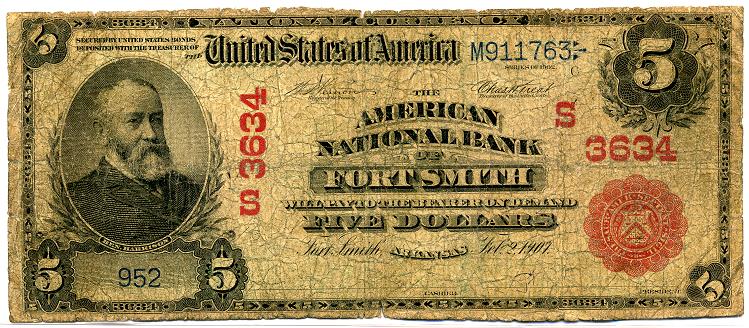 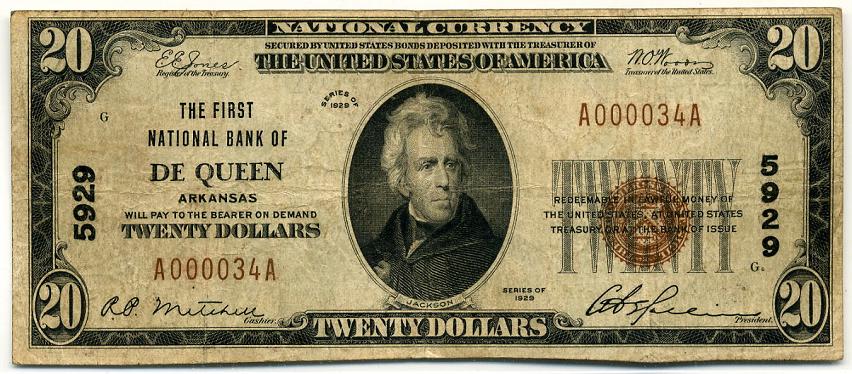 The Federal Reserve Act was a totally different animal, and has been amended well over 200 times since becoming law in December 1913.... It was basically a power grab by the U.S. Government to gain total control of all banking affairs. The Act established the issuance of the both the Federal Reserve Note (to replace the National Bank Note) and Emergency Money (Federal Reserve Bank Note) to be used in time of 'National Emergency' (as so proclaimed by the President). Federal Reserve Note 1914 (MY NOTE) 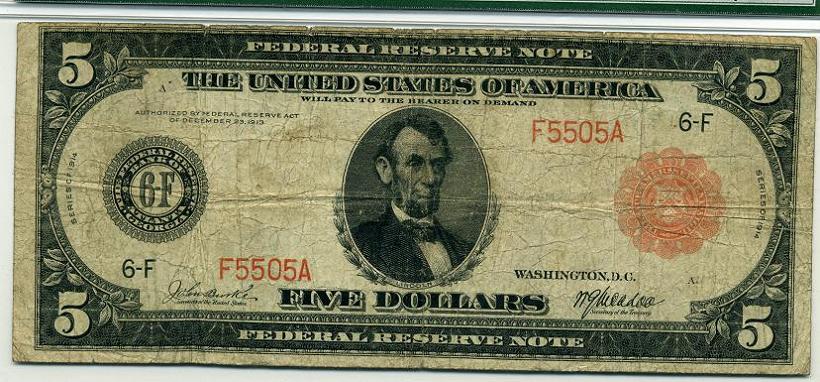 Federal Reserve Note 1928 (NOT MY NOTE) 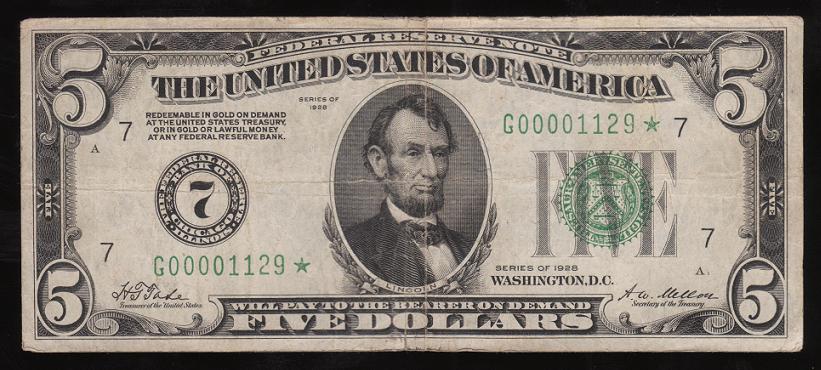 The Pitman Act of 1918 made it very profitable for the government to melt down 370 million silver dollars to sell abroad.... an equal number of silver certificates were therefore required to be destroyed as silver certificates were backed by 'silver dollars' at the time (not just silver), so this was declared an 'emergency' (of sorts), and the Federal Reserve Bank Note was issued to replace those silver certificates removed from circulation. Large size FRBN 1918 (MY NOTE) 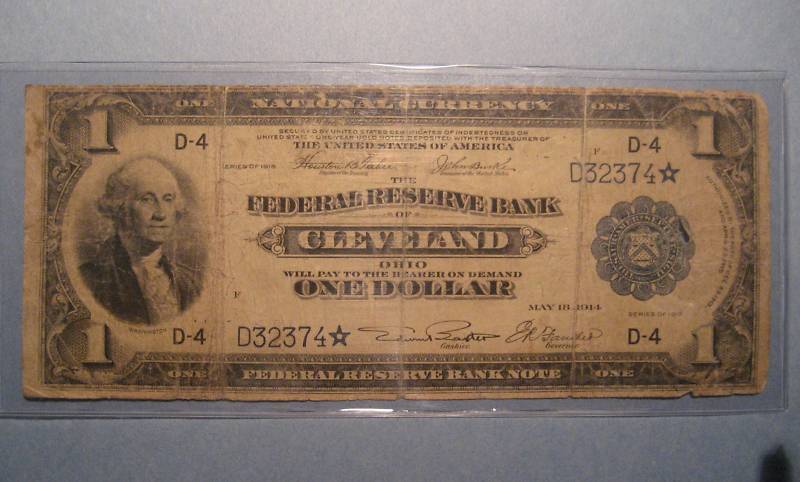 The Gold hulabaloo of 1933 (mentioned earlier in this thread) required the removal of Gold Certificates from circulation... The nation now used small size currency however, and to quell public fears over the disappearance of gold, time was of the essence in replacing those Gold Certificates..... not enough time to design approve, and produce new printing plates, so those already being used for National bank Notes were employed for this new Federal Reserve Bank Note (Emergency Money).... That is why the wording ("National Currency") at the top of the note. (National Bank Note plates were used to print these notes). Federal Reserve Bank Note 1933 (MY NOTE) 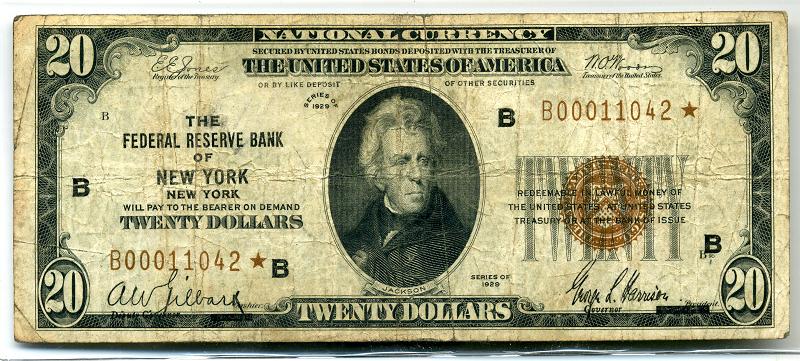 Quote:
Wouldn't the series 1934 FRN be the new kind of note, with different wording? No..... if you have specific or in depth questions about currency, I (or someone) will answer on the currency forum, as I will not revisit this thread for fear of compulsion to further comment. My apologies Prethen.... (I'm outta here now). |
|
Pillar of the Community
United States
3234 Posts |
Well, I didn't get any further with my perusings with the numismatic researchers I queried. They didn't have the time to look into it, which sort of tells me that perhaps the 1933 Act was never enacted. If it was, I would think they would have easily pointed it out since the 1965 act is relatively common knowledge. I will convey my findings to the Coin World editorial staff. |
|
|
Replies: 49 / Views: 4,758 |
|








 First Page
 Previous Page

 Posted 03/07/2011 09:16 am


