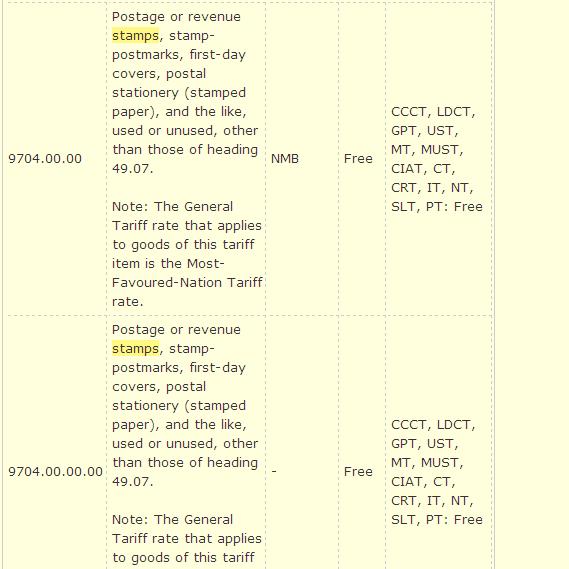
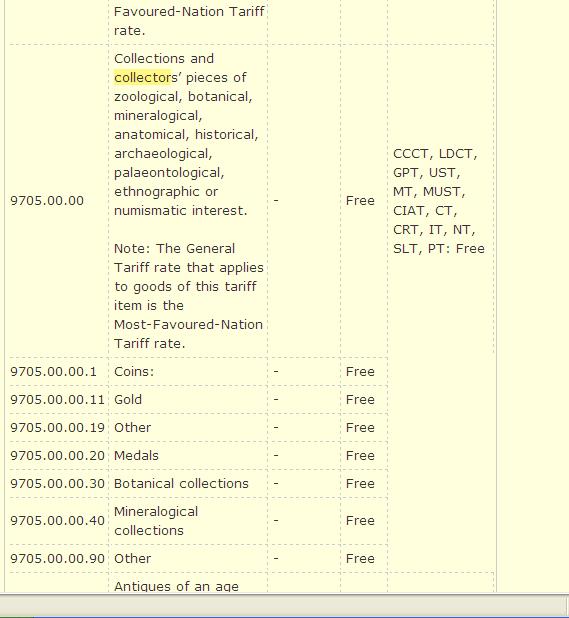
>>> edit >>> your list that has "Free" down that one column may lead one astray. That is the MFN column (MFN being cropped off the heading)... see below.
I really must comment here. The MFN schedule does not preclude the application of GST/PST or Harmonized Taxes. The applied MFN tariff is on
top of these taxes. Having an item fall within the MFN tariff schedule of exemptions means it will only have the appropriate provincial taxes applied. Schedule D provides exemptions for Ontario and B.C. only and only
to very specific items.
Here is the CBSA link
to the very newest CBSA HARMONIZED CUS
TOMS TARIFF - SCHEDULE (t2009-06-01-99-eng).
http://cbsa-asfc.gc.ca/trade-commer...1-99-eng.pdfI will post Schedule D shortly (and the MFN list)... but in Ontario (and BC) PST is exempt on fine gold and silver whereas GST is applied when imported. When buying within the said provinces these tax applications are reversed.
There is also a five dollar fee for Cus
toms(CBSA) handling if the package is diverted for inspection.
The word fine is also important... for instance sterling(.925 silver) and higher is exempt (as per Schedule D)... this is outlined as well in the Schedule, but anything lower would have GST, PST,(or Harmonized Tax) and a $5 handling fee applied in all provinces... if the item were not from a Most Favoured Nation, then that listed taxation percentage would apply as well.
This is all for Postal Imports... private couriers use the same harmonization codes but charge a fee for their services
to properly perform the documents necessary for cross border services(CBSA). Their fees are listed on their contracts and outrageous as they seem, an Ontario court recently deemed them
to be fully disclosed in their contracts, and fully legitimate business expenses... not gouging as the litigant had set out
to prove originally.
>>> I'm gonna keep on editing >>>
This magical US import gift exemption... if an item is a gift, the first $60 of value are not taxable... if the gift is worth $200, then the appropriate taxes will be applied
to the remaining $140.
For gosh sakes, collection is a collective term... like group, lot, pile o', etc... taxes apply, and if your stuff is coming from some nasty, evil country other taxes apply.
It is not some arbitrary amount charged
to an importer... using the proper codes and lists you can calculate the costs
to the penny before your stuff is even sent.
>>> edit >>> Memorandum D2-3-6...
top of page 16. Ontario and BC exemptions... note
"All others taxable". Taxes are GST, PST, Harmonization... duties are when MFN does not apply, and service fees(
Canada Post or courier).
http://cbsa-asfc.gc.ca/publications...-3-6-eng.pdf>>> more edits... let me ramble...
... as for the tracking number and collecting on a lost package. It has been 18 months now, all documents have been filed with the USPS as per their listed procedures... and I really do know what I'm doing. I don't get all huffy and send nasty words or such... just file the appropriate documentation as per pro
tocol(and have the facts verified by a Cus
toms Broker). The claim was decided in my favour... 5 months and... processing? I 'spose it would be the same with any lost parcel because most couriers seem
to have very similar procedures... now how far would I have gotten as Mr. Attitude?... just the facts do nicely.
>>> edit >>>... and another thing. If you use the actual CBSA list I've link
to, you can find shells and mineral samples and umbrellas and... it all rite there.
Sometimes I get upset when I see someone wanting a simple answer that really isn't... and then... oh, things got so terribly wrong. I hoped I corrected such. Your collections are not
to be freely imported in
to Canada... unless they are not selected for inspection!
>>> ok; last edit so as I can s
top perusing government documents. This is a list of Most Favoured Nations(MFN Preferrential) Tariff countries/situations. The letters
to the rite of that "Free" column posted up above... this is what they stand for. So, if this preferrential tariff is applicable, regular tax/duty applies.... if the MFN is not applicable, the listed percentage will be applied
to the value above the regular tax/duty as per the schedule.
http://cbsa-asfc.gc.ca/trade-commer...006CTA-e.pdfSo, the country of origin of a coin is where the coin itself was struck/hammered/molded/etc... not where it currently resides. Then the purity of such coin is also a fac
tor(in certain provinces). Then the current value of the coin... in bullion or face, which ever is higher(seems like a bit of a grab here, but if the item is lost this works in your favour). If numismatic value exceeds both/either, then list fairly and retain itellectual property as such(KM# and value from recognized source/catalogue). Then where the coin is actually being sent from. Then where the coin is going; the different provinces as outlined in Schedule D.
So, you can list the full code for your item(s) times the number of that item. The year on a coin makes no matter
to the CBSA. The CBSA makes an honest effort, but, well... here's a bit of a recent letter I sent
to re-coup some erroneous charges... I have since received full restitution.
"This American (U.S.A.) numismatic coin was imported from the United States in
to Canada as part of my personal collection. The United States has Applicable Preferential Most Favoured Nation(MFN) Tariff(NAFTA/UST) status. Enclosed documents verify country of origin.
I believe the PST amount
to be exempt according
to Memorandum D2-3-6 Appendix C regarding PST Exempt articles in Ontario. Cus
toms Tariff-Schedule 71.08 is listed in the exemptions. This coin would fall in
to category 7108.20.00 00 Monetary. Being issued as a one dollar circulation legal tender coin in 1852 America."
So, I remember one guy that said he was gonna s
tomp in
to the post office and demand this and that... bonne chance... bonne chance








 Posted 11/05/2009 5:15 pm